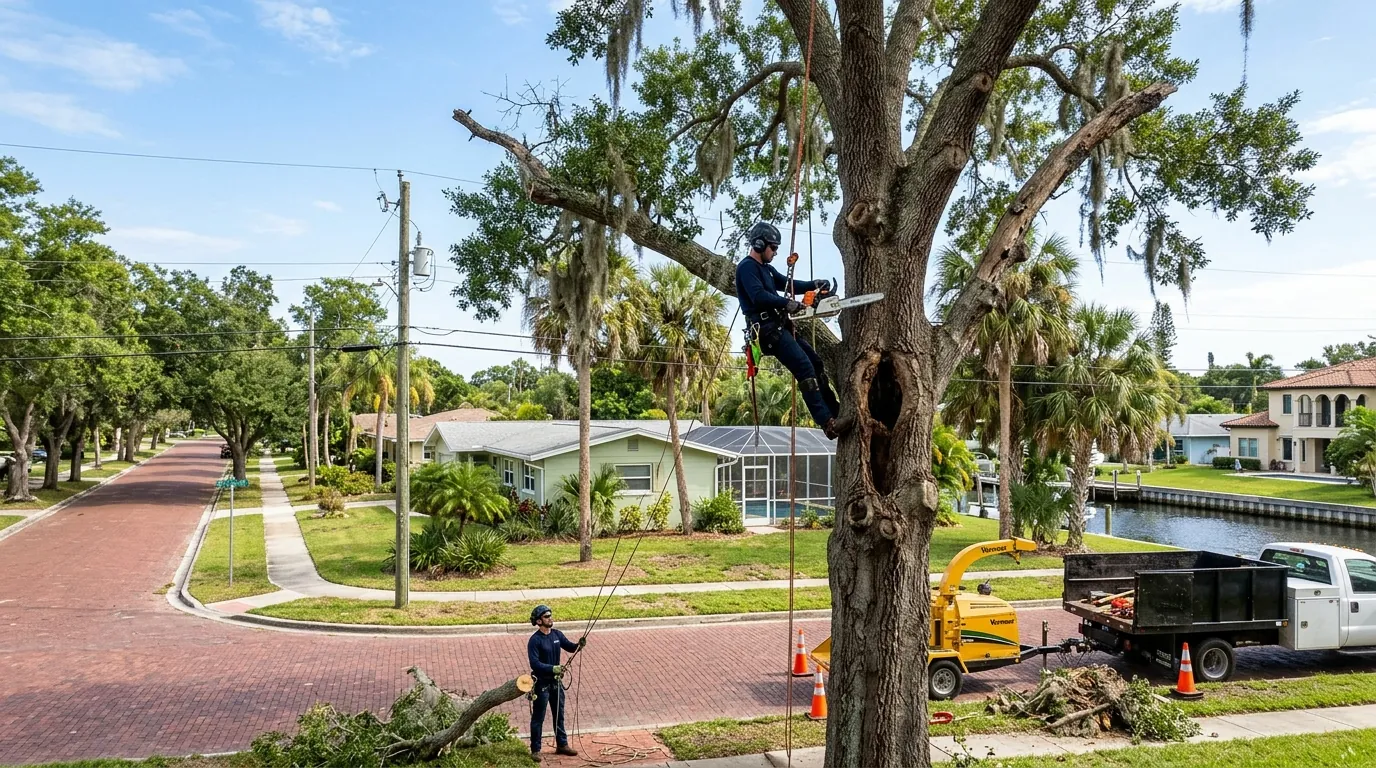
Most palm removals we price around St. Pete are not about looks. They are sick palms, salt-damaged palms from the 2024 surge, or tall fan palms that have outgrown a small lot. This guide covers the two diseases that kill palms in Pinellas County, what removal involves when disease is the reason, and the permit rules that still apply to a dying sabal. For everything else on tree removal in St. Pete, start at the homepage.
Palm Tree Removal Cost in St. Pete by Trunk Height
| Clear trunk height | Typical range, per palm | Notes |
|---|---|---|
| Under 20 ft | $200 to $450 | Usually cut in sections from the ground or a short climb |
| 20 to 40 ft | $400 to $900 | Climber or lift; fronds and trunk lowered in pieces near structures |
| Over 40 ft | $800 to $1,500 | Tall Washingtonia; careful lowering over roofs, pools and seawalls |
| Stump grinding, first stump | $125 to $400 | Ganoderma palms need the root ball dealt with, not just the stump top |
| Each added stump, same visit | $60 to $150 | Common when several queen palms go at once |
Those are typical St. Pete-area ranges, with cleanup and haul-off included. For context, HomeGuide's national figures run $150 to $900 for palm removal alone and $230 to $1,150 with the stump. A palm over a pool cage or a dock sits at the top of its band, because nothing can be dropped. Our palm tree removal page explains how we take tall palms down in tight spots.
Ganoderma Butt Rot in St. Pete Palms
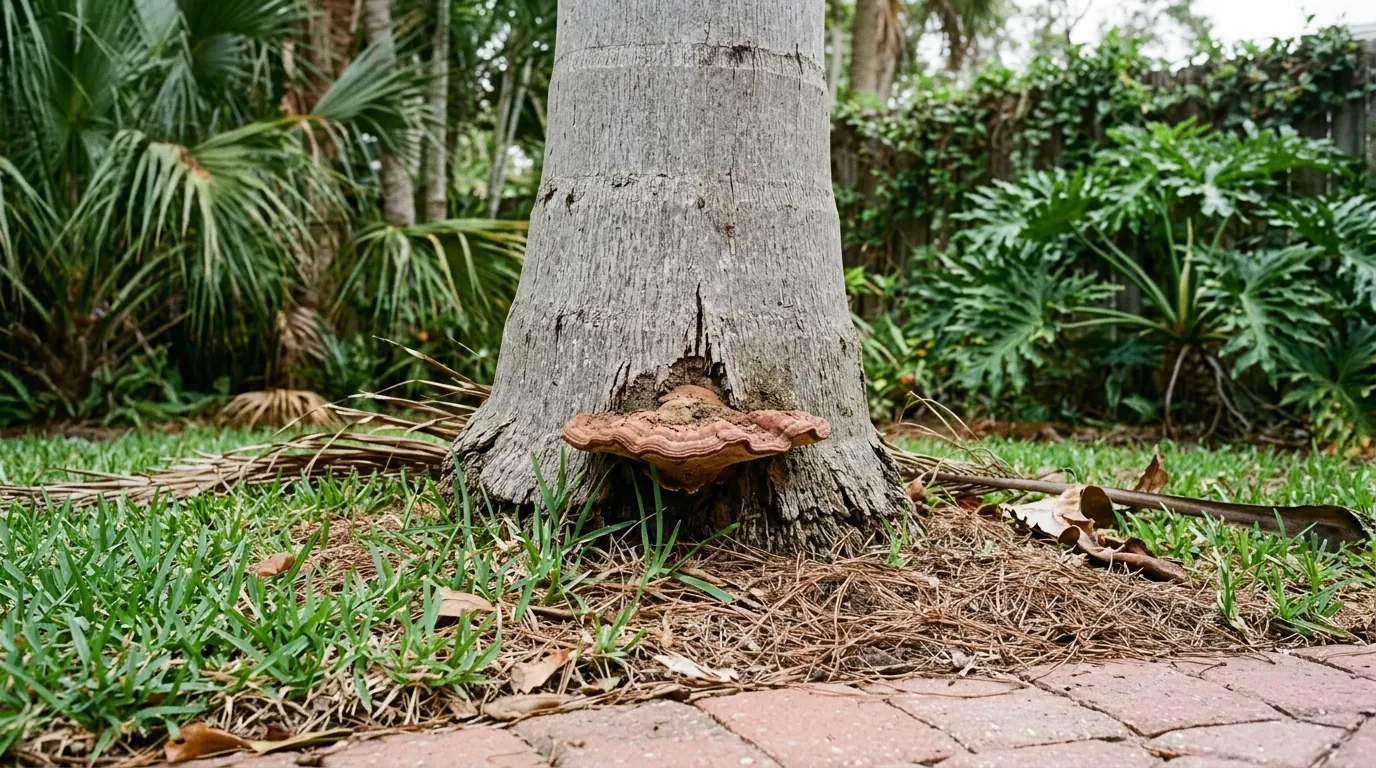
Ganoderma butt rot is a fungus that rots the lower few feet of a palm's trunk from the inside. UF/IFAS calls it fatal, with no cure and no chemical or cultural control. Locally it shows up most in queen palms and Canary Island date palms, though other palms can get it.
How to spot it
- A conk on the lower 4 to 5 ft of trunk. It starts as a soft, solid white mass flat against the bark, then hardens into a shelf with a glazed reddish-brown top and white underside.
- Wilting and decline that starts with the oldest, lowest fronds. Wilting alone does not prove Ganoderma, since other problems cause it too.
- Internal discoloration found only when the trunk is cut, or a lab test of sawdust from a declining palm.
The hard part is that many palms die before a conk ever appears. UF/IFAS notes the fungus can grow inside the trunk for years before anything shows. So a conk is a late sign, and a tall palm with one near a house should be dealt with before the next storm season.
What removal should include
- Bag the conk before breaking it off, so spores are not shaken loose into the yard.
- Take the palm down and haul it away rather than leaving the trunk on site.
- Take out the stump and dig or grind out the root ball as completely as you can, since the fungus lives in that tissue.
- Do not plant another palm in the same spot. Plant something else, or put the new palm well away from it.
- Check your other palms every month for new conks; the spores travel on the wind.
That third step is where Ganoderma removals differ from routine ones. Grinding just the top of the stump leaves infected tissue behind, so ask any company you hire what they do with the root ball. Our stump grinding page explains the difference.
Lethal Bronzing in Pinellas County Sabal Palms
Lethal bronzing is caused by a phytoplasma, a bacteria-like organism spread by sap-feeding planthoppers. It is found in Pinellas, one of 36 Florida counties where it has been confirmed, and it has infected the native cabbage palm, or sabal, since 2008. That matters here because the sabal is Florida's most salt-tolerant and wind-firm palm and is planted all over St. Pete.
| Stage | What you see |
|---|---|
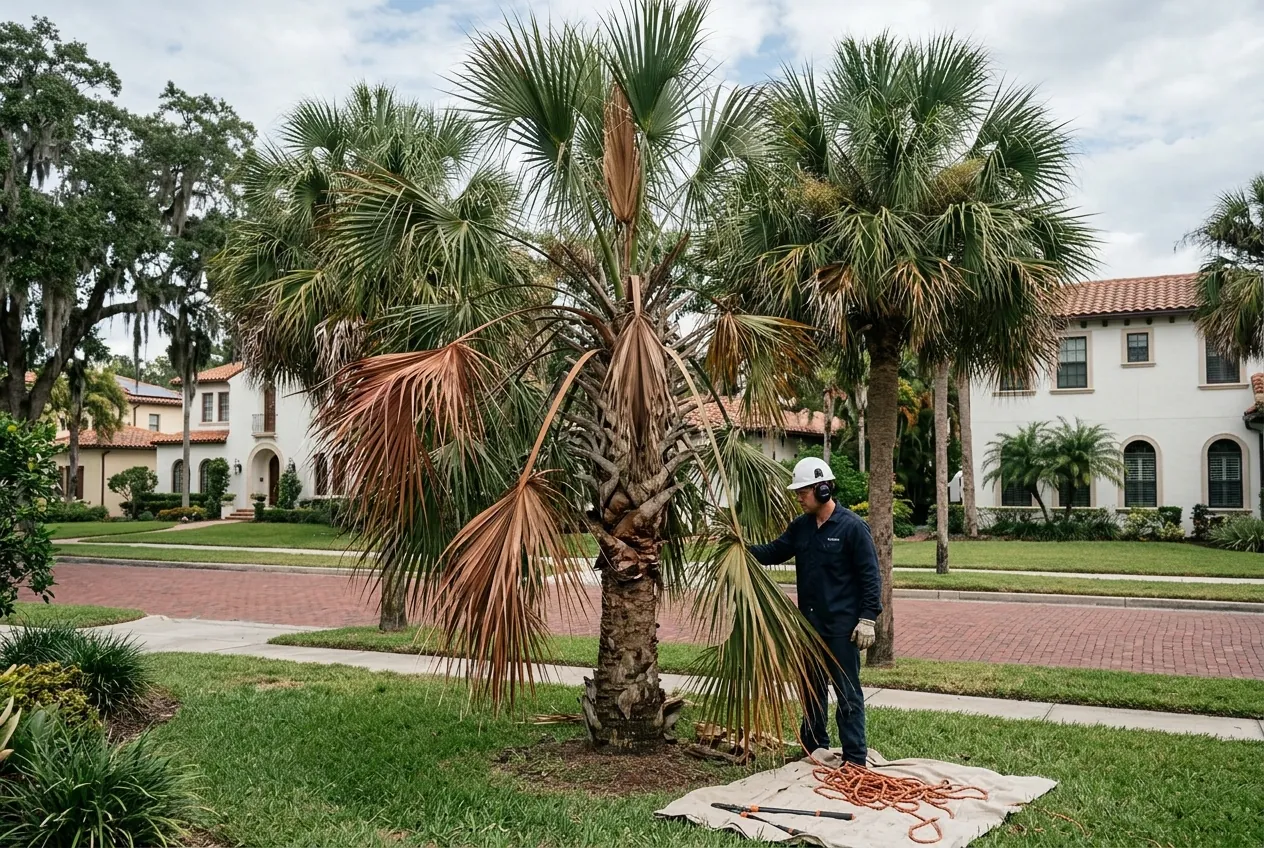
| First sign | The oldest, lowest fronds turn bronze or reddish-brown |
| Progression | Discoloration moves up through the crown toward the newest fronds |
| Spear leaf collapses | The center spear dies and hangs, meaning the growing bud is dead |
| Death | Most palms die within 2 to 3 months of the first symptoms |
There is no cure. UF/IFAS advises removing a confirmed palm right away. Pruning tools do not spread lethal bronzing, so a palm trimmed by the same crew is not at risk from the saw. A lab test through the UF Plant Disease Diagnostic Center confirms the diagnosis. Healthy palms nearby can be protected with oxytetracycline injections every 3 to 4 months, kept up for at least two years. That is a treatment decision for a palm-care specialist, not something a removal crew should promise.
Palm Removal Permits in St. Petersburg and Pinellas
A sick palm is not automatically a permit-free palm.
| Where the palm is | Rule |
|---|---|
| City of St. Petersburg, native sabal with 4 ft+ of clear trunk | Permit required, even if diseased, unless an FS 163.045 risk letter applies (single-family detached homes only) |
| City of St. Petersburg, queen palm or Washingtonia | Not covered by the native palm rule; we still confirm on site |
| Unincorporated Pinellas | Palms over 6 ft tall need a permit, except on homesteaded single-family homes, where only trees over 24 in DBH are protected since Jan. 23, 2026 |
| Other cities (Seminole, Kenneth City, Madeira Beach) | Each has its own permit; check before cutting |
Clear trunk means bare trunk: from the soil line up to the lowest green frond's base. The full rules for every jurisdiction are in our tree permit guide.
Queen and Washingtonia Palms: Removal Without Disease
Not every palm removal is a rescue. The March 2026 invasive plant list from the Florida Invasive Species Council puts both the queen palm and the Washington fan palm (Washingtonia robusta) in Category II, the council's second tier of invasive plants. The FISC list is not a law, and nobody is required to remove one. But if a queen palm keeps dropping fruit on the pool deck, or a fan palm has grown well past the roofline, they are reasonable trees to replace with something native.
How a Diseased Palm Is Taken Down Safely
A healthy palm is one of the easier trees to climb. A diseased one is not. Ganoderma decays the base of the trunk internally, which means the footing a climber depends on may be weaker than it looks, and a palm with a dead bud from lethal bronzing can shed its crown as it is worked. On a sick palm we prefer to work from a lift or bucket where there is access, and to take the crown off in controlled pieces before the trunk.
- Check the base and any conks before anyone leaves the ground.
- Remove the crown and fronds first, lowering them over roofs, pools and docks.
- Cut the trunk down in sections short enough to control.
- Bag any conks and haul all of the palm away rather than chipping it on site.
- Grind or dig out the stump and root ball if Ganoderma was the cause.
Afterward, keep an eye on the rest of the yard. UF/IFAS suggests checking nearby palms every month for new conks, and with lethal bronzing, watching neighboring sabals for the same bottom-up discoloration. Canal-front yards such as those in Tierra Verde often have rows of palms planted at the same time, so one sick palm is a reason to look at all of them.
Replanting After Palm Tree Removal in St. Pete
- After Ganoderma, choose a non-palm for that spot, such as a hardwood or shrub.
- Near salt water, a sabal is the Pinellas Extension's top pick for salt and wind, but not where a palm has just died of lethal bronzing.
- Give any new tree room to grow away from roofs, pool cages and seawalls.
If you have a palm with a conk at the base or a crown turning bronze from the bottom up, ask for a free estimate. We will price the removal by trunk height, include the stump work the disease calls for, and check the permit rules for your address first.