St. Petersburg · Pinellas County, FL
Crane Tree Removal in St. Petersburg, FL
When a big tree hangs over a roof with no room to drop wood, a crane lifts it out in sections instead of lowering every piece past the gutters. We hire in a crane only for trees that call for one, and we will tell you plainly when yours does not.
- Crane add-on
- +$700–$2,500 per job
- Best for
- Trees over roofs and lanais
- Typical job
- One day for most homes
- Included
- Mats, cleanup and haul-off
Crane Tree Removal in St. Petersburg, FL: When It Earns Its Cost
Most trees in St. Pete come down without a crane. A climber cuts and lowers limbs on ropes, a bucket truck reaches what it can, and the trunk is felled or pieced down. A crane changes the math when no spot exists to lower wood safely, when the tree is too weak to climb, or when rigging every piece would take so long that lifting is simply faster and safer.
Three ways a big tree comes down
- Climb and rig. A climber ties in, cuts sections and lowers them on ropes through blocks. It works almost anywhere, but it is slow over a roof and needs sound wood to anchor to.
- Bucket truck. Quicker than climbing and keeps the cutter out of the tree, but the truck needs firm ground close to the trunk and clear space overhead, which plenty of alley and back-yard trees lack.
- Crane. The crane takes the weight of each section before it is cut, then carries it across the roofline to the street or driveway. Nothing is dropped, and nothing swings near the roof on a rope.
Signs your tree is a crane job
- It leans over the house, a pool cage, a lanai or a neighbor's roof, with no open ground to drop wood.
- It is dead or decayed enough that a climber should not tie into it.
- It stands in a back yard with no gate wide enough for a bucket truck.
- It is already lying on the house after a storm.
- It is a very tall palm leaning over a structure.
Crane Tree Removal on St. Pete Brick Streets, Alleys and Canals
A crane needs a level, firm spot within reach of the tree, and St. Pete's neighborhoods make that interesting. In Old Northeast and Euclid-St. Paul, the setup spot may be a red brick street with granite curbs, or a narrow rear alley with overhead lines running down it. Outriggers go on pads and mats so the load spreads out, and we map the overhead lines before choosing where the crane parks. Brick streets are protected in the city's historic districts, so nothing heavy touches them unprotected.
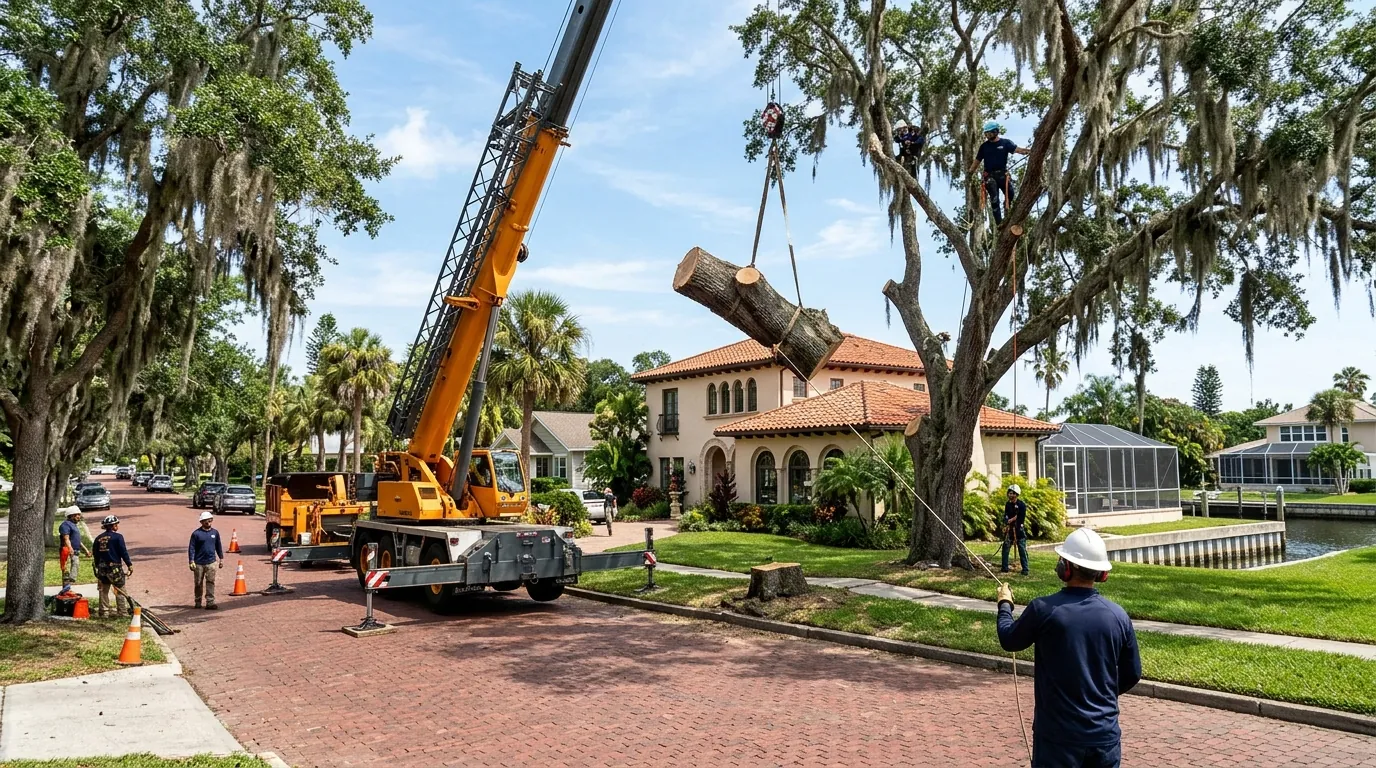
Canal lots in Riviera Bay and Tierra Verde raise other questions: seawalls, docks and soft, often wet yards. On those jobs the crane usually sets up on the street side and lifts sections back over the house. Gated communities such as Placido Bayou may need HOA approval and a scheduled gate entry for the crane and trucks. If the crane has to sit in the road, we find out what the city or county wants for that spot and build it into the schedule.
What a Crane Tree Removal Day Looks Like
- Before the day. Permit questions are settled, the crane is sized for the reach and the heaviest piece, and you have a written price with the crane on its own line.
- Setup. Cars are moved, pads and mats go down, and the crane is leveled. If the service drop is in the way, Duke Energy has already been asked to de-energize it.
- Lifts. A climber or bucket operator sets a sling on each section, the crane takes the weight, the cut is made, and the operator lifts the piece clear and sets it down on the street or drive.
- Processing. The ground crew bucks sections into rounds and feeds brush into the chipper as each piece lands, so the work area clears as the day goes.
- Breakdown and cleanup. The crane packs up, the yard is raked and blown, and the street is swept. Stump grinding can follow the same day if it is on the estimate.
Most residential crane removals take one day. A very large tree, or several on one lot, can take longer. Wind matters too: cranes do not lift in strong gusts, so a crane day can move if the forecast turns.
Is Crane Tree Removal in St. Pete Worth the Cost?
A crane is an add-on, not a separate pricing system. The tree is priced by height like any removal, and the crane goes on top. National cost guides put crane time at roughly $500 to $2,500 a day. Here is how that appears on a typical St. Pete estimate, as ranges for 2026, not quotes.
| Job | Typical range | What moves the price |
|---|---|---|
| Oak or pine, 50 to 75 ft | $1,600–$3,000 | Canopy spread, number of sections |
| Over a structure, or 75 ft and up | $3,000–$5,500 | Weight over the roof, wood condition |
| Crane add-on | +$700–$2,500 per job | Crane size, reach, setup space, number of lifts |
| Palm over 40 ft (tall Washingtonia, etc.) | $800–$1,500 | Lean over the house, crown weight |
| Stump grinding, first stump | $125–$400 | Diameter and surface roots |
| Each additional stump, same visit | $60–$150 | Size and spacing |

On many over-the-roof trees, the crane is what keeps the total in check. Rigging every limb past a roofline can take a full day of climbing and still put a gutter or ridge cap at risk, while a crane can turn that into a few hours of clean lifts. When a crane would not save time or reduce risk, we quote the job without one. The tree removal cost guide explains the other parts of a price.
Crane Tree Removal for Tall Palms
Tall palms are a common reason to bring in a crane. A Washingtonia can top out well above the roofline, and height drives the price more than anything else on a palm. When one leans over a house or a pool cage, a climber would be working off a single slender trunk with nowhere to drop the head, so lifting the crown and the trunk out in sections is often the safer plan. Washingtonia and queen palms are both listed as Category II invasives by the Florida Invasive Species Council, and neither needs a city permit to remove, so palm crane jobs tend to schedule quickly. Diseased palms are another matter: a palm with Ganoderma needs its stump and root mass pulled too. Our palm tree removal page covers smaller palms.
Permits and Timing on Crane Jobs
Big trees over old houses are exactly the trees most likely to need paperwork. Inside the city, a protected oak 30 inches DBH or larger, other than a laurel oak, is a Grand tree, and removal is approved only for documented reasons such as a licensed engineer's report on a hazard to the structure. Even trimming a Grand tree needs a permit if any cut branch is 8 inches or more. The good news for scheduling is that an approved city permit is valid for six months once it is posted, so there is time to line up crane availability and a calm-weather day after the inspection. On single-family detached homes, a signed risk finding under Florida Statute 163.045 can stand in for the permit.
Getting Ready for Crane Tree Removal
- Clear cars from the driveway and the curb out front if you can.
- Tell us about septic tanks, drain fields, sprinkler lines and anything buried where trucks may roll.
- Let the neighbors know the street may be partly blocked for part of the day.
- Keep pets and kids indoors while sections are in the air.
- If you have an HOA, get any approval in writing before the date.
Crane work usually pairs with other services: big oak tree removal over older homes, hazardous tree removal where the wood is too weak to climb, and lifting storm-downed trees off roofs. To see where crane work fits into St. Pete tree removal as a whole, start on the home page, or ask for an estimate and we will tell you whether a crane is worth it.
Tree Removal Services
Areas We Serve
Crane Tree Removal St. Petersburg Questions
Straight answers before you call.
The usual signs are a large tree leaning over the house or a pool cage with no room to drop wood, a tree too decayed to climb, or a back-yard tree no bucket truck can reach. We decide on site, and if the job can be done safely without a crane, we price it that way.
Usually. The crane parks out front on the street or the drive and reaches over the house, and the crane is sized for the distance and the heaviest section. Very deep lots or tight streets can limit the setup, which we check before we quote.
We set the outriggers on pads and lay mats where trucks and heavy wood travel, so the load is spread out. Tell us about sprinkler lines, septic tanks and anything else buried in the yard before the day so we can route around them.
The tree rules are the same whether the tree comes down by crane or by rope: the city, county or town code for your address decides. Separately, if the crane needs to sit in the road, we check what is required for that spot.
Cranes do not lift in strong gusts, so the job moves to the next suitable day. We watch the forecast in the days before and let you know early if it looks doubtful.
For a big tree over a roof, usually. A climber has to lower every limb past the roofline on ropes, while a crane lifts whole sections clear. On an open lot with room to drop wood, climbing is often quicker and cheaper.
More St. Pete Tree Removal Services
More ways we can help on the same trip.
- Tree RemovalWhole-tree takedowns, rigged and lowered over roofs, pools and lanais. From $250
- Dead Tree RemovalDead and dying trees taken down before they fall on their own. $250–$3,000
- Hazardous Tree RemovalLeaning, split or rotten trees over homes, cars and power drops. $700–$5,500
- Emergency Tree RemovalTrees on roofs, cars, fences and lanais after storms, with fast storm response. Storm calls
- Oak Tree RemovalLaurel and water oaks past their prime, with the permit question answered first. $700+
- Palm Tree RemovalQueen, Washingtonia and sabal palms removed to the root ball. $200–$1,500
- Pine Tree RemovalDead, leaning and lightning-struck pines. $250+
- Stump GrindingStumps ground out under the soil line, ready for sod or a new bed. $125–$400
See If a Crane Makes Sense
Some trees are best lifted out, not lowered.