St. Petersburg neighborhood · 33701, 33704
Tree Removal in Old Northeast, St. Petersburg, FL
Old Northeast runs on a grid of rear alleys and red brick streets, edged with granite curbs and hexblock sidewalks, and most of its houses are close to a hundred years old. Taking a tree down here is mostly a question of getting it out without breaking any of that.
- ZIPs
- 33701, 33704
- Jurisdiction
- City of St. Petersburg
- Historic status
- National Register district, not a local one
- Usual access
- The rear alley
Local snapshot Old Northeast
- Historic district
- North Shore Historic District, National Register, listed Feb. 20, 2003
- Area
- About 425 acres over 160 blocks
- Buildings counted
- 3,489, of which 2,975 contribute to the district
- Garages and garage apartments
- 1,305 counted as contributing
- Built in the 1920s boom
- More than 1,000 buildings
- Main building era
- About 1910 to about 1950
- Most common styles
- Frame Vernacular (26%) and Bungalow (25%)
- Neighborhood association
- HONNA, organized 1974
Landmarks & streets Around the area
- Granada TerracePerry Snell's 1924 Spanish-themed plat on Coffee Pot Bayou, with curving streets that break the neighborhood's grid.
- Plaza Andalusia Pergola & Granada Vista PergolaContributing objects set in small landscaped parks inside Granada Terrace.
- Plaza Valencia UrnAnother contributing object in a Granada Terrace plaza; no equipment goes on these plantings.
- Historic fountain, 2800 1st St NListed as a contributing object in the district's National Register nomination.
- The landscaped traffic circlesThree plazas noted in the nomination, where a truck and trailer have to plan every turn.
- North Shore Park & Aquatic ComplexCity park and pools at 901 North Shore Dr NE, on the bay at the district's waterfront edge.
Old Northeast Tree Removal Starts in the Alley
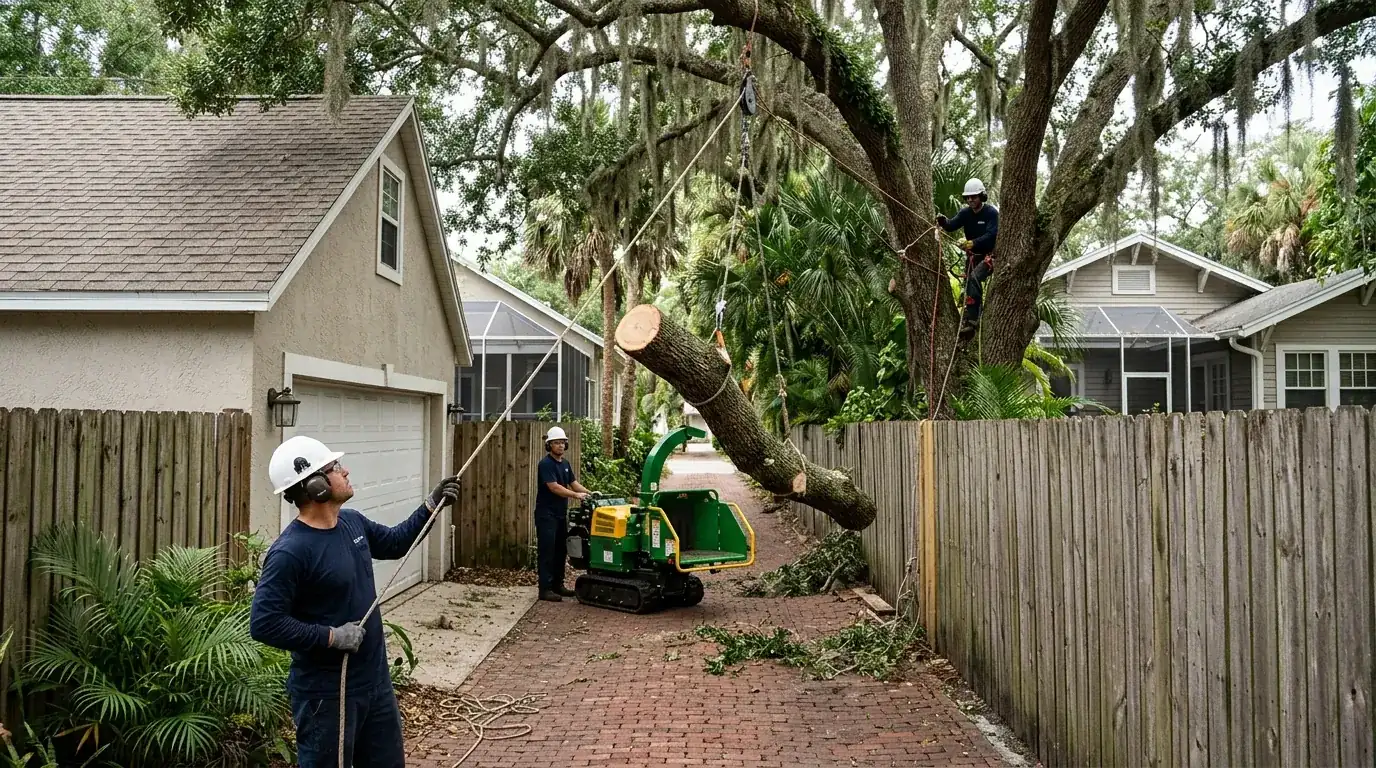
The National Register nomination for the North Shore Historic District describes a rectangular grid of 16 streets and 26 avenues, with garages set off rear alleys. That layout, platted mostly between 1910 and 1917, shapes a removal here more than the tree itself does. Front yards are shallow, the street is brick and the curb is granite. The alley is usually the only way to get a chipper, a grinder or a small loader near a backyard tree without crossing something that can't be replaced.
Alleys have their own limits. Many are narrow, some are brick too, and the nomination counted 1,305 contributing garages and garage apartments. A lot of backyard trees stand a few feet from a second building, not just the house. We walk the alley before pricing the job, measure the gap between garages and fences, and decide whether the wood can be carried out in pieces or has to be lifted over a roofline.
What we protect on the way in and out
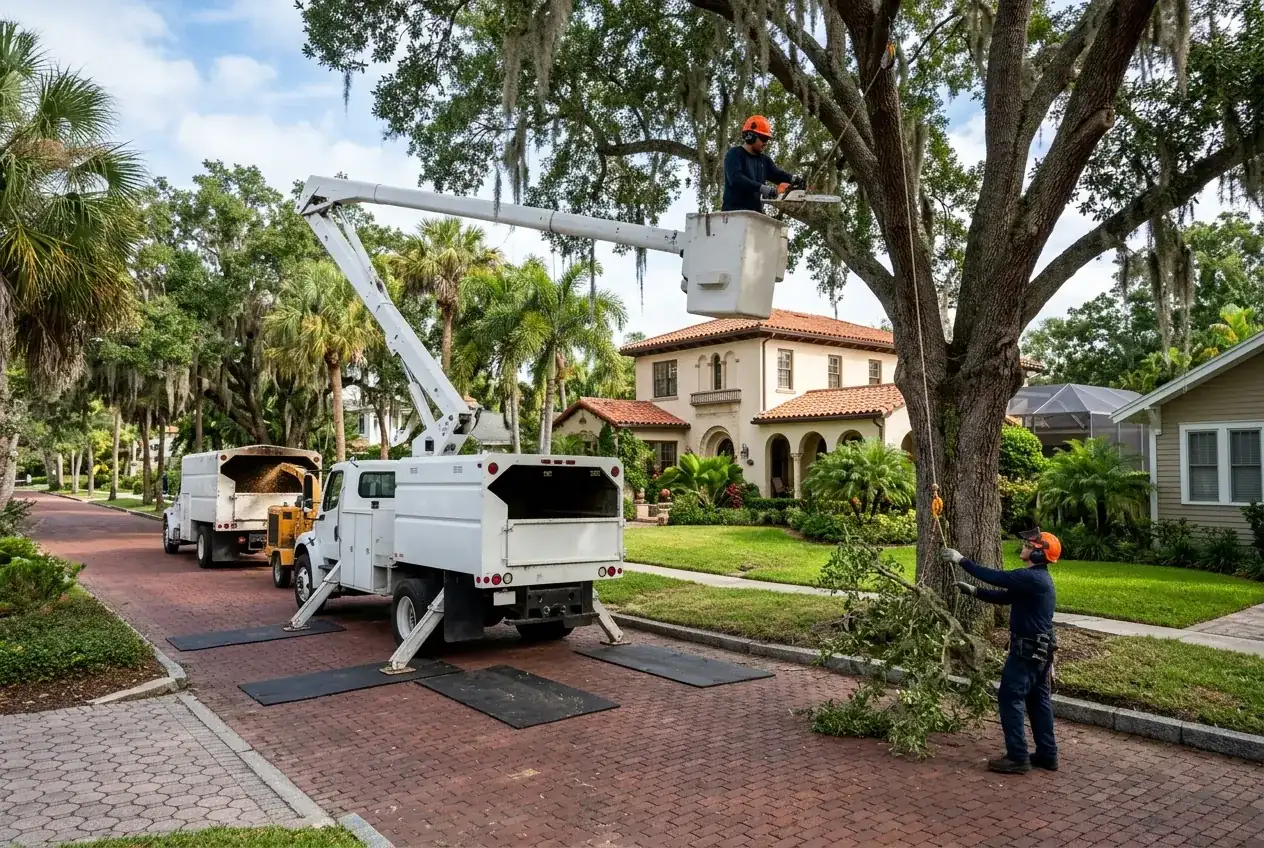
- Brick streets and alleys. The city protects brick streets in every National Register and local historic district. Outriggers sit on mats or plywood, and loaded trucks stay off the brick when a lighter machine will do.
- Hexagon-block sidewalks. St. Pete has laid hexblock since about 1914, and the blocks crack under point loads. Wood is never dropped on a sidewalk, and logs are carried across it, not dragged.
- Granite curbs. A free-falling log section can chip a curb that can't be matched, so heavy pieces are lowered on a rope.
- Garages and garage apartments. Limbs over a back building come down in short, roped sections.
None of this is exotic for a careful crew, but it adds hours, and hours are what you pay for. It's also why we don't price Old Northeast jobs from a photo.
Laurel Oak Removal in Old Northeast, St. Petersburg
This neighborhood filled in quickly. More than 1,000 of its buildings date to the 1920s land boom, and plenty of yard trees went in during the same short stretch. City Urban Forestry staff point to the same thing across St. Pete: too many trees of one age, and laurel oaks failing in numbers because so many went in during a single decade.
In urban settings, UF/IFAS expects a laurel oak to last somewhere around 50 to 70 years, and it flags the species as decay-prone. Many of the oldest laurel oaks on these blocks are past that range. Not all of them need to go, but the ones with hollow trunks, fungus at the base, dead tops or cracks at the main unions are the trees we're asked about most here. Our laurel oak guide lists the warning signs, and the oak tree removal page explains how a big oak is taken apart over a roof.
The permit math for an oak on these blocks
Old Northeast is inside the City of St. Petersburg, so Land Development Regulation 16.40.060 applies. Measured 4½ feet up the trunk, a shade tree hits protected status at 4 inches across, oaks included, and taking one out means a city permit unless Florida Statute 163.045 applies. At 30 inches a protected tree becomes a Grand tree, and the bar for removal rises: an engineer's report showing it endangers a building, for example, or an arborist's finding that it's in a decline it won't come back from. Laurel oaks are the exception: however big one gets, it can't be a Grand tree. A 36-inch laurel oak is still protected and still needs a permit, but it doesn't face the Grand-tree criteria. A live oak of the same size does.
Step one is a $25 inspection fee. Staff try to get out for the inspection inside two weeks; once approved, you pay the permit fee, hang the permit facing the street and have six months to use it. Skipping the permit gets expensive fast. The city's handout tallies a worst case for one 30-inch Grand tree at $6,855, counting the late permit, money owed in place of replanting, and the fine. Our St. Petersburg permit guide walks through each step.
Bay Exposure and Old Northeast Storm Damage
The nomination notes that virtually all of the district sits close to Tampa Bay or Coffee Pot Bayou. During Hurricane Helene in September 2024, water at the St. Pete tide gauge climbed to 6.31 feet over mean higher high water, the highest on record there. Milton followed two weeks later, and Albert Whitted Airport, a short drive south, clocked a 101 mph gust. Lots nearer the water can carry both kinds of damage: salt in the root zone from the first storm, then wind on soaked ground from the second.
Salt damage works slowly. An oak that went brown in October may well green up by spring, which is why UF/IFAS suggests holding off on a leafless tree until you see whether it pushes new leaves. A tree that cracked, heaved its roots or leans harder than it did before the storms is a different matter, and we'd rather see those early. When limbs are already down, our storm damage cleanup crew clears and hauls them.
Power lines over the alley
Many alleys carry overhead service. If a tree is touching a line, Duke Energy is the first call, not us. Duke will also cut power to the drop that runs to your house, free of charge, so we can work beside it, and we time the removal to that visit.
Old Northeast Tree Removal Cost
Prices follow the tree, the access and what sits under it. Alley-only access, roped lowering over a garage apartment and protection for brick and hexblock usually push a job toward the upper half of a range. Each range includes cleanup and hauling. The stump is priced separately unless the quote folds it in, and permit charges are listed on their own lines.
| Job | Typical range | What moves the price |
|---|---|---|
| Tree 25–50 ft tall | $700–$1,600 | Alley width; a garage or fence in the drop zone |
| Tree 50–75 ft tall | $1,600–$3,000 | Roped lowering over roofs; brick street protection |
| 75 ft and up, or leaning over a building | $3,000–$5,500 | Rigging over the house or a garage apartment |
| Crane-assisted removal | +$700–$2,500 | Whether a crane can set up on the street side |
| Stump grinding, first stump | $125–$400 | Stump width; distance from sidewalk and curb |
| City permit inspection | $25 | Pass-through city fee; the permit fee is set by the city |
These are typical St. Pete-area ranges for 2026, not quotes. Ask for a free estimate to get yours in writing. When the street side has room, we plan crane removal when the job needs one. Nearby, we also work the alley blocks of Euclid-St. Paul and the Allen family's old grove ground in Allendale Terrace, along with the rest of tree removal in St. Pete.
Tree Removal Services
Areas We Serve
Old Northeast Tree Removal Questions
Straight answers before you call.
No. It's on the National Register as the North Shore Historic District, listed in 2003, but it was never adopted as a local district. National Register listing alone doesn't restrict a private owner's yard work. The City of St. Petersburg's tree permit rules still apply, and the brick streets are protected.
No. St. Pete's code carves laurel oaks out of the Grand-tree category, however large they grow. It's protected from 4 inches up, though, which means removal goes through the city unless the FS 163.045 exemption fits your home.
We plan around it. Outriggers go on mats or plywood, we use lighter equipment from the alley when it can do the job, and logs are lowered by rope instead of dropped. If a site can't be worked without risking the brick, we tell you before we quote.
City code makes you answer for trees on your lot and in the adjoining right-of-way, and wants branches held 8 feet over the sidewalk and 14 feet over any street or alley. Dead or diseased trees that could fall into the right-of-way are the owner's to deal with.
Usually not. The statute covers single-family detached homes, and the city says duplexes, townhomes, multi-family and commercial property don't qualify. If your lot has more than one dwelling, ask the city before assuming the exemption applies.
Most of the time is paperwork. After the $25 inspection fee, the city aims to inspect within two weeks, then issues the permit, which you post facing the street and which is good for six months. The removal itself is often a single day for one tree.
Neighborhoods & Towns Near Old Northeast
Close by, same crew.
Tree Removal Services in Old Northeast
More ways we can help on the same trip.
- Tree RemovalWhole-tree takedowns, rigged and lowered over roofs, pools and lanais. From $250
- Dead Tree RemovalDead and dying trees taken down before they fall on their own. $250–$3,000
- Hazardous Tree RemovalLeaning, split or rotten trees over homes, cars and power drops. $700–$5,500
- Emergency Tree RemovalTrees on roofs, cars, fences and lanais after storms, with fast storm response. Storm calls
- Crane Tree RemovalBig trees on tight St. Pete lots with nowhere to lower wood. +$700–$2,500
- Oak Tree RemovalLaurel and water oaks past their prime, with the permit question answered first. $700+
- Palm Tree RemovalQueen, Washingtonia and sabal palms removed to the root ball. $200–$1,500
- Pine Tree RemovalDead, leaning and lightning-struck pines. $250+
Get a Written Price for Your Old Northeast Tree
Tree trouble in Old Northeast? We’ll come look.