This guide gives the real numbers from the city's Land Development Regulations, section 16.40.060, and the city's own Tree Protection Standards handout (updated July 1, 2022). It also covers the state law that can override local rules for a single-family home, and the Pinellas County code that changed on January 23, 2026. Rules get amended, so treat this as a map, and confirm with the city or with us before a saw touches a protected tree. It is part of how we price every job for St. Pete tree removal: we check the permit rules for the exact address before we quote.
St. Petersburg Tree Permit Rules Start With Your Jurisdiction
A St. Petersburg mailing address does not mean the City of St. Petersburg writes your tree rules. Pinellas County has 24 cities and towns plus large unincorporated areas, and each one enforces its own code.
| If your property is in | Whose tree code applies | Headline rule |
|---|---|---|
| City of St. Petersburg | City LDR 16.40.060 | Shade trees 4 in+, understory 8 in+, sabal palms with 4 ft+ clear trunk |
| Unincorporated Pinellas (Tierra Verde, Lealman, many Seminole mailing addresses) | County tree code, effective Jan. 23, 2026 | Trees 4 in+ and palms over 6 ft; homesteaded single-family homes protect only trees over 24 in |
| City of Seminole | Seminole Code Ch. 62 | Trees 4 in+; live oak, laurel oak and mangrove need a certified arborist's report |
| Kenneth City | Town Code Ch. 70 | Town permit before removal; contractor license registered at Town Hall |
| Madeira Beach | City Code Sec. 106-69 | No-fee permit for every tree 4 in+; mangroves need city, county and state permits |
The Census Bureau's free address geocoder will tell you which side of a city line your parcel sits on. Our area pages for Seminole and Lealman show how much the answer can change a few blocks apart.
Protected Tree Sizes in St. Petersburg, FL
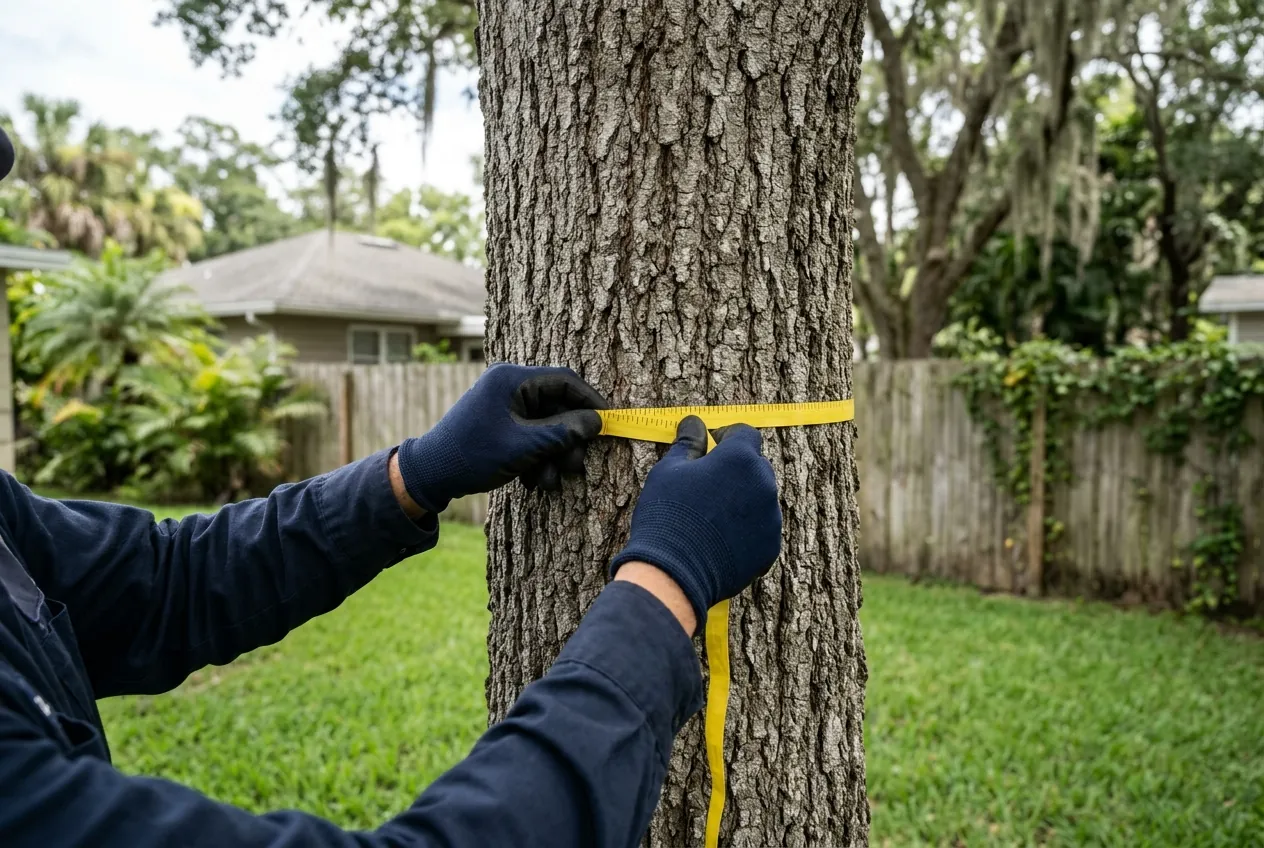
Inside city limits, trunk size is measured as DBH, diameter at breast height, taken 4½ ft above the ground. To get it without a caliper, measure the trunk's circumference there with a tape and divide by 3.14. A 12.5 inch circumference is about a 4 inch tree, and a 94 inch circumference is about a 30 inch tree.
| Category | Size that triggers protection | Permit to remove? |
|---|---|---|
| Shade tree (oaks, pines, cypress, elms, maples, magnolia, sweet gum, sycamore and others) | 4 in DBH or more | Yes |
| Understory tree (bays, buttonwood, cedar, crape myrtle, holly, ligustrum, sea grape and others) | 8 in DBH or more | Yes |
| Grand tree (any protected tree except laurel oak) | 30 in DBH or more | Yes, with limited allowed reasons |
| Signature tree: banyan | Any size | Yes |
| Signature tree: kapok | 30 in DBH or more | Yes |
| Signature tree: jacaranda, royal poinciana | 8 in DBH or more | Yes |
| Native palm (sabal or cabbage palm) | 4 ft or more of clear trunk | Yes |
| Unprotected or prohibited species | Any size | No |
Grand trees
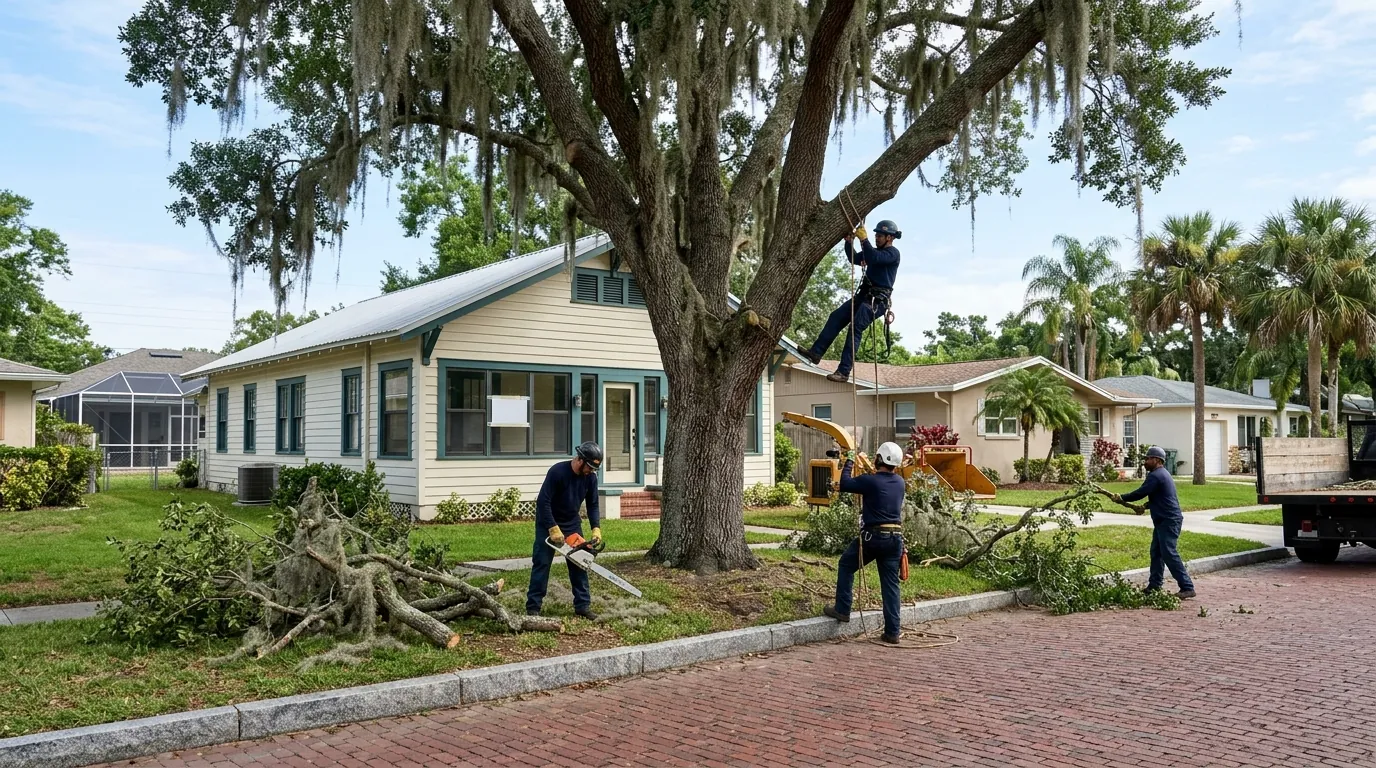
Grand status kicks in when a protected tree measures 30 inches DBH, with one exception: laurel oaks never qualify, no matter how big they get. The city says Grand trees are given a higher level of protection and are meant to be preserved. It will approve taking one down in only three cases: a licensed engineer reports that it endangers a building already on the lot; a certified arborist reports that it is diseased or declining beyond reasonable hope of recovery; or an architect, landscape architect or engineer certifies that a planned structure cannot avoid it.
Trimming a Grand tree is regulated too. Any cut that removes a branch measuring 8 inches or more at the branch collar takes a permit, and the pruning must follow the ANSI A300 standard.
Signature trees
Banyans, larger kapoks, jacarandas and royal poincianas are Signature trees. Note the twist: jacaranda, kapok and royal poinciana also appear on the city's unprotected list, so a small one needs no permit, but once it crosses its Signature size it does.
Palms
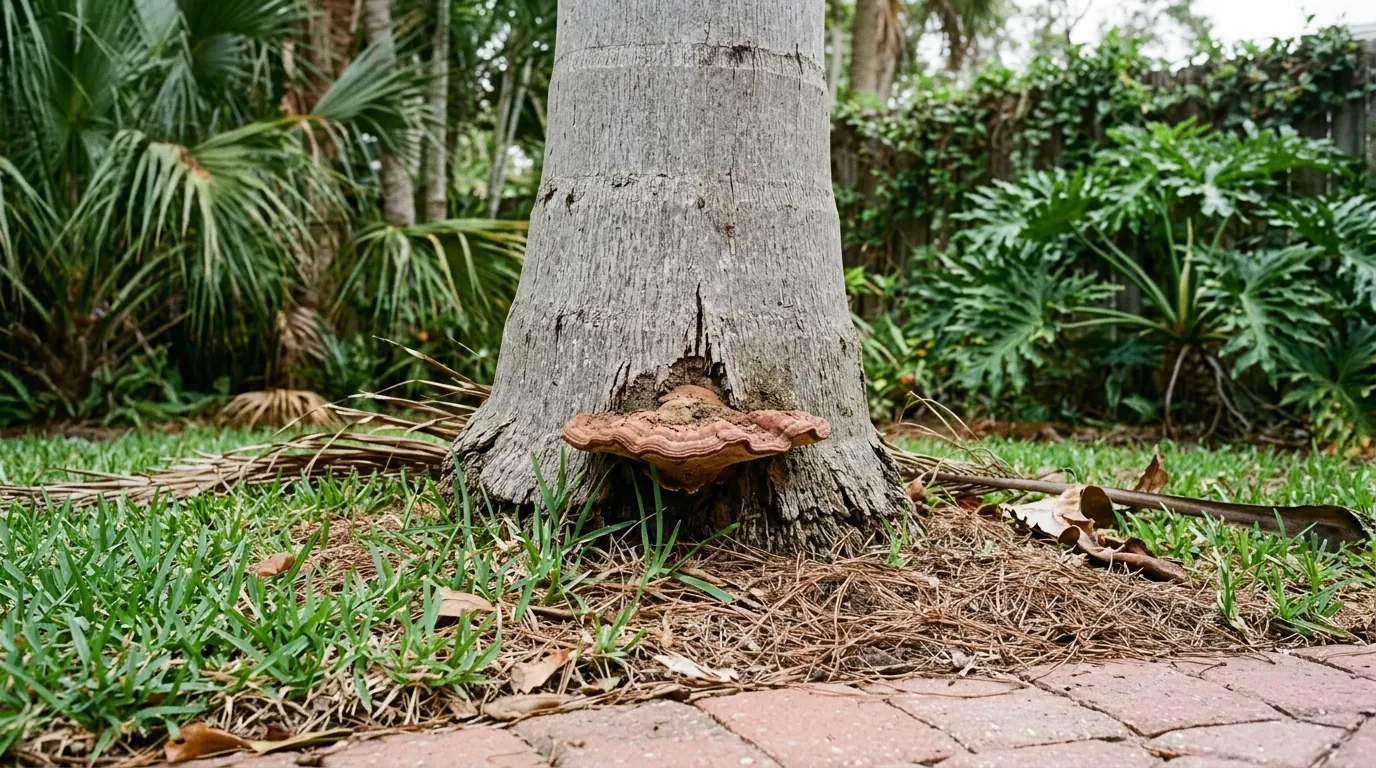
The sabal, or cabbage palm, is the native palm in the city code. Once its clear trunk reaches 4 ft (clear trunk is the bare stretch below the lowest green frond), it is permitted like any protected tree, sick or not. Imported species, including queen palms and Washingtonia fans, fall outside that rule, though we still confirm on site.
Trees That Need No Permit in St. Petersburg
The code lists two groups you can remove without a permit.
- Unprotected: avocado, camphor, cherry laurel, citrus, ear tree, eucalyptus (except silver dollar), ficus, Italian cypress, Jerusalem thorn, loquat, mango, monkey puzzle, Norfolk Island pine, orchid tree (except Bauhinia variegata), silk oak, toog, woman's tongue, and jacaranda, kapok and royal poinciana below their Signature sizes.
- Prohibited (illegal to plant or sell): earleaf acacia, Australian pine, Brazilian pepper, carrotwood, chinaberry, Chinese tallow, lead tree, melaleuca and strangler fig.
A very large Brazilian pepper or Norfolk Island pine still needs a careful crew, but not city paperwork; our pine tree removal page covers the tall ones, and palm tree removal covers queen palms and fan palms.
How the St. Pete Tree Permit Process Works
- Apply through the city's online Building Permit Portal or by email to [email protected].
- Pay the $25 initial inspection fee.
- Wait for the city inspector, an ISA Certified Arborist, who aims to visit within about two weeks.
- If approved, pay the permit fee, which is set by City Council and not published on the city's page.
- Display the permit so it is visible from the street.
- Finish the work within 6 months, when the permit expires.
For a protected tree that is not Grand, the allowed reasons are broader: the tree sits in a building footprint, blocks access or is an imminent hazard, is diseased or declining, the lot already meets the minimum tree count, or it blocks solar access. A denial can be appealed to the Development Review Commission. Urban Forestry's number is 727-463-5680.
Replacement and penalties
On one- and two-unit residential lots, a lot pushed under the city's minimum tree count by a removal owes either a new shade tree or $500 for each tree not replanted. Skipping the permit costs far more. The city's own example: cutting a 30 inch Grand tree at a residence without a permit could total up to $6,855, made up of $1,000 for an after-the-fact permit, $5,355 as a payment instead of replanting, and a $500 fine.
Florida Statute 163.045 and St. Pete Tree Removal
Since 2019, and as amended in 2022, state law has limited what local governments can require for a dangerous tree. Section 163.045 bars cities and counties from demanding any notice, application, approval, permit, fee or mitigation for pruning, trimming or removing a qualifying tree, as long as the owner holds signed documentation showing the tree is an unacceptable risk.
| Requirement | What the statute says |
|---|---|
| Type of property | A single-family, detached building actively used as a single-family home |
| Who signs the documentation | Either credential works: ISA arborist certification or a Florida landscape architect license |
| How the tree is judged | An on-site look following ISA's Tree Risk Assessment BMP (2nd ed., 2017); removal must be the one practical means of getting risk below moderate |
| Replanting | Cannot be required |
| Exclusions | Mangroves under delegated protection |
The city is clear that duplexes, townhomes, multi-family buildings and commercial property do not qualify. It also says it will not apply its own hazard definition to the exemption, and it wants the signed report sent to [email protected]. The exemption is the credentialed professional's call. Our crew does not write these letters, but we can point you to people who do and work from their report. And the statute limits governments, not private deed restrictions, so an HOA approval may still be needed.
Pinellas County Tree Rules Changed in January 2026
For unincorporated Pinellas, a new tree code took effect on January 23, 2026, after a unanimous County Commission vote. A permit is still needed to remove, effectively remove or transplant trees 4 inches or more and palms over 6 ft tall. The big change is for homesteaded, actively occupied single-family homes: there, only trees over 24 inches in diameter are protected. Vacant, rented or soon-to-be-demolished homes do not get that break.
- Removing a dead, dying, invasive or nuisance tree carries no mitigation.
- Replacement is based on a tree rating of size and condition, not inch-for-inch, with a Tree Bank Fund option.
- Replants for large trees are capped at 8, and penalties were cut by roughly 75%.
- Trees in a county right-of-way need a separate Utilization Permit.
- Contact: [email protected] or 727-464-3888.
WUSF reported the county's own example: a 5,500 sq ft lot with two large trees went from 27 replants or $10,233 under the old rules to 8 replants or $1,800 under the new ones.
Seminole, Kenneth City and Madeira Beach Tree Permits
The City of Seminole protects most trees at 4 inches, exempts a list of invasives, and requires a certified arborist's report for live oaks, laurel oaks and mangroves. Kenneth City requires a town permit, insists the tree contractor's occupational license be registered at Town Hall, bans dumping, and may require one-for-one replacement. Madeira Beach wants a permit, at no charge, before any tree of 4 inches DBH or larger comes down, and any mangrove, however small, requires city, county and state approval. Details for each town are on our Kenneth City and Madeira Beach pages.
If you have a dead or leaning tree and the clock matters, read our page on hazardous tree removal, and for laurel oaks specifically, see the laurel oak problem in St. Pete. Or have us out for a free estimate; checking the rules for your address is part of it.