St. Petersburg · Pinellas County, FL
Residential Tree Removal in St. Petersburg, FL
Taking a tree down on a St. Pete lot means working around roofs, alleys, pool cages and a city tree code with real numbers in it. We confirm whose tree rules apply to your lot, put one fixed price in writing, and leave the yard raked and hauled.
- Typical range
- $250–$5,500 per tree
- Estimate
- Free, on site, in writing
- Permit check
- Done before we quote
- Included
- Cleanup and haul-off
Residential Tree Removal in St. Petersburg Starts With the Address
Before anyone talks about saws, the first question on a St. Pete job is which government's tree rules apply. The City of St. Petersburg, unincorporated Pinellas County, Seminole, Kenneth City and Madeira Beach each write their own, and a mailing address that says St. Petersburg or Seminole does not always tell you which one you fall under. Lealman and Tierra Verde, for example, sit outside any city, so the county code covers them. That is why we look up the jurisdiction for your lot before we write a price, not after the crew shows up.
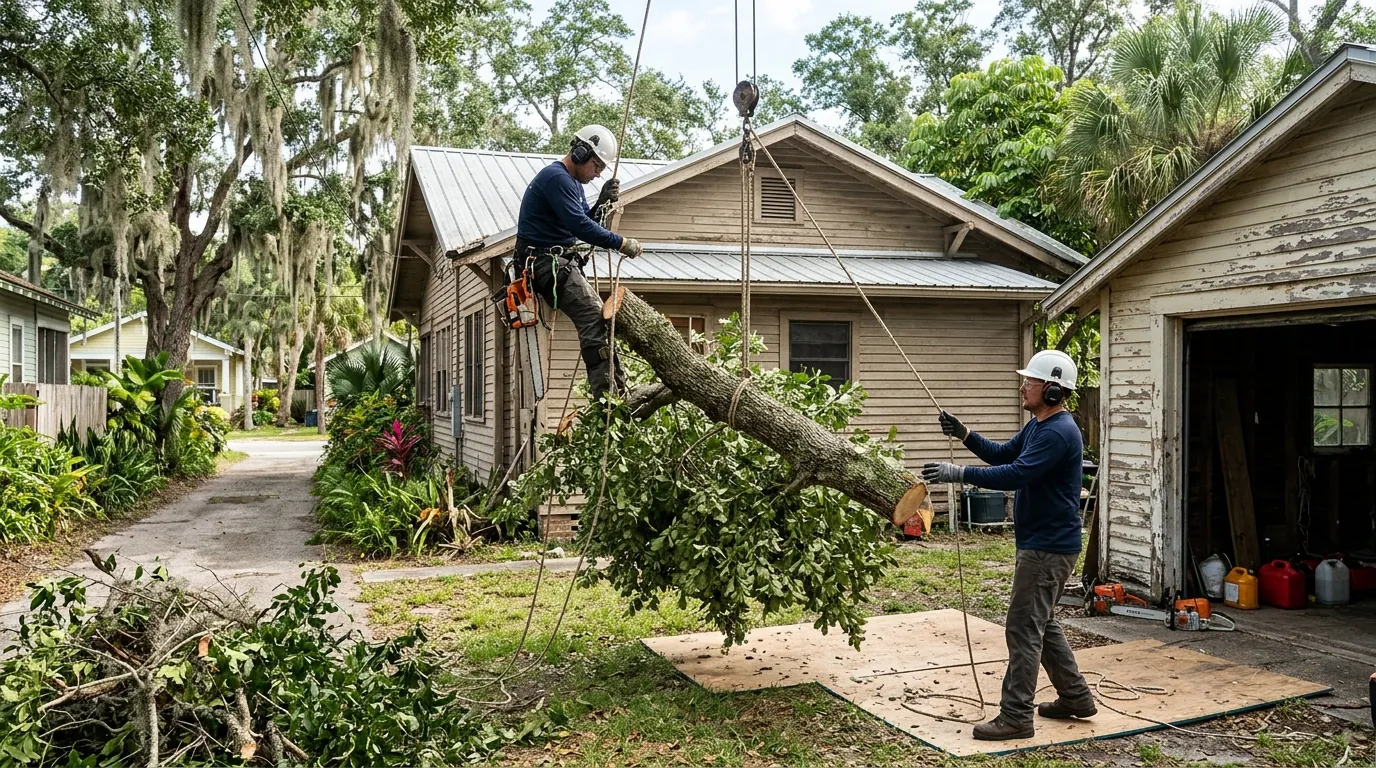
The removal itself has one goal: get the tree on the ground in pieces small enough to control, keep it off the house, the fence and the car, and leave nothing behind but a low-cut stump, or nothing at all if you add stump grinding. Here is the sequence, the same whether it is one queen palm or a big laurel oak behind a bungalow.
How a removal runs
- Free on-site estimate. We walk the tree and the ground around it: lean, dead wood, cracks, root heave, and what sits underneath. Roofs, screen cages, sheds, septic lids and sprinkler lines all change how a tree has to come down.
- Permit check. We measure trunk diameter at 4½ feet, identify the species and confirm the jurisdiction. If a permit or an arborist's documentation is needed, the estimate says so on its own line.
- Fixed written price. One number for the removal, cleanup and haul-off. Stump grinding and permit costs are itemized separately so you can see each one.
- Power line check. If any part of the tree is near a line, Duke Energy gets called first. For the line feeding your house from the street pole, called the service drop, Duke will cut power to it free of charge before work starts.
- Takedown. Open yards let a trunk be felled whole. Most St. Pete lots lack that room, so limbs are cut and lowered on ropes, and the biggest trees get a bucket truck or crane removal when the job needs one.
- Cleanup. Brush is chipped, wood is loaded out, and the lawn is raked and blown. Nothing goes to your curb for someone else to pick up.
St. Pete Tree Removal Permits by the Numbers
Inside city limits, the rules live in Land Development Regulation 16.40.060, and they are more specific than most homeowners expect. These are the thresholds we check on every city job.
- Protected trees: shade trees such as oaks, pines, elms, maples, magnolia and sycamore at 4 inches DBH or more, and understory trees such as crape myrtle, sea grape, holly and ligustrum at 8 inches or more. DBH is measured 4½ feet above the ground.
- Grand trees: any protected tree 30 inches DBH or larger, except laurel oaks. The city expects these to stay, and removal is approved only for a short list of documented reasons.
- Signature trees: banyans of any size, kapoks at 30 inches, and jacaranda or royal poinciana at 8 inches.
- Native palms: a sabal (cabbage) palm needs a permit once it shows 4 feet of bare trunk between the soil and its lowest green frond. Queen palms and Washingtonia do not.
- No permit at all: species on the city's unprotected or prohibited lists, such as Norfolk Island pine, camphor, earleaf acacia, carrotwood, Brazilian pepper and Australian pine.
Applying starts with a $25 inspection fee, paid through the city's Building Permit Portal or arranged by email to [email protected]. Staff aim to inspect within about two weeks, and the inspector is an ISA Certified Arborist. Once a permit is approved and paid for, it has to be posted where it can be read from the street, and it stays valid for six months. The city does not publish the permit fee itself, so we show it as a pass-through once the city sets it.
Outside the city, the numbers change. Since January 23, 2026, unincorporated Pinellas protects only trees over 24 inches DBH on homesteaded, owner-occupied single-family lots, which matters in Lealman and Tierra Verde. Madeira Beach requires a free permit for trees from 4 inches DBH up, and the City of Seminole protects live and laurel oaks from 4 inches up. Our St. Petersburg tree permit guide walks through each of them.
There is one more route. Florida Statute 163.045 lets the owner of a single-family detached home skip local permits and replanting when a credentialed professional signs a finding of unacceptable risk on that tree. The statute accepts that finding from two professions only: ISA-certified arborists and landscape architects licensed in Florida. Duplexes, townhomes and commercial lots are left out. Our hazardous tree removal page explains how that documentation works.
Residential Tree Removal Cost in St. Petersburg, FL
Height is the number most people can judge from the ground, so our ranges are built around it. These are typical St. Pete-area ranges for 2026, not quotes. Every job gets its own written price after we see it, with cleanup and haul-off always included.
| Job | Typical range | What moves the price |
|---|---|---|
| Small tree, under 25 ft | $250–$700 | Species, distance to the truck |
| Medium tree, 25–50 ft | $700–$1,600 | Lean, rigging needed, fences and sheds below |
| Large tree, 50–75 ft high | $1,600–$3,000 | Climbing time, canopy spread, alley or street access |
| Very large tree, 75 ft+ or over a structure | $3,000–$5,500 | Roof or pool cage underneath, piece-by-piece lowering |
| Crane-assisted removal | +$700–$2,500 per job | Crane size, setup space, number of lifts |
| Stump grinding, first stump | $125–$400 | Gate width, trunk diameter, root flare |
| City of St. Pete permit inspection | $25 pass-through | Approval fee is the city's call |
Two oaks of the same height can land in different rows. A laurel oak in an open back yard in Disston Heights may come down in a morning, while the same tree hanging over a 1920s roof with no side yard takes rigging all day. The St. Pete tree removal cost guide has worked examples.

Tree Removal Around Brick Streets, Alleys and Seawalls
Older neighborhoods were laid out for bungalows, not bucket trucks. In Old Northeast, many lots back onto rear alleys, and the streets are red brick with granite curbs and hexagon-block sidewalks. We put mats or plywood under outriggers and log drops so heavy wood never lands straight on brick or block, and we decide where the chipper will sit before the first cut.
Waterfront lots bring a different problem. Canal homes in Riviera Bay often have a tree leaning toward the seawall, with the house on one side and open water on the other. Those trees are pieced down toward the yard in short sections, and any mangroves along the shore are left alone. Mangroves carry their own permits and registered trimmers, and we are not the crew for that work.
What is left when we drive away
A standard removal leaves the stump cut as low as the saw can safely go. If you want the spot level for sod, pavers or a new tree, grinding takes it below grade, and oaks often have surface roots worth grinding at the same visit. The grinder fits through most garden gates, so back-yard stumps are rarely a problem.
What St. Pete Tree Removal Does Not Cover
Knowing where the job stops saves surprises later.
- Energized power lines. We do not cut near primary lines. Duke Energy deals with trees in its lines, and no homeowner should try it from a ladder.
- Mangroves. Not a routine service. In Madeira Beach even one mangrove needs sign-off from the city, the county and the state, and Pinellas keeps a list of registered professional trimmers.
- Arborist risk letters. The state's dangerous-tree exemption has to be signed by one of two credentialed professionals, an ISA arborist or a Florida landscape architect. We can help you arrange one.
- City curbside pickup. The storm debris passes after Helene and Milton were a disaster program, not a standing service. We haul everything we cut.
For trees that have already died, failed in a storm or cannot wait, see dead tree removal, emergency tree removal and storm damage cleanup. For an overview of everything we do across the city, start with tree removal in St. Pete, or schedule a free estimate and get a number on paper.
Tree Removal Services
Areas We Serve
Tree Removal St. Petersburg Questions
Straight answers before you call.
It depends on the address and the tree. Inside city limits, shade trees 4 inches DBH and up, understory trees 8 inches and up, Signature trees and sabal palms with 4 feet of clear trunk generally need one, while unprotected and prohibited species do not. Outside the city, county or town rules apply instead. We check before we quote.
After the $25 inspection fee is paid, the city aims to inspect within about two weeks. Once the permit is approved and paid, it has to be posted where it is visible from the street, and it is valid for six months, which leaves plenty of room to schedule the work.
No. Laurel oaks are excluded from Grand-tree status, but inside the city they are still protected shade trees from 4 inches DBH up. A laurel oak that size normally needs a permit unless the owner uses the state's dangerous-tree exemption with an arborist's documentation.
Only if the estimate says so. Removal includes cutting the stump low plus full cleanup and haul-off. Grinding is its own line, typically $125–$400 for one stump, with extra stumps on that visit running $60–$150 apiece.
Sometimes. On one- and two-unit residential lots in the city, when taking a tree out leaves the lot short of the city's minimum tree standard, the city asks for a replacement shade tree or a $500 payment in lieu. A removal done under Florida Statute 163.045 cannot be made to require replanting.
Photos help us plan, but the price comes after a visit. Lean, decay, what sits under the canopy, gate width and the permit question all change the number, and most of that only shows up in person. The estimate is free, and you get one fixed written price before any work starts.
More St. Pete Tree Removal Services
More ways we can help on the same trip.
- Dead Tree RemovalDead and dying trees taken down before they fall on their own. $250–$3,000
- Hazardous Tree RemovalLeaning, split or rotten trees over homes, cars and power drops. $700–$5,500
- Emergency Tree RemovalTrees on roofs, cars, fences and lanais after storms, with fast storm response. Storm calls
- Crane Tree RemovalBig trees on tight St. Pete lots with nowhere to lower wood. +$700–$2,500
- Oak Tree RemovalLaurel and water oaks past their prime, with the permit question answered first. $700+
- Palm Tree RemovalQueen, Washingtonia and sabal palms removed to the root ball. $200–$1,500
- Pine Tree RemovalDead, leaning and lightning-struck pines. $250+
- Stump GrindingStumps ground out under the soil line, ready for sod or a new bed. $125–$400
Get a Written Price on Your Tree
One visit, one fixed number, and the permit question answered.