Pinellas County town · 33714
Tree & Limb Removal in Lealman, FL
In Lealman the job is often one dead limb over a mobile home or a 1960s roof, not a whole tree. We take down what's dangerous, tell you plainly what can wait, and check the county's 2026 tree rules for your lot before any cutting.
- Governed by
- Pinellas County (unincorporated)
- ZIP
- 33714
- Tree rules
- Pinellas County code (2026)
- Typical job
- Hazard limb over a roof
Local snapshot Lealman
- Population
- 21,189 (2020 Census)
- Recent estimate
- 20,567 (ACS 2020–2024)
- Land area
- 4.02 sq mi
- Median home built
- 1968 (ACS 2020–2024)
- Mobile homes
- 2,540 of 10,591 housing units (24%)
- Single-family detached
- 5,006 housing units
- Lealman CRA
- Created 2015, first in unincorporated Pinellas
- Joe's Creek
- 9.8-mile county stormwater channel
Landmarks & streets Around the area
- Raymond H. Neri Park4300 Duval Park Blvd. The 38-acre former Joe's Creek Greenway Park, reopened after improvements on Feb. 7, 2026.
- Lealman Exchange5175 45th St N. A 77,000-square-foot community campus on six acres, in a former charter school the county bought in 2018.
- Joe's CreekAbout 23 feet wide and 16 feet deep, with a county restoration project from 37th St N to 66th St N.
- Pinellas Park lineLealman's northern border. Cross it and you're under a different city's rules.
- St. Petersburg lineThe city wraps Lealman on the east and south, where St. Pete's tree code takes over.
Lealman Tree Removal Where Limbs Hang Over Homes
Lealman is a big place that a lot of people drive through without knowing its name. It had 21,189 residents in the 2020 Census on about 4 square miles of land, and it was called East Lealman until 2010. It is not part of St. Petersburg or Pinellas Park, even with both cities on its borders. The county governs it.
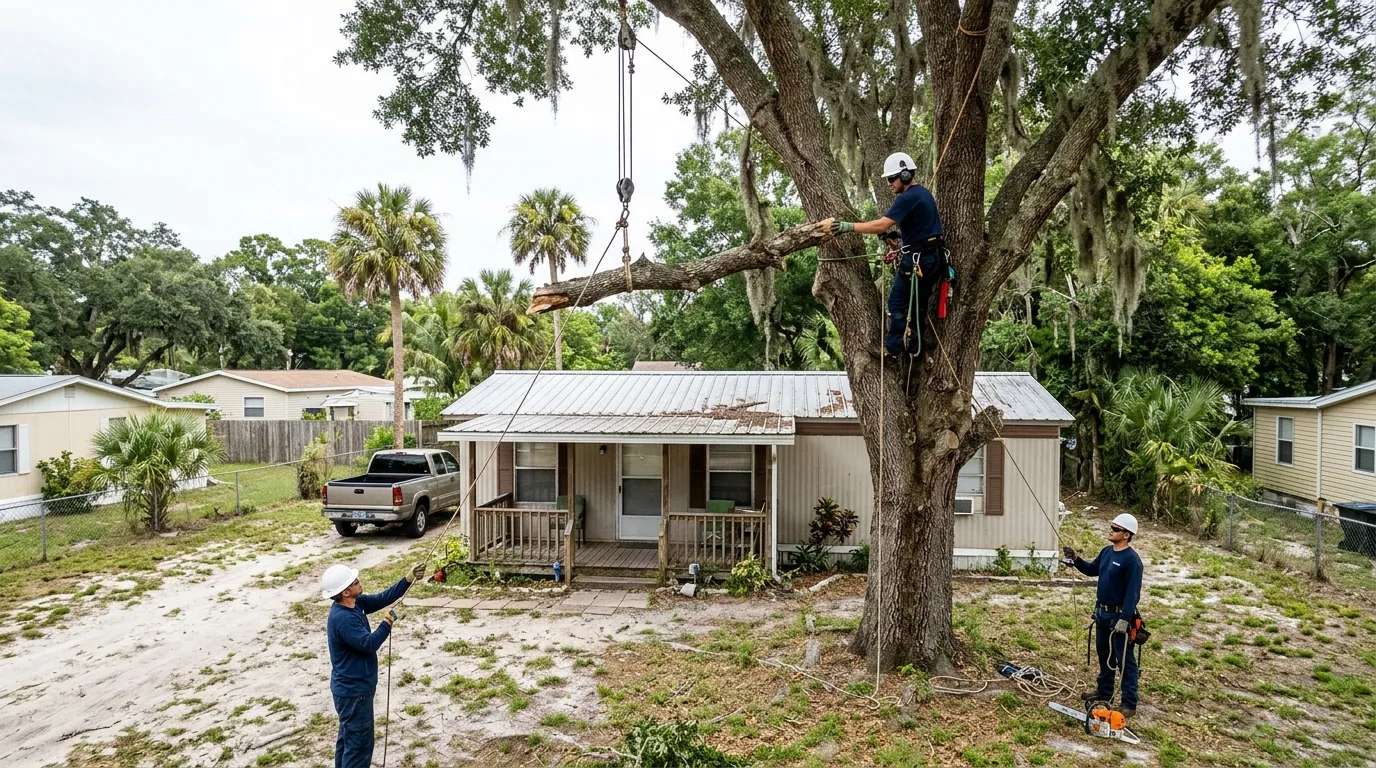
The housing shapes the tree work. Census figures put the median home at 1968, and 2,540 of Lealman's 10,591 housing units are mobile homes, about 24 percent. A 50-year-old oak or a tall pine beside a manufactured home is a different risk from the same tree beside a block house. A limb that would crack a few shingles on one can open the roof of the other.
Which limb to deal with first
- Anything touching the line to your house. Call Duke Energy first. Duke kills power to that line for free before tree work, and nobody should cut near a live wire.
- Dead limbs over a bedroom or living space. Dead wood breaks without warning, and it breaks first in a storm.
- Trees leaning toward the home with soil lifting on the far side. That is the root plate starting to fail.
- Split trunks and cracked crotches. A tree with two equal stems and a crack between them can split in a strong gust.
- Healthy limbs that rub the roof. Worth fixing, but they can usually wait for a calm month.
Our hazardous tree removal page shows how a tree gets taken apart piece by piece over a roof.
Lealman Hazard Tree Removal That Fits the Budget
Not every call needs the whole tree gone. If one dead limb is the problem and the rest of the tree is sound, removing that limb can be the honest answer, and it costs far less. If the trunk is rotten or the tree leans hard at the house, we'll say so and price the full removal. Either way you get a fixed written price before we start, with cleanup and haul-off included.
Here's what that looks like in our St. Pete-area ranges. They're guides, not quotes:
- Tree under 25 feet: $250–$700. Most small yard trees and many limb-and-tree jobs land here.
- Tree 25 to 50 feet: $700–$1,600. A mature oak or pine beside a house usually falls in this band.
- Tree 50 to 75 feet: $1,600–$3,000.
- Stump grinding: $125–$400 for one, $60–$150 for each extra stump done that day. It can be done later if you want to spread out the cost.
Grouping work saves money. If two trees and a stump all need attention, one visit costs less than three. Stump grinding and tree removal both have more detail on what's included.
County Tree Rules in Lealman Since January 2026
Because Lealman is unincorporated, the Pinellas County tree protection ordinance applies, and the county rewrote it effective Jan. 23, 2026. A permit is generally required for trees measuring 4 inches across or more at 4.5 feet off the ground, and palms taller than 6 feet. If the property is a homesteaded single-family house and the owner lives in it, protection now reaches only trees wider than 24 inches. Dead, dying, invasive and nuisance trees need no replacement planting when they come out.
The homestead rule doesn't fit every Lealman property. A rented house, a vacant lot, or a home in a mobile home park where you don't own the land may fall under the wider rule. We ask the county about your specific property before we quote, and we don't guess. Trees in the public right-of-way need a separate county permit.
One state law can help with a truly dangerous tree. Florida Statute 163.045 bars local governments from requiring a permit, fee or replanting for a tree on a single-family detached home once a signed assessment, by an arborist with ISA credentials or a landscape architect licensed in this state, rates the tree an unacceptable risk. Whether a particular manufactured home counts is a question for the county, and we'll help you find out. Our permit article compares the county rules with St. Pete's.
Lealman Palm and Invasive Tree Removal
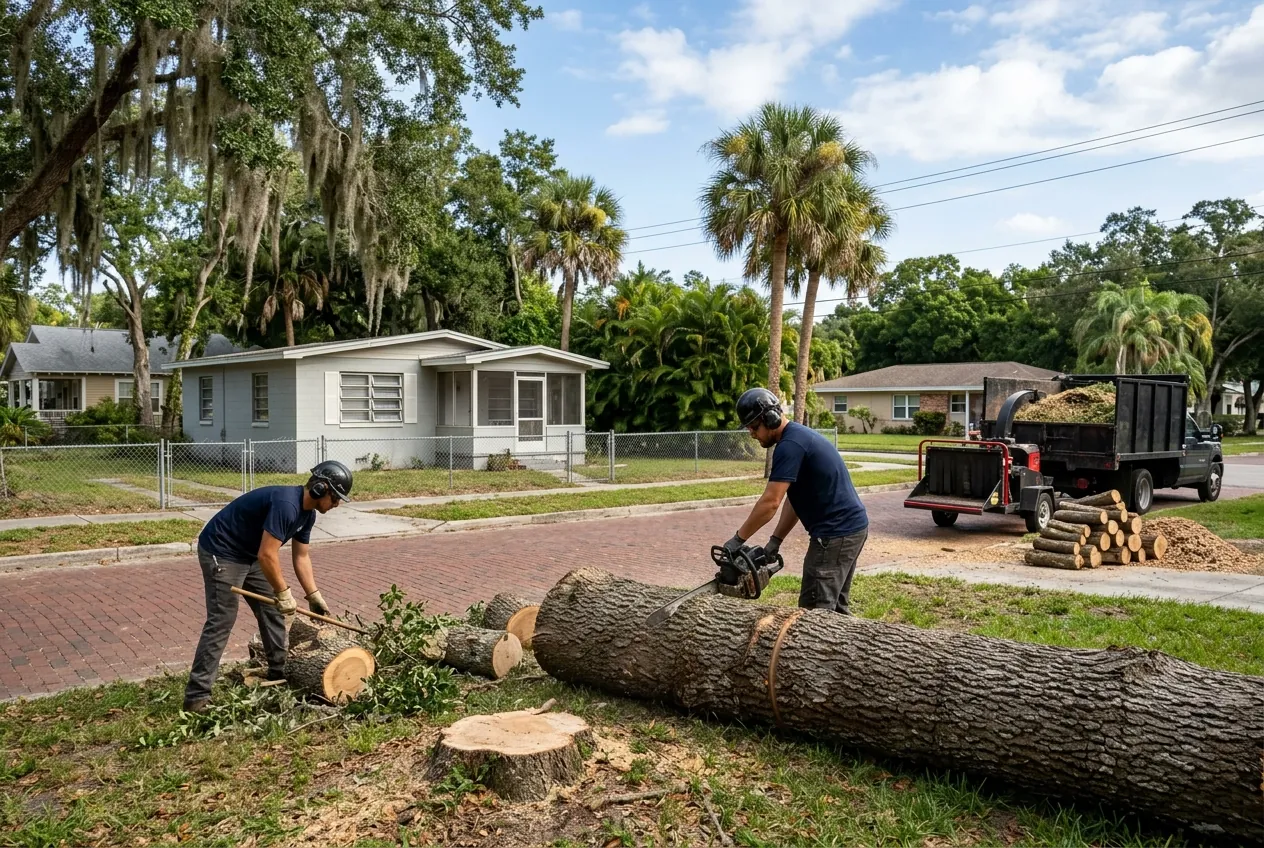
Older Lealman yards often hold trees nobody planted on purpose. The Florida Invasive Species Council lists earleaf acacia, carrotwood, Australian pine and Brazilian pepper as Category I invasives, its most serious tier, and queen palms as Category II. Brazilian pepper in particular spreads along fence lines and creek banks until it shades out everything else. The county code requires no replacement planting for an invasive or nuisance tree that comes out, though we still confirm how the county treats your particular tree before we cut.
Palms are priced by trunk height in our typical ranges: about $200 to $450 under 20 feet, $400 to $900 from 20 to 40 feet, and the tallest, past 40 feet, $800 to $1,500. A queen palm with shelf fungus on the trunk is a Ganoderma suspect, and those come out with the stump. The palm tree removal page has the details.
Lealman Storm Damage Tree Removal Near Joe's Creek
Lealman sits inland, so its storm risk is wind and water from above rather than surge. Pinellas ordered all mobile home parks evacuated for Helene in September 2024, and for Milton two weeks later, every mobile home in the county. Milton's gusts reached 80 to 100 mph countywide, and just over 15 inches fell at a gauge on the east side of Pinellas Park. Saturated sand lets top-heavy trees tip, roots and all.
Joe's Creek runs through the middle of it. Roughly 23 feet wide and 16 feet deep, the county-run channel stretches 9.8 miles, and a restoration effort is underway between 37th and 66th streets north. The creek also anchors Raymond H. Neri Park, the 38-acre greenway that reopened in February 2026. Trees along the low ground near the creek grow in wetter soil and deserve a look after a long rainy stretch.
When a trunk is already lying on a roof, emergency tree removal is the call; we take storm and emergency calls. Our first-24-hours guide for a tree on the house walks through the first 24 hours, from Duke Energy to photos for your insurer.
Lealman borders Kenneth City, which runs its own town permit, and St. Pete neighborhoods like Meadowlawn and Disston Heights follow the city's code. For tree removal in St. Pete proper, start at our home page, or get a free estimate for your Lealman lot.
Tree Removal Services
Areas We Serve
Lealman Tree & Limb Removal Questions
Straight answers before you call.
No. Lealman (ZIP 33714) never incorporated and is counted as a census-designated place, bordered by Pinellas Park to the north and St. Petersburg to the east and south. Pinellas County sets its tree rules.
The county code reaches trees from 4 inches and palms above 6 feet. For an owner-occupied homestead house, though, protection applies only to trees over 24 inches. Rentals and some mobile home park lots may not qualify for that rule, so we check your property first.
Yes. If one dead or cracked limb is the hazard and the rest of the tree is sound, removing that limb is often the right call and costs much less. We'll tell you honestly if the whole tree needs to go.
Stay away from it and call Duke Energy first. Duke can switch off that line without charge so the limb comes down safely. Never cut or pull a limb that's touching a line.
In our typical St. Pete-area ranges, expect $250 to $700 for a tree below 25 feet and $700 to $1,600 for one between 25 and 50 feet. Grinding one stump is $125 to $400. Cleanup and haul-off are included in the written price.
Neighborhoods & Towns Near Lealman
Close by, same crew.
Tree Removal Services in Lealman
More ways we can help on the same trip.
- Tree RemovalWhole-tree takedowns, rigged and lowered over roofs, pools and lanais. From $250
- Dead Tree RemovalDead and dying trees taken down before they fall on their own. $250–$3,000
- Hazardous Tree RemovalLeaning, split or rotten trees over homes, cars and power drops. $700–$5,500
- Emergency Tree RemovalTrees on roofs, cars, fences and lanais after storms, with fast storm response. Storm calls
- Crane Tree RemovalBig trees on tight St. Pete lots with nowhere to lower wood. +$700–$2,500
- Oak Tree RemovalLaurel and water oaks past their prime, with the permit question answered first. $700+
- Palm Tree RemovalQueen, Washingtonia and sabal palms removed to the root ball. $200–$1,500
- Pine Tree RemovalDead, leaning and lightning-struck pines. $250+
Get a Hazard Limb or Tree Priced in Lealman
Tree trouble in Lealman? We’ll come look.