St. Petersburg neighborhood · 33704, 33705
Tree Removal in Euclid-St. Paul, St. Petersburg, FL
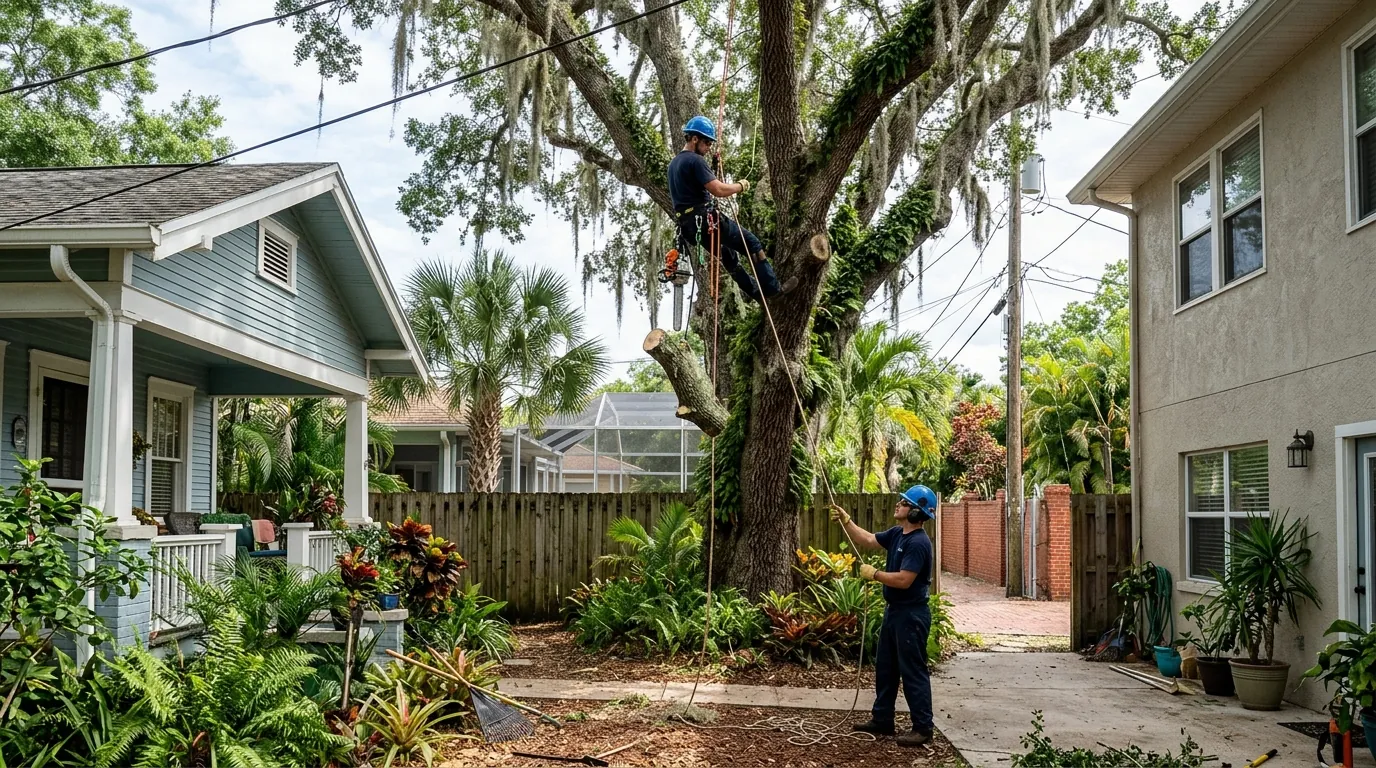
Euclid-St. Paul is a 1920s grid between 9th and 22nd Avenues North, with alleys behind most lots and garage apartments tucked against them. A big backyard tree here usually has no easy way out, so the job is planned piece by piece.
- ZIPs
- 33704 (33705 on some southern blocks)
- Jurisdiction
- City of St. Petersburg
- Boundaries
- 22nd Ave N, 9th St N (MLK), 16th St N, 9th Ave N
- Typical job
- Backyard tree, alley-only access
Local snapshot Euclid-St. Paul
- Neighborhood association
- ESPNA, all-volunteer
- Area
- About 240 acres (Wikipedia)
- Orange grove planted
- 1912, about 20 acres
- Land bought by John B. Green
- 1921
- Euclid School
- Built 1924, opened 1925; St. Petersburg Register 2014
- Euclid School apartments
- 16 units, opened 2017
- St. Paul parish
- Land bought 1922; parish established 1929
- Right-of-way trees planted
- 29, through a 2005 neighborhood grant
Landmarks & streets Around the area
- Euclid School (Euclid Schoolhouse Flats)1090 10th St N; a 1924 school on the city's historic register, now 16 apartments.
- St. Paul Catholic Church & School1800 12th St N, on 10 acres bought in 1922; the parish dates to 1929.
- Former Euclid Methodist Episcopal ChurchThe 1936 church building at 919–921 10th Ave N.
- Dr. MLK Jr. Street NorthThe eastern edge, and the side most trucks come in from.
- Crescent Lake ParkJust outside the neighborhood to the east, across MLK.
- Mirror LakeNearby to the south, downtown side of 9th Ave N.
Euclid-St. Paul Tree Removal on an Alley Lot
Euclid-St. Paul started as a 20-acre orange grove in 1912. John B. Green bought land here in 1921, and the 1920s boom filled the grid with bungalows, small masonry houses and garage apartments facing the alleys. The neighborhood association, ESPNA, sets the boundaries at 22nd Avenue North, Dr. MLK Jr. Street North, 16th Street North and 9th Avenue North. Inside those lines, most lots are narrow, and the tree that needs to come out is usually in the back.
That combination, narrow lot plus alley plus a second building, decides how a removal goes. Here's the sequence on a typical job.
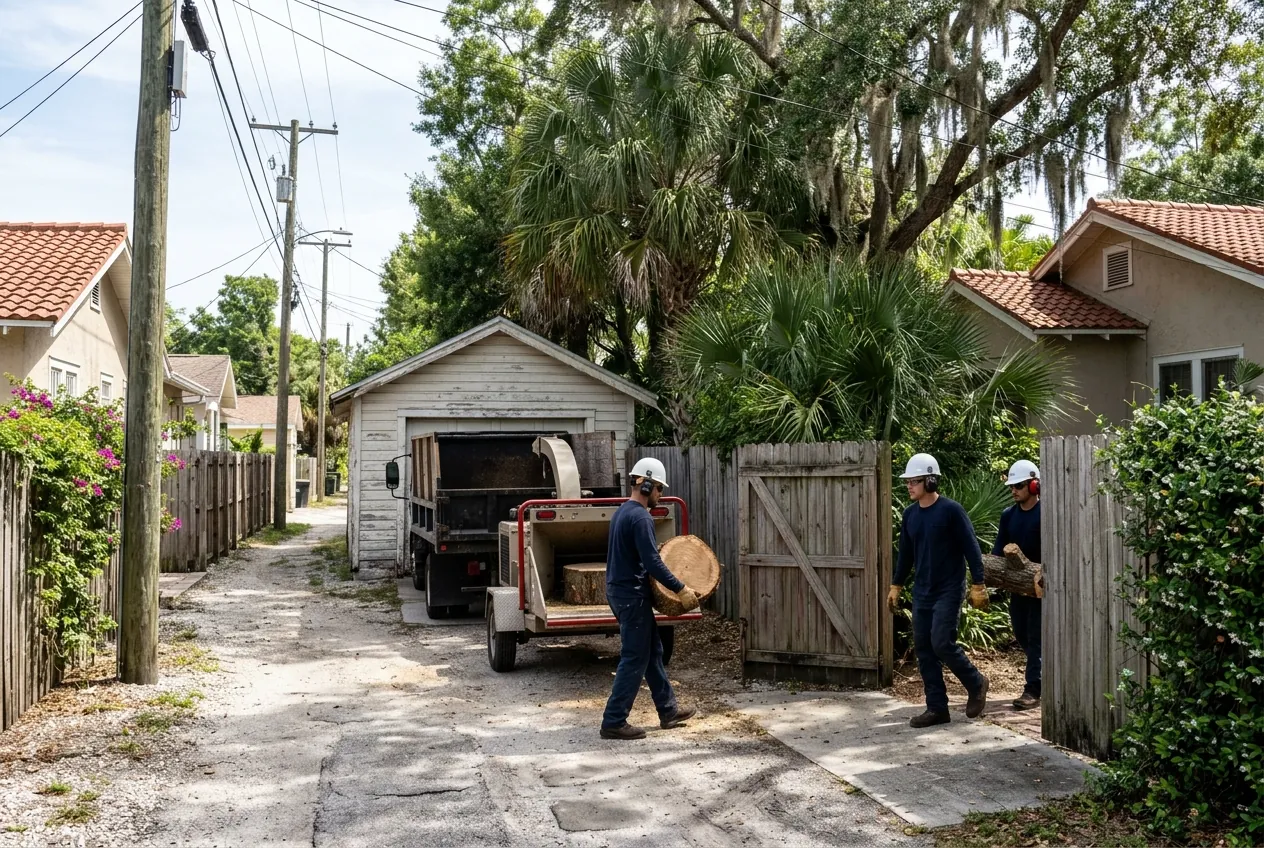
- Walk the alley first. We measure its width, look for low wires and overhanging limbs on neighboring lots, and check whether a truck and chipper can sit there without blocking anyone's garage for the day. If they can't, we plan to carry wood out to the street.
- Sort out the lines. Overhead lines run through many of these alleys. If the tree touches a line, Duke Energy comes first. Duke will switch off the drop serving your house at no charge so the crew can work around it.
- Pick the landing zones. Every piece has to land somewhere: the lawn, a cleared patch of alley, the bed of a truck. Garage roofs, fences and the neighbor's yard are off the list.
- Climb and rig. Up in the tree, limbs are cut into short lengths, and a groundsman on the rope lowers each so it never swings into a wall.
- Bring the trunk down in rounds. Once the canopy is off, the trunk comes down a few feet at a time, small enough to roll or carry.
- Clean up and haul. Wood, brush and sawdust leave with us. Stump grinding happens now or on a later visit if the grinder can't reach the backyard yet.
Sometimes no landing spot is safe at all, and then a crane parked on the street hoists whole sections up and over the roof. We organize crane removal when the job needs one. The estimate explains why it's worth the extra cost.
Garage Apartments and Euclid-St. Paul Tree Removal
Garage apartments are part of the neighborhood's character, and they're often the reason a tree can't simply be felled. A backyard oak may stand between the main house and a two-story garage apartment with only a few feet on either side. If someone lives in the apartment, we coordinate the day with them too, keep the path to their door clear, and keep cars out of the drop zone. If the lot holds more than one dwelling, keep in mind that Florida Statute 163.045, the dangerous-tree exemption, applies only to single-family detached homes, and St. Pete says duplexes and multi-family property don't qualify. A tree on a lot with a rented garage apartment may need the regular city permit; ask the city before assuming otherwise.
When the tree is the neighbor's
On lots this close together, a limb from next door is one of the most common questions. Per UF/IFAS, Florida lets you cut back encroaching limbs and roots yourself, paying for it and stopping at the boundary. Anything past that line, or the whole tree, is the owner's decision. Our neighbor-tree article covers who pays when one falls; for anything specific, your insurer or a Florida lawyer is the right call, since this isn't legal advice.
Euclid-St. Paul Trees on Century-Old Lots
A neighborhood platted in the 1920s has had about a hundred years to grow big trees on small lots. Oaks are usually the trees big enough to matter on lots this size, and the question with each one is age and decay. Laurel oaks, which UF/IFAS gives a city life expectancy of about 50 to 70 years, are often well past that here. Our oak tree removal page and the laurel oak article explain what we look for.
Some trees here are on the city's unprotected list, such as camphor, citrus, loquat and mango, and those don't need a removal permit. Camphor is also a Category I invasive on the Florida Invasive Species Council's 2026 list. Protected trees work differently: oaks, pines and the other shade species once the trunk reaches 4 inches, Grand trees from 30 inches (never a laurel oak), and sabal palms with clear trunks of 4 feet and up all need a permit.
The trees by the curb
In 2005 a neighborhood grant paid for 29 trees, crape myrtles, magnolias, oaks and maples, along the rights-of-way. Those curb strips are the adjacent owner's to maintain under city code, and limbs must leave 8 feet of room above the sidewalk and 14 above the pavement. A curb-strip tree that's dying is the owner's to handle, but because it's in the right-of-way, we check with the city before quoting removal.
Permits for Tree Removal in Euclid-St. Paul
Euclid-St. Paul isn't a local historic district or a National Register district, though the Euclid School is individually listed on the city's register. The usual city process applies: pay $25 for the inspection, wait up to about two weeks for the visit, pay the permit fee once approved, display the permit toward the street, and finish within six months. Our St. Petersburg permit guide covers the details, including the Grand-tree removal criteria.
Euclid-St. Paul Tree Removal Cost
Tight alley access and rigging over garage apartments push prices up compared with an open suburban lot. Typical 2026 St. Pete-area ranges by height: 25 to 50 feet, $700–$1,600; from 50 feet to 75, $1,600–$3,000; very large, or over a garage apartment or house, $3,000–$5,500. Lifting with a crane tacks on $700–$2,500. Grinding costs $125–$400 for one stump and $60–$150 more per stump after that on a single trip. Cleanup and haul-off are included, and permit costs are itemized.
That's a range, not a quote. Schedule a free estimate and we'll walk the alley with you. We also work the alley blocks of Old Northeast to the east and the big former grove lots of Allendale Terrace to the north, along with every other part of tree removal in St. Pete.
Tree Removal Services
Areas We Serve
Euclid-St. Paul Tree Removal Questions
Straight answers before you call.
Yes. We carry wood out by hand to the street, use smaller equipment, or, when there's no safe way to lower pieces, lift them out with a crane set up on the street. The estimate spells out which approach your lot needs.
Duke Energy, before anyone else. Don't touch the tree or the line. They'll also kill power to your home's service drop, free, so we can work safely next to it.
Possibly not. FS 163.045 covers single-family detached homes, and St. Pete says duplexes and multi-family property don't qualify. Ask the city how your lot is classified before relying on the exemption.
No. Camphor is on St. Pete's unprotected list, so removing one doesn't take a city permit. Oaks, pines and other protected shade trees with trunks of 4 inches and up do.
No. The Euclid School is individually on the city's historic register, but the neighborhood itself isn't a local or National Register district. Normal city tree rules apply.
Most backyard trees here land between $700 and $3,000 in typical St. Pete-area 2026 ranges, more when the tree is over a garage apartment or needs a crane. Cleanup and haul-off are included.
Neighborhoods & Towns Near Euclid-St. Paul
Close by, same crew.
Tree Removal Services in Euclid-St. Paul
More ways we can help on the same trip.
- Tree RemovalWhole-tree takedowns, rigged and lowered over roofs, pools and lanais. From $250
- Dead Tree RemovalDead and dying trees taken down before they fall on their own. $250–$3,000
- Hazardous Tree RemovalLeaning, split or rotten trees over homes, cars and power drops. $700–$5,500
- Emergency Tree RemovalTrees on roofs, cars, fences and lanais after storms, with fast storm response. Storm calls
- Crane Tree RemovalBig trees on tight St. Pete lots with nowhere to lower wood. +$700–$2,500
- Oak Tree RemovalLaurel and water oaks past their prime, with the permit question answered first. $700+
- Palm Tree RemovalQueen, Washingtonia and sabal palms removed to the root ball. $200–$1,500
- Pine Tree RemovalDead, leaning and lightning-struck pines. $250+
Get a Written Price for Your Euclid-St. Paul Tree
Tree trouble in Euclid-St. Paul? We’ll come look.