If you live under one of these trees, you have probably noticed more of them being taken down around you. That is not your imagination, and it is not just the 2024 storms. Here is what the city and UF/IFAS say about laurel oaks, how to read the warning signs on your own tree, and how the rules work when one has to go. It is one of the most common jobs we see for St. Pete tree removal.
Why St. Pete Laurel Oak Removal Is So Common Right Now
The City of St. Petersburg's Urban Forestry program has flagged the problem itself. Its community tree inventory work warns of low age diversity and of large laurel oak losses, because many of them were planted within the same ten-year period. When a whole street of trees is the same species and the same age, they tend to decline on the same schedule.
Add the biology. UF/IFAS describes the laurel oak as a fast-growing tree that reaches 60 ft or more with a 35 to 45 ft spread, and says it is susceptible to breakage and needs structural pruning. Its life expectancy is 50 to 70 years in urban settings, though it can live far longer in the wild, and its susceptibility to decay often shortens that. UF's tree tour notes that after 50 to 70 years the tree may become hazardous in urban settings. Postwar yards in neighborhoods like Meadowlawn and Disston Heights have trees right in that age window.
Laurel Oak, Live Oak and Water Oak Compared
These three oaks fill most St. Pete yards, and they age very differently.
| Laurel oak | Live oak | Water oak | |
|---|---|---|---|
| Life expectancy (UF/IFAS) | 50 to 70 years in cities | Not listed as short-lived | 30 to 50 years |
| Wood and structure | Fast-growing, prone to breakage and decay | Strong wood | Poor at walling off decay; many hollow by 40 |
| Storm record (UF studies) | Lower survival than live oak in Panhandle hurricanes | Little failure in hurricanes | Large branches split in storms |
| St. Pete Grand tree at 30 in+ | Never | Yes | Yes |
UF research is not unanimous on laurel oaks in storms. Panhandle studies found laurel oaks survived hurricanes less well than live oaks, while a South Florida study listed laurel oak among the better-surviving trees. So we do not call it the worst storm tree. We do treat an old, decaying one as a real risk.
Telling a laurel oak from its look-alikes
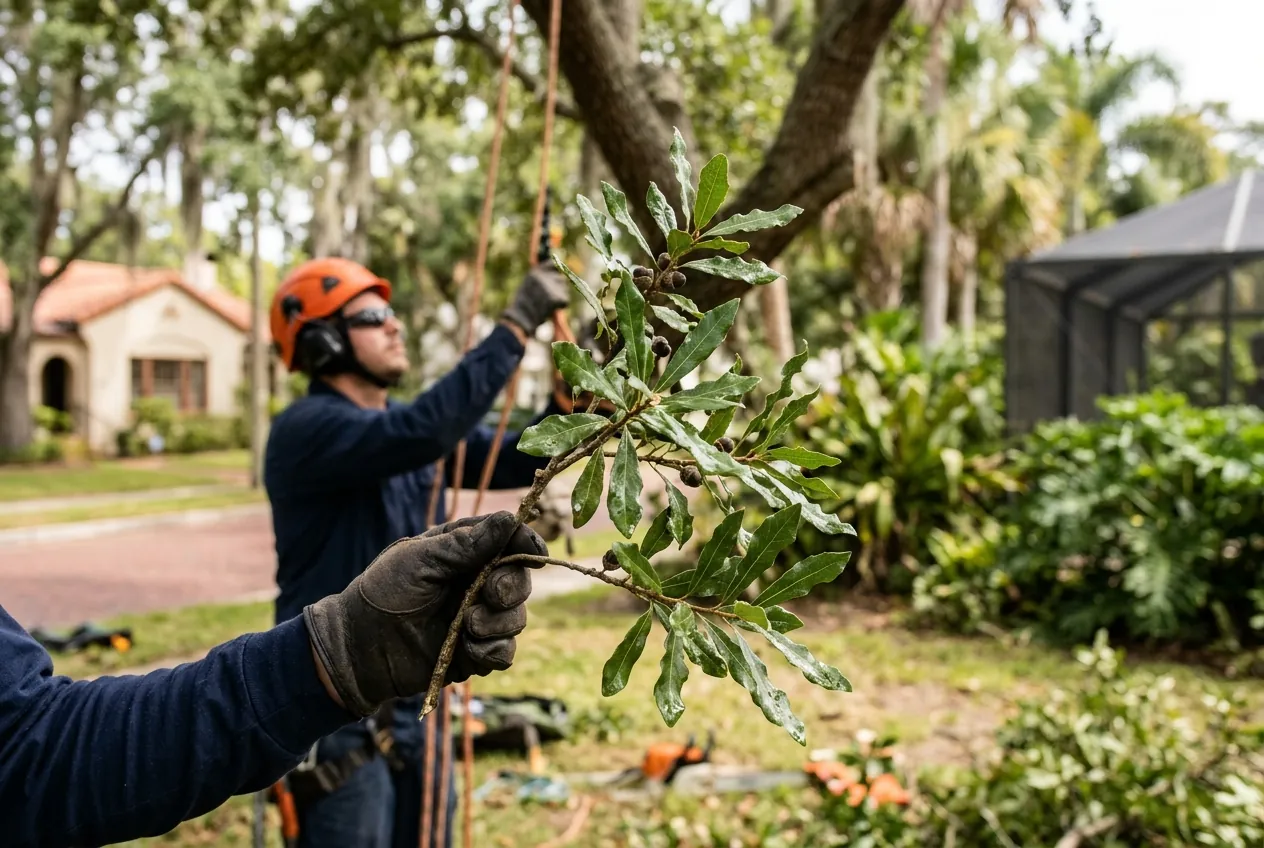
Laurel oak leaves are smooth, glossy on top, lighter underneath, narrow, and often widest in the middle so they look diamond-shaped, with slightly wavy edges. UF notes that laurel oak and Darlington oak are easily confused and were once treated as the same species. If the species affects your permit, the city inspector or an arborist can confirm it from a leaf sample.
Signs a Laurel Oak in St. Petersburg Needs Removal
None of these alone means a tree must go. Two or three together, on a tree that can reach your house, is when we start talking about removal instead of pruning.
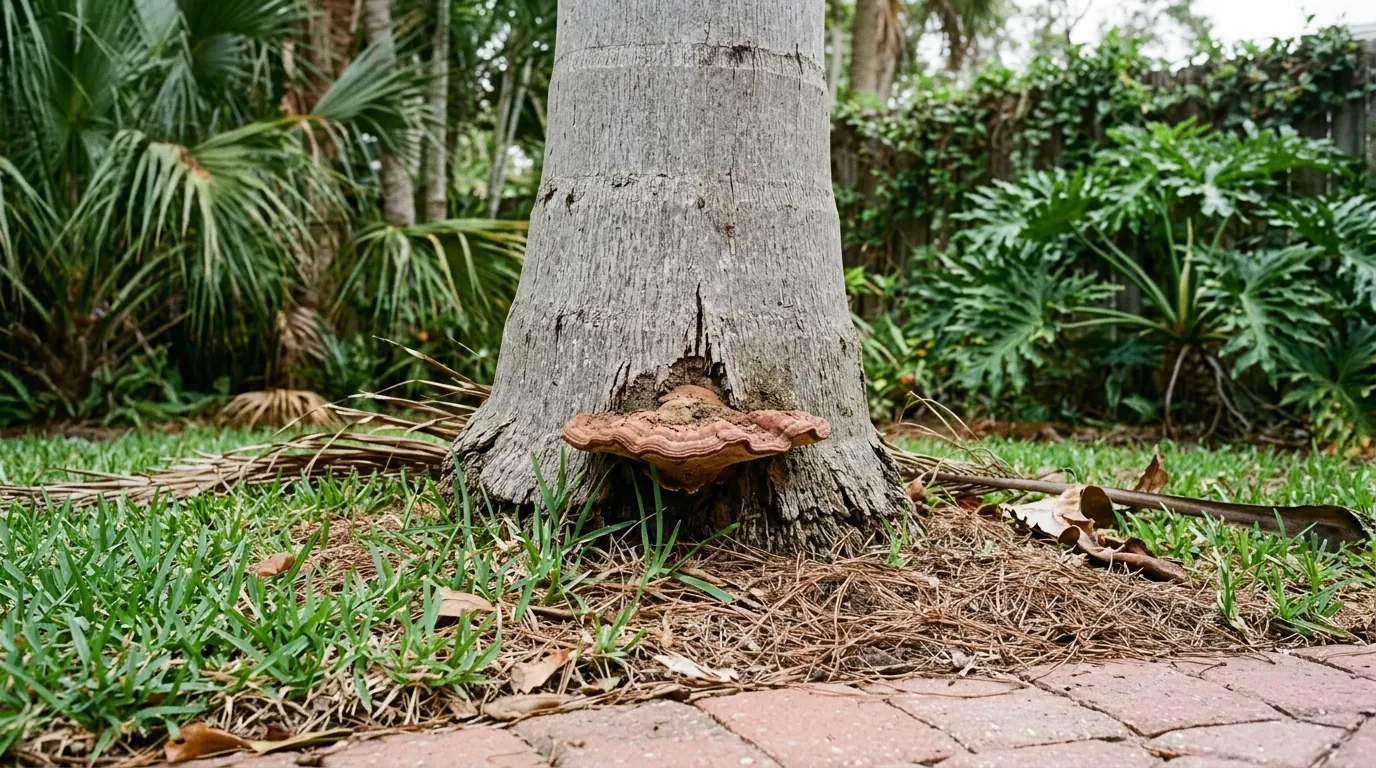
- Mushrooms or shelf-like fungus at the base or on the trunk, which points to decay inside.
- Cavities or hollows where large limbs once were.
- Dead limbs high in the crown, especially big ones.
- Large limbs dropping in calm weather.
- Cracks, seams or oozing on the main trunk.
- A thinning crown that leafs out later and sparser each spring.
- Bark falling away to show soft, dark wood.
A tree showing several of these is a candidate for hazardous tree removal, especially if it hangs over a roof, driveway or play area.
Laurel Oak Pruning vs. Removal in St. Pete
A younger laurel oak with a sound trunk can often be kept safe with structural pruning: removing competing leaders, shortening long heavy limbs and taking out dead wood. St. Pete's code limits this. The code caps pruning at 25% of a canopy in any 12 months, dead wood excepted, and shaping trees into balls or boxes is not allowed. That rule is good for the tree, but it means you cannot fix a badly overgrown oak in one visit.
Pruning stops making sense when decay has reached the trunk or the main limb unions. You cannot prune out a hollow trunk. At that point the choice is removal now, on your schedule, or removal later after it fails. Our oak tree removal page covers how we take down big oaks over houses, and the tree removal cost guide has the price bands.
Laurel Oak Removal Permits in St. Pete and Nearby
| Where the tree is | Laurel oak rule |
|---|---|
| City of St. Petersburg | Protected shade tree at 4 in DBH or more; permit required; never a Grand tree, so the stricter Grand tree removal limits do not apply |
| City of Seminole | Protected at 4 in or more, and the permit needs a certified arborist's report |
| Unincorporated Pinellas, homesteaded single-family home | Only trees over 24 in DBH need county approval since Jan. 23, 2026 |
| Any single-family detached home | No permit, fee or replanting if a credentialed arborist or landscape architect documents unacceptable risk (FS 163.045 sets who qualifies) |
Because a laurel oak cannot be Grand, the reasons the city accepts for removing one are the broader ones for ordinary protected trees, including an imminent hazard, disease or decline, or a lot that already meets its minimum tree count. Should the removal put a single-family or duplex lot under its minimum tree count, the city asks for one replacement shade tree or $500 in lieu. The full rules are in our St. Petersburg permit guide.
How a Laurel Oak Comes Down on a Tight St. Pete Lot
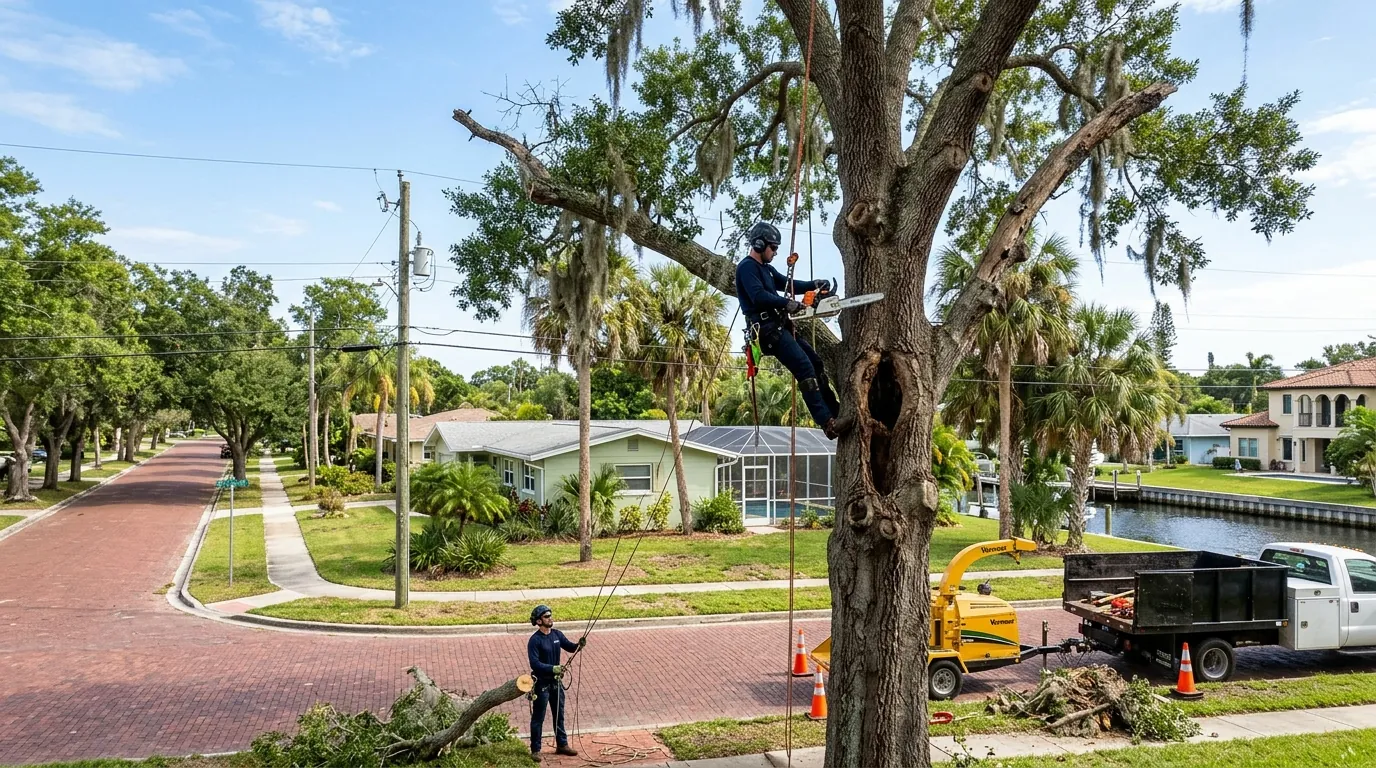
Decay changes how a big laurel oak is taken apart. A climber normally ties a rope into a strong union high in the tree and lowers cut pieces from it. On a laurel oak with hollow limbs or a rotten trunk, that tie-in point may not be trustworthy, and neither is the wood the climber would stand on. That is why an old laurel oak over a house often ends up as a bucket truck or crane job even when a sound tree of the same size could be climbed.
- Open yard, no roof underneath: the tree can often be reduced from the top and felled in a few large pieces, which keeps it near the low end of its height band.
- Over a house, garage or lanai: every limb is cut and lowered, and a decayed tree may need a crane. Expect the top band, $3,000 to $5,500, with a crane adding another $700 to $2,500.
- Alley or side-gate access only: logs are carried or lifted out in smaller pieces, which adds crew time.
A typical 40 to 50 ft laurel oak in an open back yard would fall in the $700 to $1,600 band, with the city's $25 inspection fee and the permit fee on top, and stump grinding listed separately. Older bungalow neighborhoods with rear alleys, such as Euclid-St. Paul, can be quicker to clear than a fenced back yard reached only through a side gate.
What to Plant After a Laurel Oak Comes Down
The city's answer to same-age laurel oaks is more variety. A few practical points if you are replanting:
- Live oak has strong wood, tolerates salt and showed little failure in UF hurricane studies, if you have room for a big tree.
- Sabal palm rates highest for both salt and hurricane wind on the Pinellas Extension's list of trees for the area, useful near the water.
- UF/IFAS Pinellas recommends a 30 by 30 ft soil area and 10 ft from pavement for large trees, and smaller trees where the soil is shallow.
- Have the old stump ground out first so the new tree's roots are not fighting it; see stump grinding.
If you cannot tell if your laurel oak has years left or is nearing the end, ask us for a free look. We will tell you what we see, what the permit path is for your address, and what each option costs.