St. Petersburg · Pinellas County, FL
Emergency Tree Removal in St. Petersburg, FL
A tree on the roof, across the driveway or tangled in a line needs things done in the right order. Get people clear, call Duke Energy if wires are involved, then call us. We take storm and emergency calls and quote before we cut.
- Regular hours
- Mon–Sat, 7am–6pm
- Storm calls
- Taken outside regular hours
- Premium
- +25%–50% over standard
- Lines down
- Call Duke Energy first
Emergency Tree Removal in St. Petersburg, FL, in the Right Order
When a tree comes down, the instinct is to start dragging branches. Hold off. Limbs pinned under a trunk can be loaded like a spring, and a tree resting on a roof may be the only thing keeping a broken rafter in place. The order below is the one we would want our own families to follow.
The first 15 minutes
- Move everyone out of any room beneath the tree, and keep children and animals inside.
- Look for wires before anything else. Assume every downed or tangled wire carries current, and keep your distance.
- Report the downed line or outage to Duke Energy. A tree in a line is Duke's call first, then ours.
- If there is a gas smell, fire or an injury, call 911 before anyone else.
The first hour
- Take photos and video from several angles before anything is moved: the whole tree, the point of impact, the roof and any ceiling damage inside.
- Call your insurer to open a claim and ask what they need to see before removal.
- Reach us with the address, what the tree is resting on and whether any lines are involved.
- If water is coming in, move belongings away from the leak. A roofer handles tarping once the weight is off.
The first day
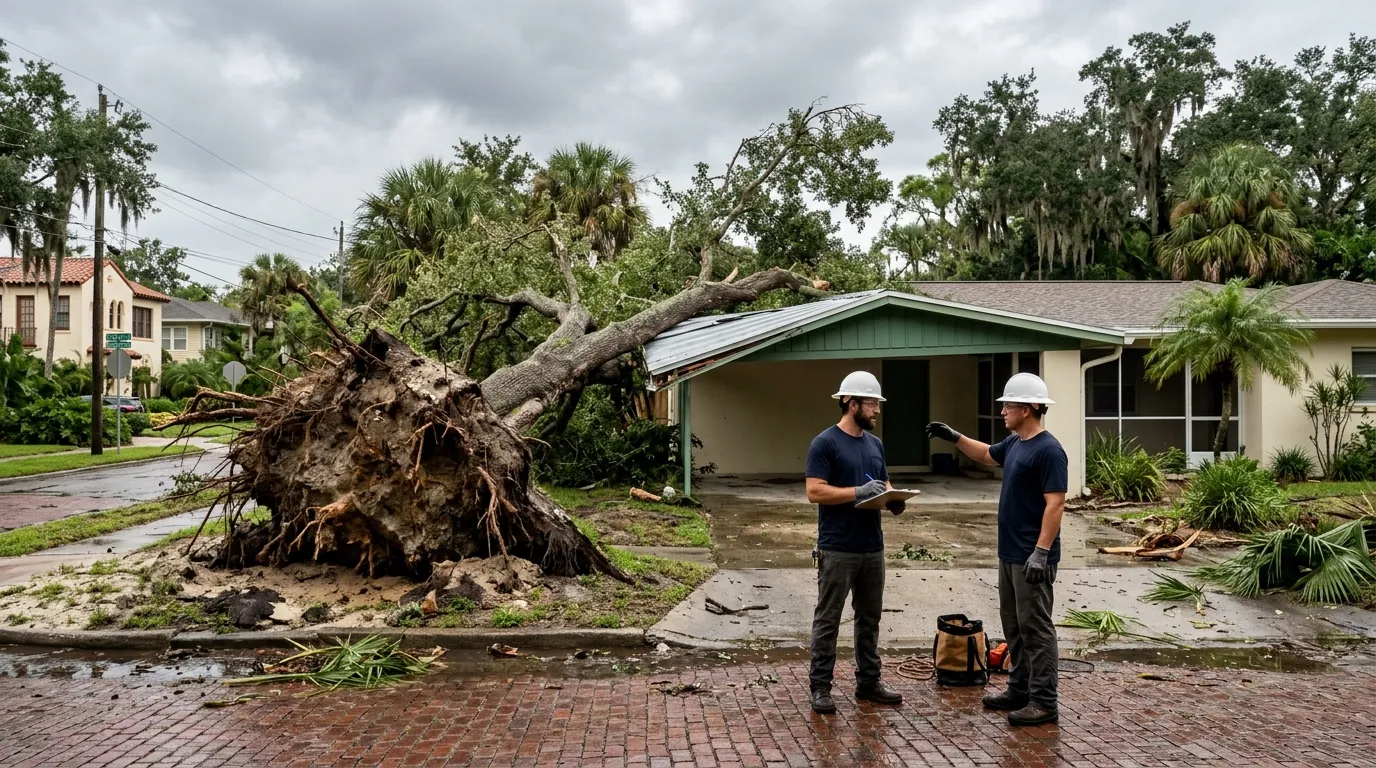
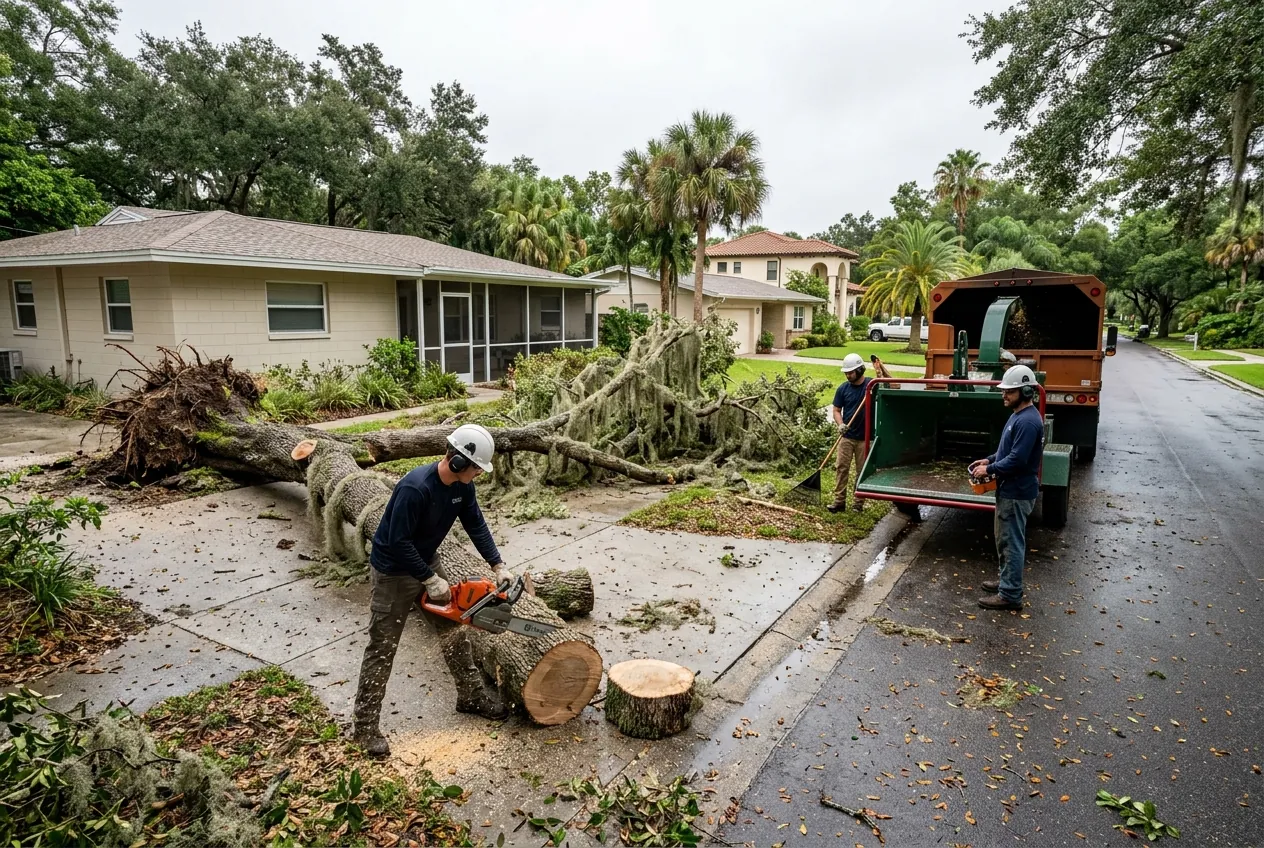
On site, the first job is getting the property safe, not necessarily finishing. That means cutting weight off the structure in small, controlled pieces, clearing a blocked driveway or doorway, and bringing down anything still hanging. The full removal, stump and cleanup can wrap up that day or the next, depending on daylight and whether a crane is needed. You get a written price before the saws start, emergency or not.
The first week
Once the tree is off, have a roofer or contractor check the structure, and keep your photos and our itemized invoice together for the adjuster. Then walk the rest of the yard. Trees that rode out the same wind can be cracked or loosened at the roots without showing it yet. Our tree-on-the-house checklist covers the insurance steps in more detail.
St. Pete Emergency Tree Removal After Helene and Milton
2024 gave the city two very different storms two weeks apart. Helene, on September 26 and 27, was a surge event here: the St. Petersburg tide gauge reached a record 6.31 feet above mean higher high water, and at least 85 trees were reported down in the city. Milton, on October 9 and 10, was wind and rain. Albert Whitted Airport logged a 101 mph gust and 18.88 inches of rain in one day, and hundreds of trees and power lines came down across St. Pete. That Thursday evening about 141,000 Duke customers in the city were still without power, many of them because of trees on wires.
Two lessons came out of it. Strong wind on ground already soaked by days of rain pulls trees out by the roots, so a tree that starts leaning after a heavy storm needs attention fast. And trees in lines are what keep the lights off longest, which is why Duke gets the first call. When the city finished its storm debris passes in January 2025, more than 2 million cubic yards had gone out in over 37,000 loads. That curbside effort was a disaster program. On our jobs we haul everything we cut.
Salt water causes a slower kind of emergency. Trees that sat in Helene's surge often looked fine for weeks and then declined, because chloride in the soil rises as flooded ground dries out. If your yard took bay water, UF/IFAS Extension in Pinellas can test soil chlorides for a small fee, and a tree that is still bare the following spring belongs on the dead tree removal list before it fails in the next blow.
After a declared emergency the city can relax its tree permit requirements to help restore order, but that is not automatic and it does not last forever. We check what is in effect for your address at the time of the call. Bayfront areas like Jungle Prada and Madeira Beach took Helene's salt water, while inland neighborhoods such as Allendale Terrace felt Milton's wind.
How Emergency Tree Removal Calls Work
- Hours. Regular hours are Monday through Saturday, 7 a.m. to 6 p.m. We take storm and emergency calls outside those hours.
- Order of work. After a named storm, trees on occupied homes and blocked exits come ahead of yard debris.
- What can wait. Scattered limbs, a tree down across open lawn with nothing under it, or leaves and twigs. Those go on the regular schedule at regular prices, and we will say so.
- Paperwork. An itemized invoice that separates structural removal from yard cleanup, plus our job photos if your adjuster wants them.
- Hard limits. No work near energized lines, and no mangrove cutting, emergency or not.
Fewer Emergencies: Tree Checks Before Hurricane Season
The cheapest emergency removal is the one that never happens. Atlantic hurricane season runs June 1 through November 30, and July through September are also St. Pete's wettest months, so the weeks before June are the time to look hard at what is standing over the house. A planned removal is priced at the regular rate, can wait out a permit inspection, and lets the crew choose a calm, dry day.
- Walk the yard and look up. Dead limbs, cracked unions and trees leaning toward the house are the ones that fail first.
- Check trees near the service drop and the street lines. If a tree threatens Duke's primary line, Duke takes trimming requests and follows up within 10 business days.
- Look hard at older laurel and water oaks, which decay young, and at palms with conks or a drooping spear.
- Pay extra attention where limbs hang over mobile homes and lightweight roofs. In Lealman, about a quarter of homes are mobile homes, and a limb that a shingle roof would shrug off can go straight through one.
- Get anything doubtful on our hazardous tree removal list now, while permits and scheduling can run at normal speed.
Emergency Tree Removal Cost in St. Pete, FL
Emergency and after-hours work carries a premium of 25 to 50 percent over the standard price for the same tree, because a crew is pulled off scheduled work, often in poor light or bad conditions. For big storm cleanups with trees already on the ground, crew-hour pricing is sometimes fairer to you. Typical St. Pete-area ranges in 2026, offered as guides rather than quotes.
| Job | Typical range | What moves the price |
|---|---|---|
| Emergency or after-hours removal | Standard price +25%–50% | Time of day, hazard level, structure involved |
| Storm cleanup by the crew-hour | $150–$250 per crew-hour | Crew size, chipper and truck time |
| Downed limbs and trees on the ground, hauled off | $350–$1,500 per yard | Volume and how far it is carried |
| Tree 50–75 ft, before any premium | $1,600–$3,000 | Rigging off a roof versus open ground |
| Tree 75 ft+ or resting on a structure | $3,000–$5,500 | Weight on the house, access |
| Crane lift off a roof | +$700–$2,500 per job | Reach and how many pieces |
Insurance often covers more than people expect. Removing a tree that struck the house is usually part of dwelling coverage, while a yard-only tree often falls under a debris-removal limit, commonly somewhere around $500–$1,000, applied per tree or per claim depending on the policy. Your policy wording controls, so ask your insurer before you assume either way.
For trees that are failing but still standing, see hazardous tree removal. For the yard-wide mess after a storm, see storm damage cleanup, and for trees too heavy to lift off a roof by hand, crane tree removal. Our main St. Pete tree removal page covers everything else.
Tree Removal Services
Areas We Serve
Emergency Tree Removal St. Pete Questions
Straight answers before you call.
Yes, for storm and emergency calls. Regular hours are Monday through Saturday, 7 a.m. to 6 p.m. Outside those hours we take emergency calls and tell you straight whether the tree needs a crew right away or can safely wait for daylight.
Duke Energy first, every time. Report the downed line or outage and stay well away from the tree and anything touching it. Once Duke has made the line safe, we can remove the tree. We do not work near energized lines.
Often, when the tree hit an insured structure like the house. Trees that only fell in the yard usually run into a debris-removal cap, often in the $500–$1,000 range. The exact wording of your policy decides it, so photograph everything and call your insurer early.
Not when it is on a structure, near a line or under tension. Pinned limbs can spring loose when cut, and moving debris before photos can weaken an insurance claim. Small limbs on open lawn are a different matter.
An imminent hazard is one of the reasons the city approves removing a protected tree, and after a declared emergency the city can relax its tree requirements for a time. For a single-family detached house, a signed arborist finding under the state's dangerous-tree law is another route. We check what applies when you call.
After a big storm nobody can honestly promise a time. We work in order of risk, so trees on occupied homes and blocked exits come first. If your tree can safely wait, we will tell you that and put it on the schedule at the regular price.
More St. Pete Tree Removal Services
More ways we can help on the same trip.
- Tree RemovalWhole-tree takedowns, rigged and lowered over roofs, pools and lanais. From $250
- Dead Tree RemovalDead and dying trees taken down before they fall on their own. $250–$3,000
- Hazardous Tree RemovalLeaning, split or rotten trees over homes, cars and power drops. $700–$5,500
- Crane Tree RemovalBig trees on tight St. Pete lots with nowhere to lower wood. +$700–$2,500
- Oak Tree RemovalLaurel and water oaks past their prime, with the permit question answered first. $700+
- Palm Tree RemovalQueen, Washingtonia and sabal palms removed to the root ball. $200–$1,500
- Pine Tree RemovalDead, leaning and lightning-struck pines. $250+
- Stump GrindingStumps ground out under the soil line, ready for sod or a new bed. $125–$400
Tree Down? Start Here
Get people clear, call Duke for any lines, then let us make it safe.