St. Petersburg · Pinellas County, FL
Hazardous Tree Removal in St. Petersburg, FL
A tree becomes a hazard when something is wrong with it and something you care about sits where it would land. We look at both, explain whether the city's rules or Florida's dangerous-tree law applies, and take it down in a controlled order.
- Priced by
- Height, plus rigging or crane
- State exemption
- Single-family detached homes only
- Power lines
- Duke Energy first
- Included
- Cleanup and haul-off
Hazardous Tree Removal in St. Petersburg, FL: Defect Plus Target
A leaning pine on an empty lot is a curiosity. The same pine leaning over a bedroom is a hazard. Tree risk always has two halves: a defect that makes failure likely and a target it would hit. On St. Pete's small lots the target is nearly always present, whether that means a roof, a lanai screen, a parked car, a sidewalk or a neighbor's house.
Defects we look for
- Cracks and splits through the trunk or where two large stems meet, especially at a tight V-shaped union.
- A fresh lean with lifted soil on the side opposite the lean. A tree that has leaned for twenty years is a different case from one that started leaning after a storm.
- Decay showing as cavities, soft wood, fungal conks or carpenter ants at the base. Trees that are already gone belong on our dead tree removal page.
- Dead or hanging limbs over the roof, driveway or a play area.
- Root damage from trenching, pool or driveway work, or ground that stayed flooded.
- Wires in the canopy. A tree growing into overhead lines is a hazard on that alone.
St. Pete adds a pattern of its own. Laurel oaks, planted in large numbers within a single decade, are reaching the age when decay and limb failure become common, and Milton showed what heavy wind does to trees standing in soaked ground: uprooted trunks and snapped limbs across the county. A tree with one of the defects above and a target below is a candidate for removal now, not after the next storm.
Florida's Dangerous Tree Law, FS 163.045, Explained Plainly
Florida Statute 163.045 is easily the most misunderstood tree rule in the state. It does not let anyone cut any tree they like. What it does is narrower, and for the right property it is very useful.
- Property type. It covers residential property only, which the statute defines as a single-family, detached building used as a single-family home. The City of St. Petersburg says duplexes, townhomes, multifamily and commercial properties do not qualify.
- Who documents it. The owner must hold a written finding of unacceptable risk, signed by a professional of one of two kinds: either ISA arborist certification or a Florida landscape architecture license.
- How it is assessed. The assessment has to follow the ISA's Best Management Practices for Tree Risk Assessment (second edition, 2017), be done on site and be signed, and it has to conclude that nothing short of removal can practically get the risk under moderate.
- What it changes. With that documentation, the city or county can't demand a permit, a fee, an application, a notice, an approval or mitigation, and it cannot require a replacement tree.
- What it skips. It does not reach mangroves covered by delegated mangrove protection.
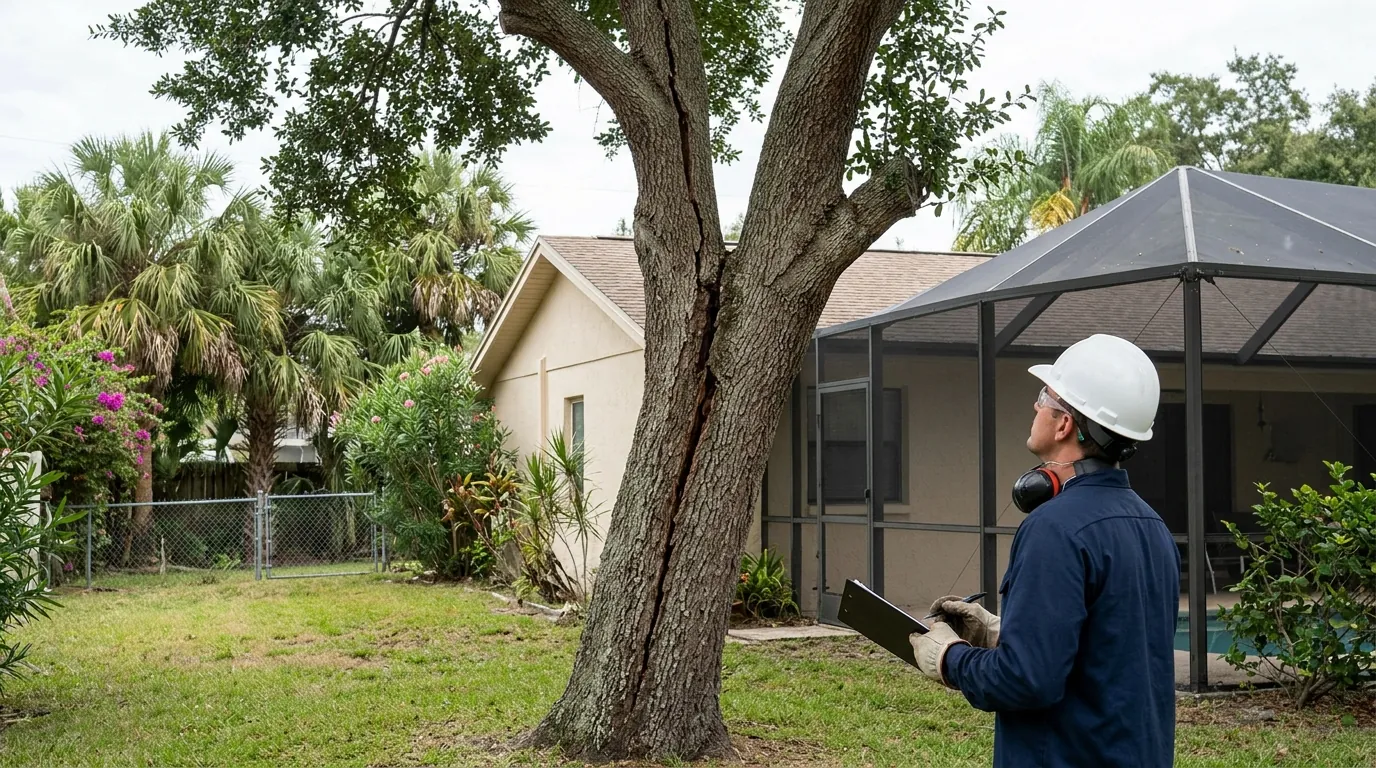
In St. Pete, the city wants that paperwork sent by email to [email protected], and it will not apply its own definition of a hazardous tree to the exemption. The letter is the arborist's professional call, not the tree crew's. What we can do is help you arrange that assessment and plan the removal around it. HOA covenants are a separate matter, since the statute limits local governments rather than private associations, so check yours.
St. Pete Hazardous Tree Removal Under City Rules
Duplex owners, townhome associations, landlords with multi-unit buildings and businesses go through the city process instead. The code lets the city approve removal of a protected tree that is an imminent hazard or is diseased and declining. The $25 inspection fee comes first, and staff aim to visit within about two weeks.
Grand trees, meaning protected trees 30 inches DBH and up other than laurel oaks, face a stricter list. Removal for a safety hazard to an existing structure needs a licensed engineer's report, and removal because the tree is declining with no reasonable chance of recovery needs a certified arborist's report. A denial can be appealed to the city's Development Review Commission.
Outside city limits, the local rule decides. In unincorporated Pinellas since January 2026, homesteaded single-family lots protect only trees over 24 inches DBH, and dead, dying or invasive trees need no mitigation. Within the City of Seminole, protection for live and laurel oaks starts at 4 inches DBH, and removing one takes a certified arborist's report. Our Seminole page covers which side of the city line an address falls on, and Kenneth City has a town permit of its own.
Hazardous Trees Over Sidewalks, Streets and Neighbors
St. Pete puts trees in the abutting right-of-way on the property owner as well. Owners are expected to keep 8 feet of clearance over sidewalks and 14 feet over streets and alleys, and to remove or fix dead and diseased trees positioned to come down on public ways or a neighbor's lot. If you are unsure whether a street tree is yours to handle, the city takes reports through SeeClickFix.
When the hazard tree is the neighbor's, Florida law generally lets you trim branches that cross onto your side paying for it yourself and stopping at the property line. Inside the city that trimming still has to respect the one-quarter-canopy limit and the permit rule for 8-inch limbs on Grand trees. Whether an owner is responsible after a tree falls often turns on whether it was dead or visibly failing and whether they had notice, so written notice helps. Our neighbor's tree liability post goes deeper. This is general information, not legal advice; talk to your insurer or a Florida attorney about a specific case.
Power Lines Come First on a Hazard Tree
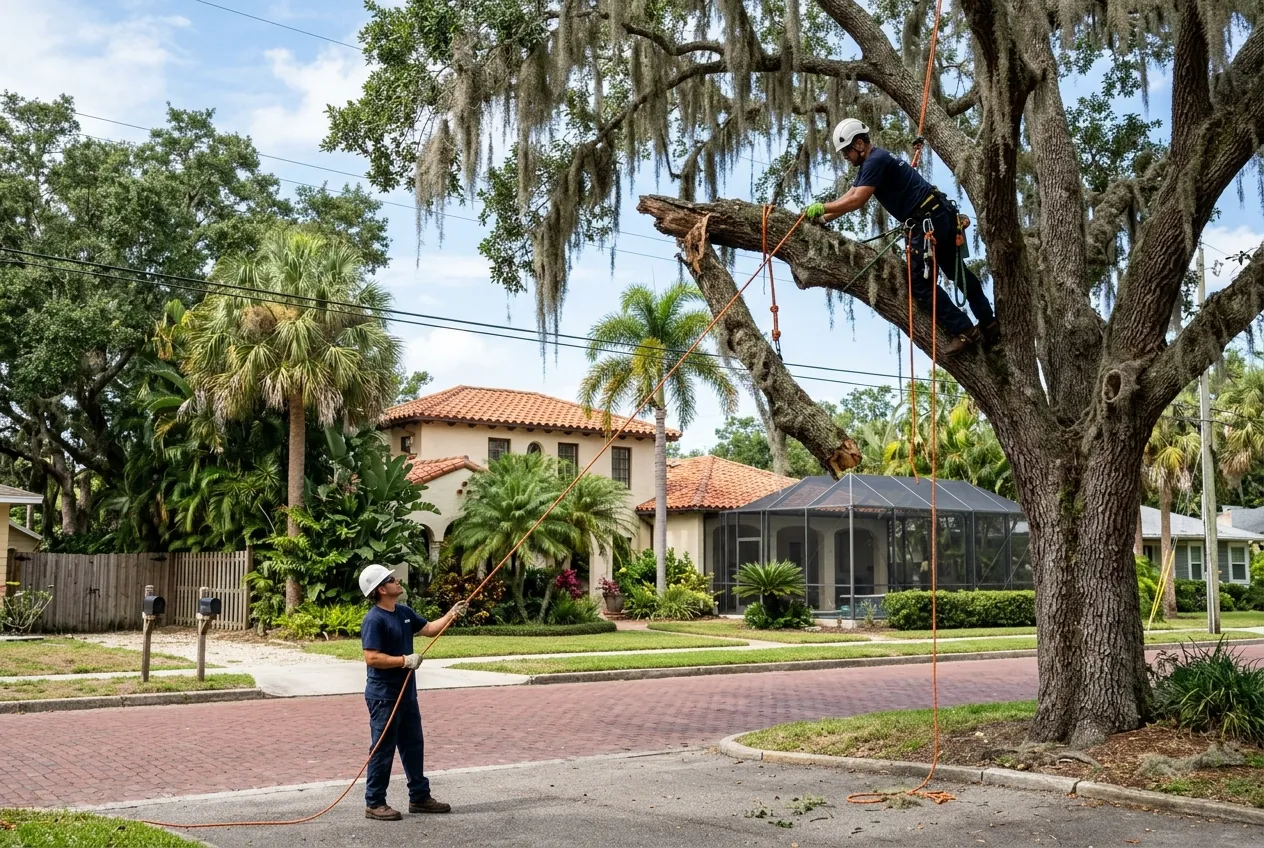
If the hazard is a tree leaning into or growing through power lines, call Duke Energy before you call us. Duke trims around its primary lines and follows up within 10 business days on a request about a tree threatening one. For the service drop, the single overhead wire feeding your home, Duke will shut it off free of charge so a contractor can work near it safely. We do not cut near energized lines.
Sometimes the answer is to keep the tree
Not every scary-looking tree needs to come out. Live oaks have strong wood and fail far less often in hurricanes than laurel or water oaks, and sabal palms rank at the top of the Pinellas Extension list for both salt tolerance and wind resistance. A sound live oak with one broken limb usually needs that limb removed, not the whole tree. If the defect can be fixed by taking off a branch, we will say so, and inside the city any cut on a Grand tree still follows the permit rule for 8-inch limbs and the ANSI A300 pruning standard.
Hazardous Tree Removal Cost in St. Pete, FL
A hazard tree is priced by its height, then adjusted for the extra rigging or crane time it takes to lower it without touching what is underneath. The table shows typical St. Pete-area ranges as of 2026; treat them as guides, not quotes. Cleanup and haul-off are always included, and permit costs are itemized.
| Job | Typical range | What moves the price |
|---|---|---|
| Hazard tree under 25 ft | $250–$700 | Split or lean direction, what sits below |
| Hazard tree 25–50 ft | $700–$1,600 | Rigging each limb versus felling |
| Hazard at 50–75 ft | $1,600–$3,000 | Decay that rules out climbing |
| Hazard over a structure, or above 75 ft | $3,000–$5,500 | Roof, pool cage or neighbor's house in the drop zone |
| Crane over a roof | +$700–$2,500 per job | Lift count, reach over the house |
| Emergency or after-hours response | +25%–50% | Only when the tree truly cannot wait |
| City permit inspection | $25 pass-through | City sets the permit fee once approved |
If the tree has already failed or is moving, go straight to emergency tree removal. If it is a big tree over a roof, the crane tree removal page shows how those jobs run. For trees weakened in 2024, our Helene and Milton tree guide sorts what to remove now from what to watch. Everything else starts with a free estimate: see how it fits our tree removal in St. Pete, or request a visit.
Tree Removal Services
Areas We Serve
Hazardous Tree Removal St. Petersburg Questions
Straight answers before you call.
There are two paths. For a single-family detached home, a qualified professional can document the risk as unacceptable under Florida Statute 163.045. Otherwise the city can approve a removal when a protected tree is an imminent hazard, and Grand trees need a licensed engineer's report for a structural hazard.
No. The statute covers a single-family, detached building used as a single-family home, and the City of St. Petersburg says duplexes, townhomes, multifamily and commercial properties do not qualify. Those properties go through the city's permit process, where an imminent hazard is one of the listed reasons for approval.
No. State law limits who can sign it to ISA-certified arborists and Florida-licensed landscape architects, and the finding has to follow a visit to the tree. We can help you arrange that assessment and then schedule the removal around it.
Not when the removal is done under Florida Statute 163.045 with proper documentation. The statute bars local governments from requiring replanting, mitigation, permits or fees in that case. Removals under the city's regular permit process can carry replacement rules.
Florida law generally lets you trim branches over your property at your own expense, up to the property line, within the city's pruning limits. Put your concern in writing to the neighbor, since notice can matter later, and talk to your insurer. This is general information, not legal advice.
No. Many trees grow with a lean and stay stable for decades. A lean that appears suddenly, particularly if the ground on the far side has cracked or bulged, is a different story and should be looked at right away.
More St. Pete Tree Removal Services
More ways we can help on the same trip.
- Tree RemovalWhole-tree takedowns, rigged and lowered over roofs, pools and lanais. From $250
- Dead Tree RemovalDead and dying trees taken down before they fall on their own. $250–$3,000
- Emergency Tree RemovalTrees on roofs, cars, fences and lanais after storms, with fast storm response. Storm calls
- Crane Tree RemovalBig trees on tight St. Pete lots with nowhere to lower wood. +$700–$2,500
- Oak Tree RemovalLaurel and water oaks past their prime, with the permit question answered first. $700+
- Palm Tree RemovalQueen, Washingtonia and sabal palms removed to the root ball. $200–$1,500
- Pine Tree RemovalDead, leaning and lightning-struck pines. $250+
- Stump GrindingStumps ground out under the soil line, ready for sod or a new bed. $125–$400
Have a Risky Tree Looked At
Find out where it would fall and what it would take to bring it down safely.