St. Petersburg · Pinellas County, FL
Pine Tree Removal in St. Petersburg, FL
A tall pine can go from green to dead in a few weeks once beetles or lightning get to it. We sort out what kind of pine you have, whether the city protects it, and how to bring it down without its height becoming your roof's problem.
- Typical range
- $700–$3,000 for most yard pines
- Slash pine
- Protected in St. Pete at 4 in+
- Norfolk Island pine
- Unprotected, no city permit
- Australian pine
- Prohibited invasive in St. Pete
Pine Tree Removal in St. Petersburg, FL: Is It Really a Pine?
Three very different trees get called "pine" around St. Pete, and only one of them is a true pine. The difference decides whether the city cares about the removal, how the tree is likely to fail and how much work the takedown takes. Sorting that out is the first step of any St. Pete tree removal estimate we write for a pine.
- Slash pine. Florida's native flatwoods pine and a true pine. UF/IFAS lists mature height at 75 to 100 feet with a 35 to 50 foot spread and notes it is susceptible to breakage. Pines appear on St. Pete's protected shade-tree list, so a slash pine measuring 4 inches or more across at chest height (4½ feet) needs a city permit to remove.
- Norfolk Island pine. The tall, tiered, symmetrical tree planted in many mid-century yards. It is not a true pine, and it sits on the city's unprotected list, so no city permit is needed inside St. Pete limits.
- Australian pine (Casuarina). Wispy, needle-like foliage, but UF/IFAS says it is unrelated to true pines. It is a Florida Invasive Species Council Category I species and on St. Pete's prohibited list, which means it is illegal to plant or sell and needs no permit to remove. UF/IFAS also notes it has little wind resistance and tends to topple because of its shallow roots.
If you are not sure which one is in your yard, a photo of the bark, foliage and whole tree is usually enough for us to tell before the site visit.
St. Pete Pine Removal Warning Signs
Pines tend to give less warning than oaks. Once one starts to go, the needles can fade quickly, and a dead pine sheds brittle limbs and eventually snaps. These are the signs that usually lead to a call.
Bark beetles
UF/IFAS lists three Ips engraver beetle species found wherever pines grow in Florida. They go after pines that are already stressed by drought, root injury, construction damage or lightning. The clue is small globs of resin mixed with boring dust, called pitch tubes, usually on the flat bark plates. On a pine that has already died, the beetles leave boring dust with no resin flow at all.
UF/IFAS also notes that these beetles do not usually spread on to healthy neighboring pines outside of an epidemic, so one attacked tree does not automatically mean the whole yard. Removal makes more sense when the struck pine stands among other mature pines or leans toward something you care about.
Lightning
A tall pine is often the highest point on the block. UF/IFAS counts lightning among the stresses that open a pine to engraver beetles, so even a struck pine that keeps its color for a while can be attacked later. We treat a fresh lightning scar as a reason to watch the crown closely over the next few months.
Storm damage
A snapped top, a crack in the trunk or a root plate heaving up on one side after high wind. A pine in that condition belongs under hazardous tree removal, and a pine that has already browned out completely is handled as dead tree removal.
Pine Tree Removal and the Height Problem
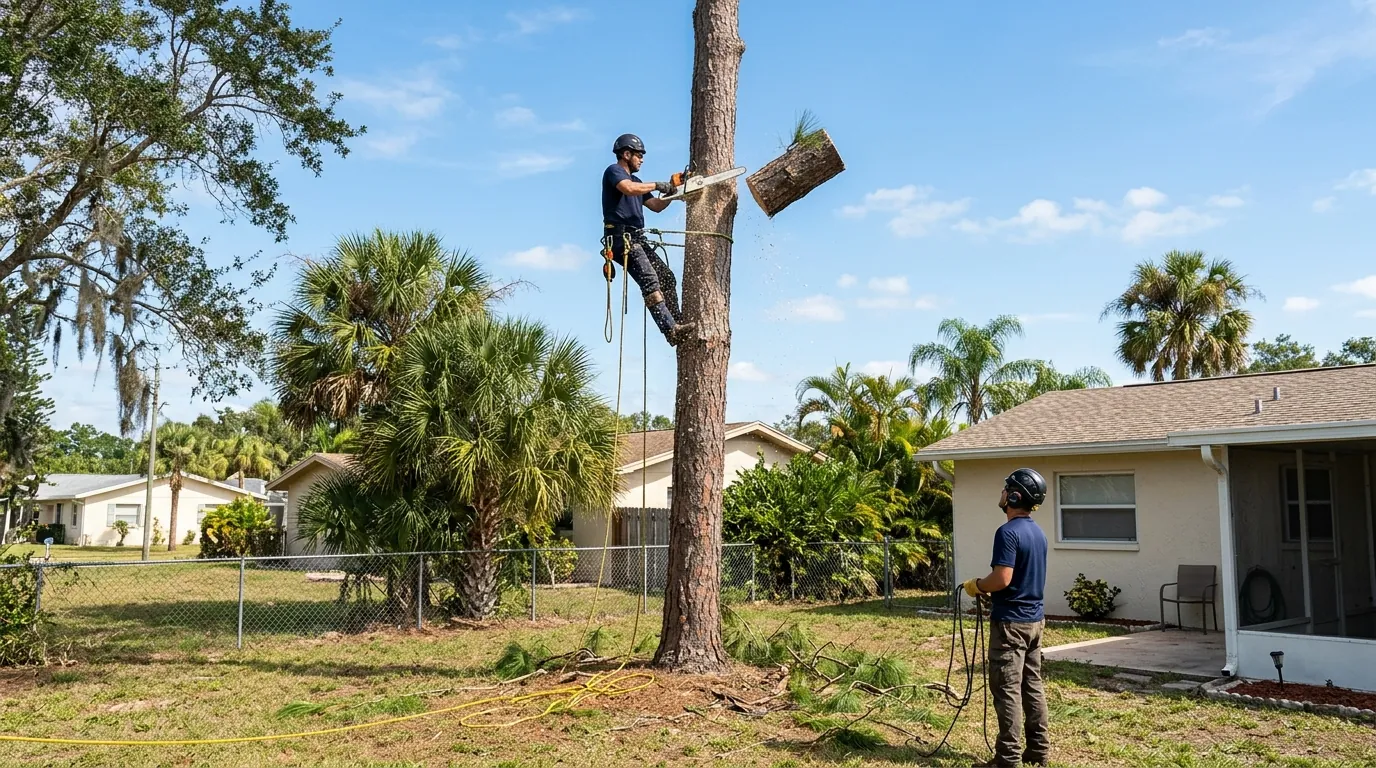
Pines are tall and narrow, which sounds easy until you measure the drop zone. A slash pine near the top of its range is longer than most St. Pete lots are deep, so felling it whole is rarely an option in town. On most residential jobs a climber works down from the top, cutting the trunk into short lengths that are either roped down or let fall onto a cleared patch of ground.
- Open backyard: the top sections are lowered and the lower trunk is dropped in pieces onto the lawn.
- Over a roof or pool cage: every section is roped and lowered, which takes longer and costs more.
- Dead or beetle-killed pine: brittle wood is not safe to climb, so a lift or a crane may be the safer way in.
- Near wires: ask Duke Energy to kill power on the overhead feed to the house first; Duke does that without charge. Pines touching primary lines are Duke's call, not ours.
Pine jobs also leave more small debris than most. Needles slip into gutters, screen-cage tracks and pool skimmers, and resin from fresh cuts sticks to pavers and car paint. Raking and blowing those areas is part of the cleanup, and if a pool sits close by, putting the cover on before the crew arrives saves skimming later.
When a pine cannot be climbed or reached safely, we bring in crane tree removal for that one job.

Pine Tree Removal Permits in St. Pete, Seminole and the County
The same pine can need a permit on one street and not the next. Here is how the nearby rules line up.
- City of St. Petersburg: pines are protected shade trees from 4 inches. Removal needs a $25 initial inspection, then a permit fee set by the city, and the posted permit is good for six months. Norfolk Island pines and Australian pines need no permit.
- City of Seminole: pine is listed among protected trees at 20 inches and up, with a permit through Community Development.
- Unincorporated Pinellas: under the code effective January 23, 2026, a homestead single-family house the owner lives in only has to worry about trees thicker than 24 inches. Other properties use the 4 inch threshold.
- Kenneth City: its own town permit, and tree contractors must have their occupational license registered at Town Hall before working there.
- Detached single-family houses: state law (F.S. 163.045) overrides the local permit when the owner holds a signed risk finding from a qualified assessor, which means an arborist with ISA certification or a Florida-licensed landscape architect.
That spread of rules is why addresses in Seminole and Kenneth City get their jurisdiction checked before we quote.
Pine Tree Removal Prices in St. Petersburg
Height is the biggest factor for pines, followed by what is under them and whether the wood is still sound enough to climb. Use these typical St. Pete-area figures for 2026 as a starting point, not a quote.
| Job | Typical range | What moves the price |
|---|---|---|
| Pine under 25 ft (young slash, small Norfolk Island) | $250–$700 | Access through the side gate, open drop area |
| Pine 25–50 ft | $700–$1,600 | Lean direction, fences and sheds in the way |
| Pine 50–75 ft | $1,600–$3,000 | Number of sections lowered on rope |
| Pine over 75 ft, or leaning over a roof | $3,000–$5,500 | Dead, brittle wood; rigging over the roof |
| Crane-assisted pine removal | +$700–$2,500 | Unclimbable dead pines, no lift access |
| Stump grinding, first stump | $125–$400 | Stump diameter, roots near slabs |
| Each additional stump, same visit | $60–$150 | Clusters of Australian pine stumps |
Every price includes cleanup and haul-off of the wood and needles. Stumps are a separate line unless stated, and permits are itemized. More worked examples sit in our 2026 St. Pete price guide.
Pine Removal in Gated and Wooded Neighborhoods
Some of the tallest pines we see stand in planned communities with their own approval steps. Placido Bayou even has a street named Slash Pine Lane, and like many gated neighborhoods it can require architectural approval on top of the city permit, plus gate access arranged ahead of the crew. Its bayou has been a protected mangrove preserve since 1983, so any work near the water stays on the upland side. After a storm season, pines that dropped limbs or browned are worth a look; the write-up on what to cut and what to wait on after Helene and Milton sorts the urgent from the patient.
Tree Removal Services
Areas We Serve
Pine Tree Removal St. Pete Questions
Straight answers before you call.
For a slash pine or other true pine 4 inches or more in diameter inside City of St. Petersburg limits, yes, because pines are protected shade trees. Norfolk Island pines are on the unprotected list and Australian pines are prohibited, so neither needs a city permit. Seminole, Kenneth City and unincorporated county addresses each have different thresholds.
No. UF/IFAS says Casuarina is unrelated to true pines despite its needle-like foliage. Florida's invasive species council puts it in Category I, and St. Pete prohibits it. Its shallow roots make it prone to toppling in high wind, which is one more reason owners take them out.
Small globs of resin mixed with sawdust-like boring dust, often on the flat plates of the bark. They mark spots where beetles bored in. A pine that is already dead may show boring dust with no resin. Beetles usually target pines already stressed by drought, root damage or lightning.
UF/IFAS says that outside an epidemic, these beetles generally do not move on to healthy neighboring pines. Removal makes more sense when the attacked pine stands among other mature pines or threatens a structure. We look at the whole group before recommending anything.
Sometimes it keeps going for a while, but a strike stresses the tree and can draw bark beetles afterward. Watch the needles over the following months, and call if the crown starts to fade or turn red.
Most St. Pete lots are not long enough. A mature slash pine can stand 75 feet or taller, so dropping it whole would reach a house, fence or street. Taking it down in sections from the top keeps every piece inside a safe landing area.
More St. Pete Tree Removal Services
More ways we can help on the same trip.
- Tree RemovalWhole-tree takedowns, rigged and lowered over roofs, pools and lanais. From $250
- Dead Tree RemovalDead and dying trees taken down before they fall on their own. $250–$3,000
- Hazardous Tree RemovalLeaning, split or rotten trees over homes, cars and power drops. $700–$5,500
- Emergency Tree RemovalTrees on roofs, cars, fences and lanais after storms, with fast storm response. Storm calls
- Crane Tree RemovalBig trees on tight St. Pete lots with nowhere to lower wood. +$700–$2,500
- Oak Tree RemovalLaurel and water oaks past their prime, with the permit question answered first. $700+
- Palm Tree RemovalQueen, Washingtonia and sabal palms removed to the root ball. $200–$1,500
- Stump GrindingStumps ground out under the soil line, ready for sod or a new bed. $125–$400
Get a Price on Your Pine
Browning, beetled or lightning-struck? We’ll measure.