St. Petersburg · Pinellas County, FL
Palm Tree Removal in St. Petersburg, FL
Queen palms rotting at the base, sabals bronzing from the bottom up, Washingtonias towering over the roofline. We take palms down cleanly, deal with diseased stumps the way UF/IFAS recommends, and tell you up front if a permit applies.
- Typical range
- $200–$1,500 per palm
- Priced by
- Height of clear trunk
- Sabal permit
- 4 ft+ clear trunk, City of St. Pete
- Diseases
- Ganoderma, lethal bronzing
Palm Tree Removal in St. Petersburg, FL: Three Palms, Three Different Jobs
Most palm calls in St. Pete involve one of three palms, and each brings its own reason for coming down. One is an invasive that rots from the base, one is a skyscraper that outgrew the house decades ago, and one is the native Florida palm that the city actually protects. Knowing which you have tells us how the job will go, whether paperwork is involved and what the stump needs afterward. It is the same first step as any other St. Pete tree removal estimate: identify, measure, check the address.
Queen palm
Feathery, fast and everywhere in older landscaping. The Florida Invasive Species Council lists queen palm as a Category II invasive on its March 2026 list, and it is one of the palms Ganoderma butt rot shows up in most often locally. Because it is not native, removing one inside St. Pete limits does not trigger the city's palm permit, though we still confirm on site.
Washington fan palm
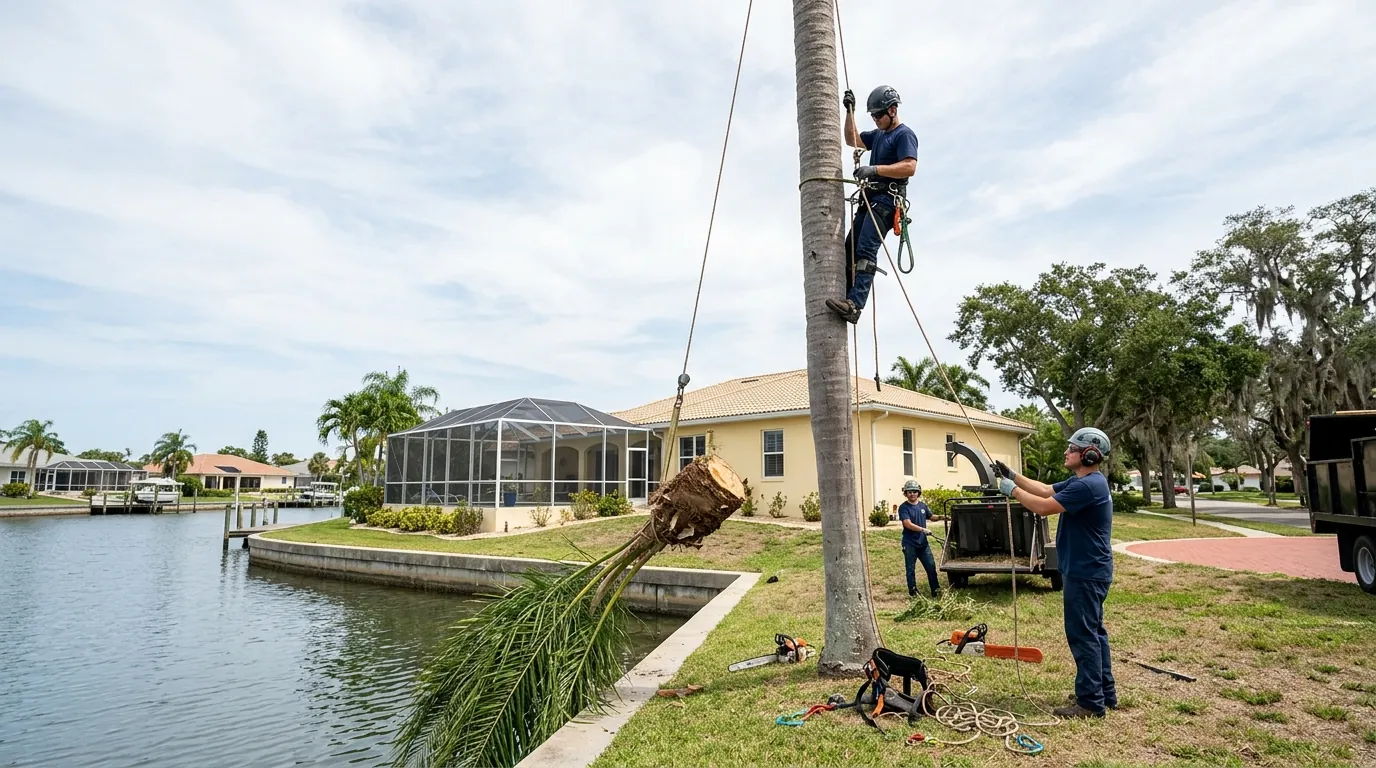
The skinny palm whose head sits far above the roof. Washingtonia robusta is also a FISC Category II invasive. Its height is what drives the price, since a crew has to climb it or reach it and then lower the head and the trunk in pieces without touching the house, wires or pool cage.
Sabal (cabbage) palm
Florida's native palm. UF/IFAS Pinellas Extension ranks it at the top for both salt tolerance and hurricane wind resistance, which is why so many survive storms that flatten everything around them. It is also the palm the city code treats as native, and the one lethal bronzing has been killing in Florida since 2008.
St. Pete Palm Removal for Ganoderma Butt Rot
Ganoderma is a fungus that decays the lower few feet of a palm trunk from the inside. UF/IFAS is blunt about it: the disease is fatal, there is no cure, and no spray or care routine stops it. The tell-tale sign is a conk, a hard shelf-shaped fungus growing on the trunk near the soil. The trouble is that a palm can die with no conk in sight, and the only other confirmation is discolored tissue seen once the trunk is cut.
That guidance shapes how we work. Conks get bagged before the trunk comes down, the base and root ball are ground out rather than left to break down, and debris leaves the property instead of being chipped across your beds. If something other than a palm will go in that spot, our stump grinding page covers how the hole gets backfilled.
Palm Tree Removal for Lethal Bronzing in Pinellas County
The cause of lethal bronzing is a phytoplasma, a tiny bacteria-like pathogen that sap-feeding planthoppers carry from palm to palm. It does not spread on pruning tools. UF/IFAS lists Pinellas among the 36 Florida counties where it has been found, and cabbage palms have been confirmed hosts since 2008.
- First sign: bronzing starts on the bottom, oldest fronds, the opposite of normal aging.
- Next: the spear leaf in the center collapses, which means the bud is dead.
- Timeline: UF/IFAS says most infected palms are dead two to three months after symptoms first show.
- Confirmation: samples sent to UF's Plant Disease Diagnostic Center for testing.
There is no cure. A confirmed palm should come out right away so it stops feeding the insects that carry the disease. Neighboring healthy palms can get preventive oxytetracycline treatments every three to four months for two years or more, which is a job for a licensed applicator rather than a removal crew. One catch for St. Pete homeowners: a sabal with at least 4 feet of bare trunk still needs a city permit or a Florida Statute 163.045 risk letter, even when it is dying.
Palm Tree Removal Permits Around St. Pete
Palm rules depend on the species and on which government covers the address.

- City of St. Petersburg: removing a native palm carrying 4 or more feet of clear trunk needs a permit, with the clear trunk measured from the ground to the lowest green frond's base. Queen and Washingtonia palms are not native and do not trigger that rule.
- Unincorporated Pinellas (Tierra Verde, Lealman and many Seminole mailing addresses): the county code effective January 23, 2026 covers palms over 6 feet tall, with a carve-out for homesteaded single-family lots, where protection starts above 24 inches. We confirm how that applies to a specific palm before quoting.
- Madeira Beach: a no-fee city permit is required for any tree 4 inches or larger in diameter.
- Single-family detached homes anywhere: Florida Statute 163.045 sets aside the local permit, fee and replanting rules if a credentialed arborist or licensed landscape architect has signed an on-site finding of unacceptable risk.
Waterfront palm jobs bring their own limits. Mangroves along a seawall are protected by separate rules, and we never treat trimming or removing them as routine work. For the full rundown on disease, permits and prices, read our palm disease and cost guide.
Palm Tree Removal Cost in St. Pete, FL
Palms are priced by the height of clear trunk, because that is what decides whether we climb, reach or rig. Disease changes the cleanup more than the cutting. The bands below are typical 2026 ranges around St. Pete, a guide rather than a quote.
| Job | Typical range | What moves the price |
|---|---|---|
| Short palm, trunk below 20 ft | $200–$450 | Frond load, a cluster versus a single trunk |
| Palm, 20–40 ft of trunk | $400–$900 | Clearance from the roof, wires and pool cage |
| Palm, over 40 ft (tall Washingtonia and similar) | $800–$1,500 | Climbing or reach, lowering the head in one piece |
| Stump grinding, first stump | $125–$400 | Root ball size, extra digging for Ganoderma |
| Each additional stump, same visit | $60–$150 | Distance between stumps, access for the grinder |
| Crane-assisted removal | +$700–$2,500 | Palms leaning over a house with no climbing room |
Haul-off and raking are included. Grinding is quoted separately unless the price says otherwise, and any permit is its own itemized line.
Tall Palm Removal Next to Canals, Pools and Lanais
Many of the palms we see stand inches from a seawall, a pool deck or an aluminum screen cage. On those lots the head is roped and lowered rather than dropped, and the trunk comes down in short rounds that can be carried out by hand. A palm that leans hard over a roof after a storm falls under hazardous tree removal rather than a routine visit.
Salt is the other recurring theme. Helene pushed bay and Gulf water across canal neighborhoods and barrier islands in 2024, and some palms are still browning. Pinellas Extension advice written after earlier hurricanes notes that palms can need half a year or more before fresh fronds appear and a year or two to fill out again, so a brown palm with a firm green spear is often worth waiting on. A collapsed spear is a different story. We see this most on lots in Madeira Beach, Tierra Verde and Riviera Bay, and palms knocked down by wind get handled through storm damage cleanup.
Tree Removal Services
Areas We Serve
Palm Tree Removal St. Pete FAQ
Straight answers before you call.
Within city limits, a native sabal (cabbage) palm needs a permit once its clear trunk reaches 4 feet. Queen palms and Washingtonias sit outside that rule because they are not native. Unincorporated county addresses, Madeira Beach and other towns have their own rules, so we check your address before quoting.
Look for a hard, shelf-like conk on the trunk near the ground. Wilting or browning fronds can come first, and many palms die before a conk appears. UF/IFAS says the only other confirmation is internal discoloration seen when the trunk is cut. Since nothing cures it, a palm showing a conk is a removal, stump and roots included.
Not if Ganoderma killed it. UF/IFAS advises against replanting a palm in that spot, since the fungus can remain in the soil. A shade tree, shrub or bed is a safer choice. For lethal bronzing, the concern is the insects carrying it, so ask about protecting nearby palms before replanting.
No. It moves from palm to palm through planthoppers that feed on palm sap, not on saws or pruners. That is why a confirmed palm should come out quickly: it stops being a source for the insects. Nearby healthy palms can be protected with antibiotic injections every three to four months.
Height decides how we reach the head and how carefully each piece has to come down. A short palm in an open yard can be cut and lowered from the ground. A 50 foot Washingtonia beside a roof and power line needs climbing, rigging and more crew time, which is why palms over 40 feet sit in their own price band.
Not always. UF/IFAS Pinellas material notes that a burned palm may sit for half a year or longer before new fronds emerge. If the center spear is still green and firm, waiting is often reasonable. If the spear pulls out or has collapsed, the bud is dead and the palm will not recover.
More St. Pete Tree Removal Services
More ways we can help on the same trip.
- Tree RemovalWhole-tree takedowns, rigged and lowered over roofs, pools and lanais. From $250
- Dead Tree RemovalDead and dying trees taken down before they fall on their own. $250–$3,000
- Hazardous Tree RemovalLeaning, split or rotten trees over homes, cars and power drops. $700–$5,500
- Emergency Tree RemovalTrees on roofs, cars, fences and lanais after storms, with fast storm response. Storm calls
- Crane Tree RemovalBig trees on tight St. Pete lots with nowhere to lower wood. +$700–$2,500
- Oak Tree RemovalLaurel and water oaks past their prime, with the permit question answered first. $700+
- Pine Tree RemovalDead, leaning and lightning-struck pines. $250+
- Stump GrindingStumps ground out under the soil line, ready for sod or a new bed. $125–$400
Get a Price on Your Palm
Rotting, bronzing or just too tall? Let’s look.