St. Petersburg neighborhood · 33703
Tree Removal in Placido Bayou, St. Petersburg, FL
Placido Bayou is a gated community in northeast St. Pete whose streets are named for the trees that grow in it, wrapped around a bayou the city has kept as a mangrove preserve since 1983. Tree work here answers to the HOA, the city and the preserve.
- ZIP
- 33703
- Jurisdiction
- City of St. Petersburg
- Community
- Gated, with a homeowners association
- Off-limits
- The bayou's mangrove preserve
Local snapshot Placido Bayou
- Residents
- About 1,330 (Walk Score)
- Homes built
- 1984 to 2006, median 1991 (Florida DOR roll, via a local realtor)
- Residential parcels
- 559, about 81% homesteaded (same source)
- Mangrove preserve
- Designated by the city in 1983
- 2019 permit requests
- 7 owners applied to trim mangroves and build docks
- Lots residents said could follow
- 42 more
- Puryear Park expansion
- Flood-damaged home bought for $225,000, April 2025
- Citywide canopy
- About 27% in 2025, down from 29% in 2024
Landmarks & streets Around the area
- Placido Bayou mangrove preserveProtected by the city since 1983 as a condition of approving the homes; the mangroves stay in their natural state.
- Guarded entrance off 47th Ave NEReached from 1st St NE; every crew, truck and crane has to be expected at the gate.
- The tree-named streetsSlash Pine Ln, Live Oak Ter, Darlington Oak Dr, Queen Palm Ter, Royal Palm Cir and Red Cedar Ct, among others.
- Waterway EstatesThe neighboring subdivision across the bayou, whose residents joined the 2019 push to keep the preserve natural.
- Puryear ParkCity park abutting Placido Bayou and Edgemoor, with a mile-long looping trail through heavy woods and a sports complex.
- Edgemoor ParkJust north of Puryear Park; the 2025 home purchase was meant to ease parking pressure on it.
Placido Bayou Tree Removal Has Three Gatekeepers
Most St. Pete neighborhoods have one set of tree rules. Placido Bayou has three, and they stack. The homeowners association decides what can change on a lot and who drives through the gate. The City of St. Petersburg decides which trees need a removal permit. And the bayou itself is a preserve the city set aside in 1983, where the mangroves are left alone. Taking them in the right order keeps a simple job from stalling.
- The HOA. Deed-restricted communities commonly ask for architectural approval before a tree comes out. We can't speak for any association's rules, so read your covenants or call the management office first, and ask whether a replacement tree is expected.
- The city. Placido Bayou is inside city limits, so St. Pete's tree code applies here the same as downtown. We note species and trunk diameter during the estimate and tell you whether a permit looks likely.
- The preserve. The bayou's mangroves are protected, and mangrove work isn't a service we offer. When a tree stands near the preserve line, we price only the upland tree.
- The gate. Crews, trucks and any crane need to be expected. We confirm the day with you so the guard has our names.
Placido Bayou Trees, Street by Street
The developers named the streets after trees, and the names are a decent guide to what grows behind the houses.
- Slash Pine Lane and the pines. St. Pete lists pines among its protected shade trees from 4 inches in diameter, so a mature slash pine beside a pool cage usually raises a permit question. Our pine tree removal page shows how tall pines come down in sections.
- Live Oak Terrace and Darlington Oak Drive. Live oaks shrug off wind and salt better than most, and they're the oaks most likely to grow past 30 inches into Grand-tree territory, where removal gets harder to justify. Oaks of every kind are protected from 4 inches.
- Queen Palm Terrace. The Florida Invasive Species Council's newest list (March 2026) ranks the queen palm as a Category II invasive, and UF/IFAS counts it among the palms Ganoderma butt rot kills most often around here. There's no cure.
- Royal Palm Circle. Tall palms are priced mostly by height. St. Pete only requires a palm permit for natives, which in practice means a sabal showing at least 4 feet of bare trunk; royals and queens are imports and don't trigger it.
- Red Cedar Court. Cedars count as understory trees in the city code, protected from 8 inches in diameter.
Homes here went up between 1984 and 2006, so most yard trees are far younger than the century-old canopy of Old Northeast. The problems differ too: palms crowding screen enclosures, pines dropping limbs on pool cages, and oaks planted close to the house when the lot was new that now press on the roof.
Pool cages, screen enclosures and a sick palm
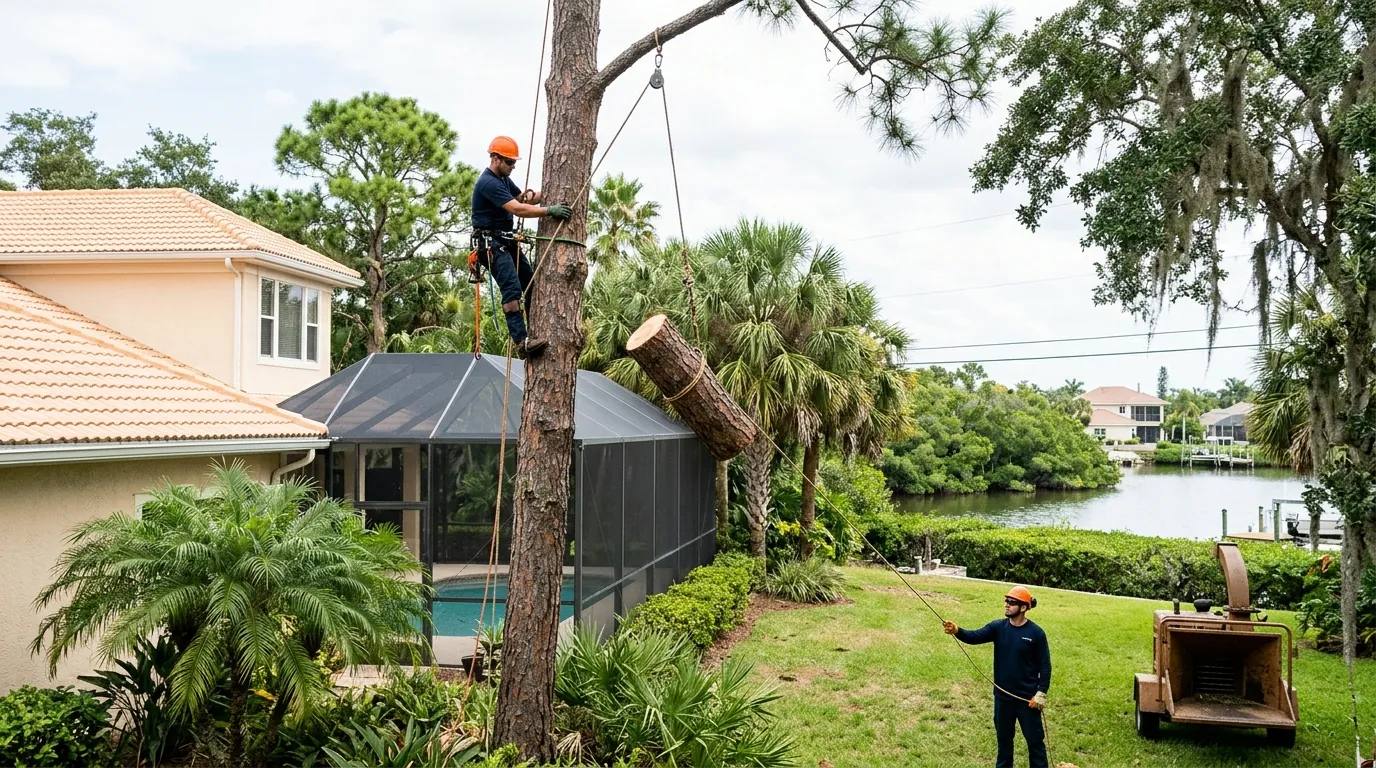
A screen enclosure is the most fragile thing on most Placido Bayou lots. Aluminum framing bends under a dropped limb, so nothing is free-felled over a cage. We rope limbs off from above, swing them clear and land them on the lawn side. When a palm near the pool shows a shelf-like conk at the base, UF/IFAS advice is specific: bag the conk before breaking it off, take out the palm, the stump and as much of the root ball as possible, don't plant another palm in the same spot, and check nearby palms monthly, since the spores travel on the wind.
Placido Bayou Storm Exposure After Helene and Milton
We haven't found reporting on storm damage inside Placido Bayou itself, so we won't guess at it. Next door the record is clearer. Helene and Milton flooded a home on 58th Ave NE beside Puryear Park, the family decided to sell, and in April 2025 the city bought it for $225,000 to grow the park. The park's playground was one of 11 across the city that stayed closed for months after Milton.
Helene's surge set the all-time mark at the St. Pete tide gauge, 6.31 feet higher than an ordinary high tide. A fortnight later Milton hit Albert Whitted Airport with gusts to 101 mph and a one-day rain total of 18.88 inches. Low ground near a bayou can see both: salt in the soil and wind on soaked roots. A tree that browned but is structurally sound deserves a growing season. A tree that's cracked, leaning harder or lifting soil on one side should be looked at. Our Helene and Milton guide sorts one from the other.
Hazardous Tree Removal in Placido Bayou and FS 163.045
Under Florida Statute 163.045, a single-family detached homeowner can take a tree down with no local permit or fee if, after visiting the site, a certified arborist (ISA) or a licensed Florida landscape architect writes up that the tree presents an unacceptable risk only removal can fix. It doesn't cover townhouses, condos or duplexes, and it never covers mangroves. The statute is written about local governments; your association's covenants are a separate question, so ask the HOA as well. That signature has to come from the credentialed professional, not from us; we can steer you toward one and handle the removal once the paperwork is in hand. The hazardous tree removal page covers the work itself.
What Tree Removal Costs in Placido Bayou
The gate doesn't change the price. Backyards that open onto water, pool cages and tight side yards do. A pine leaning over a screen enclosure has to be rigged down a piece at a time, while a queen palm standing alone out front is a much shorter job. Typical St. Pete-area ranges for 2026: palms with under 20 feet of trunk run $200 to $450, and palms 20 to 40 feet run $400 to $900. Trees between 25 and 50 feet usually land at $700–$1,600 and those from 50 to 75 feet at $1,600–$3,000; anything big hanging over the roof or the cage can climb to $3,000–$5,500.
Grinding is billed on its own, $125–$400 for the first stump with $60–$150 for every extra one done the same day, which matters when Ganoderma means a palm's stump and root ball should come out too. Cleanup and haul-off are included, and any city permit cost is itemized. These ranges aren't quotes, so set up a free estimate for your number. For the bigger picture, see St. Pete tree removal, or compare the canal lots of Riviera Bay just to the north.
Tree Removal Services
Areas We Serve
Placido Bayou Tree Removal Questions
Straight answers before you call.
Check before you schedule anything. Gated, deed-restricted communities commonly require architectural approval for tree removal and may ask for a replacement. We can't confirm any association's rules for you, so the management office or your covenants are the place to start.
No. The city designated the bayou a protected preserve in 1983, and the mangroves are meant to stay in their natural state. Mangrove work also carries its own state and county rules, and it isn't a service we offer.
Not under St. Pete's palm rule, which only reaches native palms carrying at least 4 feet of clear trunk. Queen palms aren't native. Your HOA may still want to know before it's removed.
No. Florida Statute 163.045 applies to single-family detached homes, and St. Pete says townhomes, duplexes, multi-family and commercial property don't qualify. A townhouse removal goes through the normal city process and the association.
We confirm the work day with you ahead of time so the gate has our crew and truck on its list. If a crane is needed, we tell you in the estimate so the association can plan for it.
Neighborhoods & Towns Near Placido Bayou
Close by, same crew.
Tree Removal Services in Placido Bayou
More ways we can help on the same trip.
- Tree RemovalWhole-tree takedowns, rigged and lowered over roofs, pools and lanais. From $250
- Dead Tree RemovalDead and dying trees taken down before they fall on their own. $250–$3,000
- Hazardous Tree RemovalLeaning, split or rotten trees over homes, cars and power drops. $700–$5,500
- Emergency Tree RemovalTrees on roofs, cars, fences and lanais after storms, with fast storm response. Storm calls
- Crane Tree RemovalBig trees on tight St. Pete lots with nowhere to lower wood. +$700–$2,500
- Oak Tree RemovalLaurel and water oaks past their prime, with the permit question answered first. $700+
- Palm Tree RemovalQueen, Washingtonia and sabal palms removed to the root ball. $200–$1,500
- Pine Tree RemovalDead, leaning and lightning-struck pines. $250+
Get a Placido Bayou Tree Price in Writing
Tree trouble in Placido Bayou? We’ll come look.