St. Petersburg neighborhood · 33703, 33704
Tree Removal in Allendale Terrace, St. Petersburg, FL
Allendale Terrace was carved from a citrus grove in the 1920s, and the Allen family built about 40 homes here over three decades. It's a neighborhood that has gone to bat for its big oaks, so most conversations here start with whether a tree should come down at all.
- ZIPs
- 33704 (Foster Hill Dr N), 33703
- Jurisdiction
- City of St. Petersburg
- Historic status
- Two designated local landmarks
- Main storm threat
- Wind on big, old trees
Local snapshot Allendale Terrace
- Residents
- About 683 (Walk Score)
- Walk Score
- 71
- Original grove purchase
- 160 acres, early 1920s, $186,000
- Allen-built homes
- About 40, from 1922 to 1954
- Designated local landmarks
- 2, both on Foster Hill Dr N
- Allendale United Methodist Church
- On its Haines Rd site since at least 1926
- The 2019 oak
- A live oak over 30 inches, estimated 60–80 years old
Landmarks & streets Around the area
- Cade Allen Residence ("the Castle")3601 Foster Hill Dr N; a designated local landmark built for the family that developed the neighborhood.
- Foster Grove House3650 Foster Hill Dr N; the second designated local landmark on the street, named for the grove the land came from.
- Allendale United Methodist Church3803 Haines Rd N; city records place the church on this property since at least 1926.
- Allendale ParkSmall neighborhood park on Dr. MLK Jr. St N near 38th Ave N.
- Foster Hill Drive NorthThe neighborhood's core street, where the Allen family's legacy is most visible.
- Crescent LakeJust south of the neighborhood, a neighbor rather than part of it.
Allendale Tree Removal Starts With Keep or Remove
In the early 1920s, Cade B. Allen bought 160 acres of citrus grove known as Foster Grove for $186,000. He and his family went on to build about 40 homes there between 1922 and 1954, and two of them, the Cade Allen Residence (locals call it the Castle) and the Foster Grove House, are now designated city landmarks on Foster Hill Drive North. A century of growth on old grove ground has left Allendale with big lots and big trees.
It has also left a neighborhood that notices when a big tree is at risk. In July 2019, neighbors pushed back when an infill builder planned to take down a live oak on 35th Avenue North that measured more than 30 inches across and was thought to be 60 to 80 years old. A city council member raised arborist documentation as the bar for removing it. That's a fair standard for any large tree here, and it's the one we use.
Should This Allendale Tree Come Down? A Checklist
We'd rather talk you out of an unnecessary removal than sell you one. Here's how we sort trees during a free estimate.
Signs a tree is usually worth keeping
- A live oak with a solid trunk and a full crown. UF/IFAS storm studies put live oaks among Florida's best survivors.
- A tree that lost some limbs in a storm but kept its main structure. UF/IFAS notes that live oaks often recover from partial limb loss.
- A tree that's simply too big for the space. That's usually a pruning problem, within the city's limit of one-quarter of the canopy a year.
Signs it's time for removal
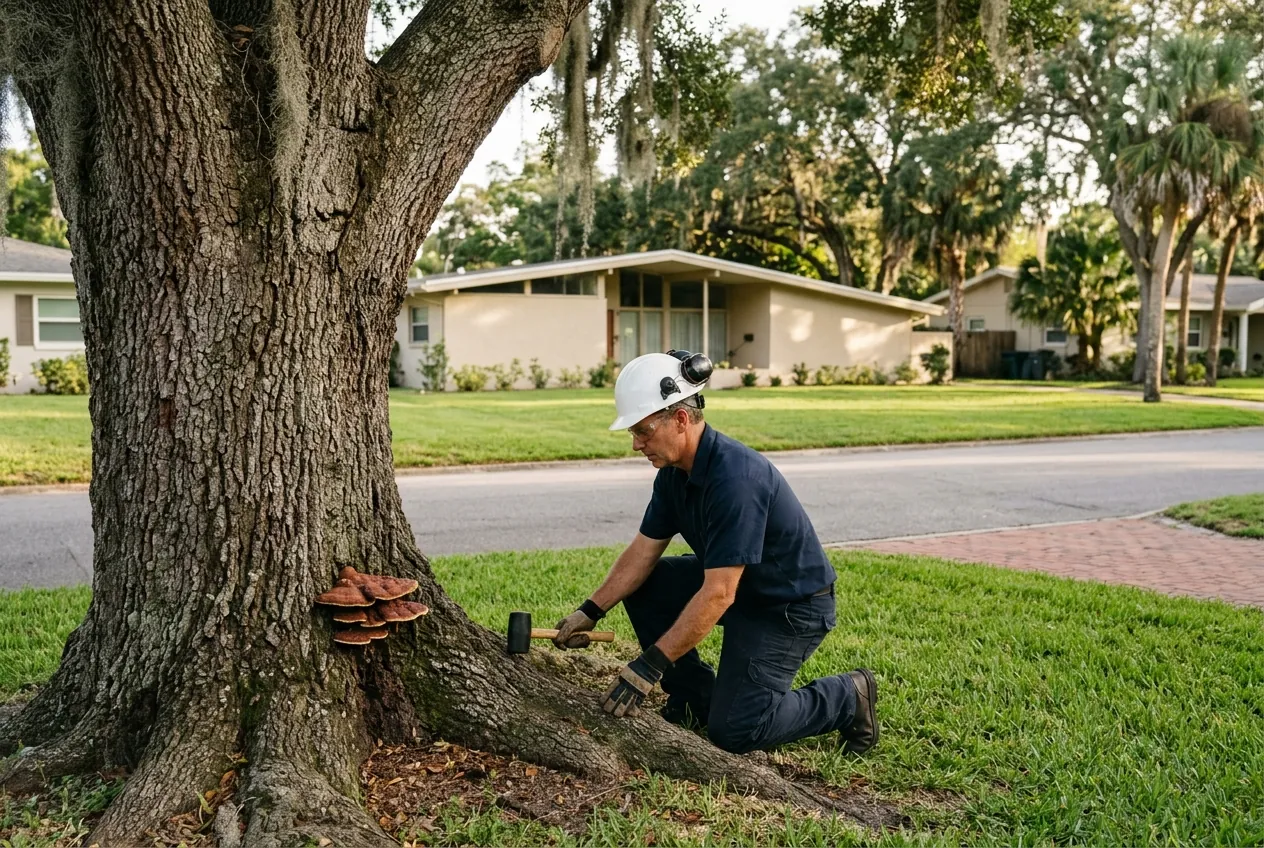
- Fungus, conks or soft, punky wood at the base or the root flare.
- A hollow trunk, a split where two main stems meet, or a dead top.
- A new or worsening lean with soil heaving on one side.
- A laurel or water oak that has outlived its expected span, which for a laurel oak in town is about 50 to 70 years by UF/IFAS's count.
If a tree lands in the second list and leans toward a house, it's a job for hazardous tree removal sooner rather than later.
Grand Trees and Allendale Tree Removal Permits
Allendale Terrace is inside the City of St. Petersburg, and this is where the city's Grand-tree rule matters most. A protected tree measuring 30 inches or more at 4½ feet up counts as a Grand tree, with one exception: laurel oaks never qualify. Taking one down requires a reason the code accepts: a licensed engineer documenting that it endangers an existing building, a certified arborist documenting decline it can't recover from, or a planned structure that can't be designed around it. Even trimming a Grand-tree branch 8 inches or more in diameter needs a permit, and that work must follow ANSI A300.
Smaller protected trees, shade trees from 4 inches and understory trees from 8 inches, still need a permit to remove. It begins with a $25 inspection fee, and the stakes for skipping it are real: the city's handout shows an unpermitted 30-inch Grand tree removal costing as much as $6,855. Owners of single-family detached homes have a second route: Florida Statute 163.045 drops the permit requirement when a risk assessment signed by an ISA-certified arborist or a licensed Florida landscape architect finds an unacceptable risk. That signature isn't ours to give, but finding a qualified professional who can provide it is something we can help with. Our permit guide lays out both routes.
Oak Tree Removal Over Allendale's Older Homes
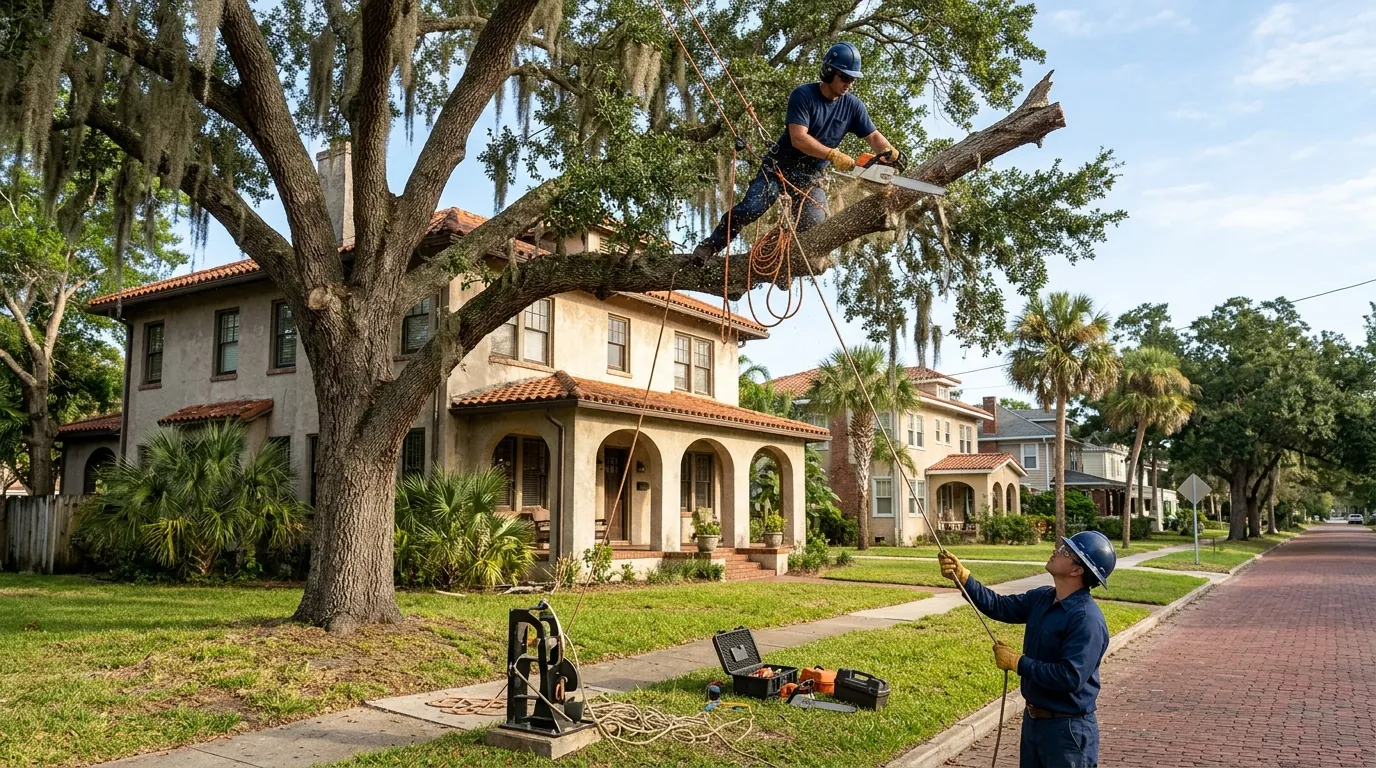
When a big tree does need to go, the older houses set the pace. Masonry walls and detailing from the 1920s through the 1950s can't be patched with off-the-shelf parts, so nothing is dropped near them. Limbs come down in roped sections, and where there's no safe lowering room we call for crane removal when the job needs one. Our oak tree removal page covers the process.
Allendale is inland and higher than the bayfront neighborhoods, so surge isn't the story here. Wind is. Milton's 101 mph gust at Albert Whitted Airport in October 2024 came with record rain, and big crowns on wet ground are exactly what fails in that combination.
After the tree is down
A big oak leaves a big stump and a root plate that can run well past the drip line. Grinding is priced separately unless the quote includes it, and our stump grinding crew works it down far enough to replant or lay sod. Then comes replanting. If taking a tree drops a one- or two-unit lot under the city's minimum, St. Pete wants a new shade tree planted, no shorter than 10 feet and no thinner than 2 inches, or $500 paid in its place. Citywide, the code aims for two or more shade trees on every home lot. In a neighborhood that fought for a single oak in 2019, planting the next generation of shade is usually the easy part of the conversation.
Allendale Terrace Tree Removal Cost
Large trees near older homes are the most involved work we do, and prices reflect the rigging. In typical 2026 St. Pete-area pricing, a 50-to-75-foot oak runs $1,600–$3,000, and a giant, or any tree above the roofline of an old house, $3,000–$5,500. Smaller trees run $250 to $700 under 25 feet and $700 to $1,600 from 25 to 50 feet. Crane help adds $700 to $2,500. The $25 city inspection fee passes straight through, and cleanup and haul-off are always included.
Those are ranges, not quotes. Book a free estimate and we'll give you an honest keep-or-remove opinion along with a written price. Nearby, we also work the alley lots of Euclid-St. Paul and the bayside grid of Old Northeast, plus the rest of tree removal in St. Pete.
Tree Removal Services
Areas We Serve
Allendale Terrace Tree Removal Questions
Straight answers before you call.
No. It has two individually designated local landmarks on Foster Hill Drive North, the Cade Allen Residence and the Foster Grove House, but the neighborhood as a whole isn't a local or National Register district. Normal city tree rules apply.
Only with a reason the code recognizes: an engineer's documentation that it threatens an existing building, say, or a certified arborist's finding that it's declining beyond recovery. Or, on a single-family detached home, through the FS 163.045 exemption with an arborist's or landscape architect's risk documentation.
No. In St. Pete a laurel oak can't be a Grand tree, whatever its size. It's protected once the trunk hits 4 inches, though, so you'll need a permit unless FS 163.045 covers the removal.
Yes. A healthy live oak is often better pruned than removed, and pruning within the city's one-quarter-of-the-canopy limit doesn't take a removal permit, though cutting a Grand-tree branch 8 inches or more across does need one. We'll say so during the estimate.
Large oaks near older homes typically fall between $1,600 and $5,500 in typical St. Pete-area 2026 ranges, depending on height and rigging, with crane help adding $700 to $2,500 when needed. Cleanup and haul-off are included.
Neighborhoods & Towns Near Allendale Terrace
Close by, same crew.
Tree Removal Services in Allendale Terrace
More ways we can help on the same trip.
- Tree RemovalWhole-tree takedowns, rigged and lowered over roofs, pools and lanais. From $250
- Dead Tree RemovalDead and dying trees taken down before they fall on their own. $250–$3,000
- Hazardous Tree RemovalLeaning, split or rotten trees over homes, cars and power drops. $700–$5,500
- Emergency Tree RemovalTrees on roofs, cars, fences and lanais after storms, with fast storm response. Storm calls
- Crane Tree RemovalBig trees on tight St. Pete lots with nowhere to lower wood. +$700–$2,500
- Oak Tree RemovalLaurel and water oaks past their prime, with the permit question answered first. $700+
- Palm Tree RemovalQueen, Washingtonia and sabal palms removed to the root ball. $200–$1,500
- Pine Tree RemovalDead, leaning and lightning-struck pines. $250+
Get a Written Price for Your Allendale Tree
Tree trouble in Allendale Terrace? We’ll come look.