Helene and Milton hit St. Pete about two weeks apart in the fall of 2024, and they damaged trees in opposite ways. One drowned roots in salt water. The other pulled trees out of saturated ground. Knowing which storm did what in your yard tells you a lot about what you are looking at now, and what still needs doing before the next season. This guide is written for St. Pete homeowners still sorting it out, and for anyone planning tree removal in St. Pete on a tree that has not been right since 2024.
Helene vs. Milton: Two Kinds of Hurricane Tree Damage in St. Pete
| Hurricane Helene | Hurricane Milton | |
|---|---|---|
| Dates | Sept. 26 to 27, 2024 | Oct. 9 to 10, 2024 |
| Main threat in St. Pete | Storm surge (salt water) | Wind and extreme rain |
| Key number | St. Pete tide gauge record: 6.31 ft over mean higher high water (Elena's 1985 mark was 3.97 ft) | 101 mph gust and 18.88 in of rain in one day at Albert Whitted Airport |
| Where it hit trees hardest | Low bayfront areas; Snell Isle, Shore Acres, Coquina Key and Venetian Isles were under bay water by midday | Citywide, on soil already soaked; hundreds of downed trees and power lines |
| How trees fail | Slowly, over weeks to months, as salt burns roots and leaves | Right away: uprooting, snapped trunks, torn limbs |
Milton's rain was extreme even by Florida standards. The FSU Climate Center counted 5.09 inches in a single hour in St. Pete, beyond a 1-in-1,000-year rate. Coastal water in Pinellas only rose about a foot above normal high tide during Milton, so the surge damage in this area is Helene's, and the uprooted trees are mostly Milton's.
The city's own count shows the scale. Figures presented to City Council put the share of St. Pete trees knocked down at about 6%, and canopy cover fell from 29% in 2024 to 27% in 2025, against a city goal of 30%. By January 3, 2025, more than 2 million cubic yards of storm debris had left the city's curbs in over 37,000 truckloads.
Salt-Flooded Trees: When to Wait and When to Remove
Salt water does its damage underground. UF/IFAS extension agents warned after Helene that most plants hit by saltwater flooding will not survive, and that even salt-tolerant natives struggle after being submerged. Salt spray on leaves is a smaller problem and can be rinsed off. Flooded soil is the bigger one, because chloride concentrates as the ground dries out. Rain that flushes the soil is the best fix, and the Pinellas Extension office has offered low-cost soil chloride tests.
The tricky part is timing. A salt-burned oak can drop every leaf and still be alive, and a palm can look dead for months. UF/IFAS Pinellas advice from past storms: a palm may need upward of six months to show a new frond and a year or two, sometimes more, to rebuild a full crown, so hold off on removing a tree that lost its leaves until new foliage appears or clearly does not. Do not fertilize flooded plantings while they recover.
Signs a salt-damaged tree has not made it
- No new leaves after a full spring and summer of growing weather.
- Bark loosening or sloughing off the lower trunk.
- Scratch tests under the bark show dry, brown tissue instead of moist green.
- On a palm, the newest spear leaf pulls out easily or the crown has collapsed.
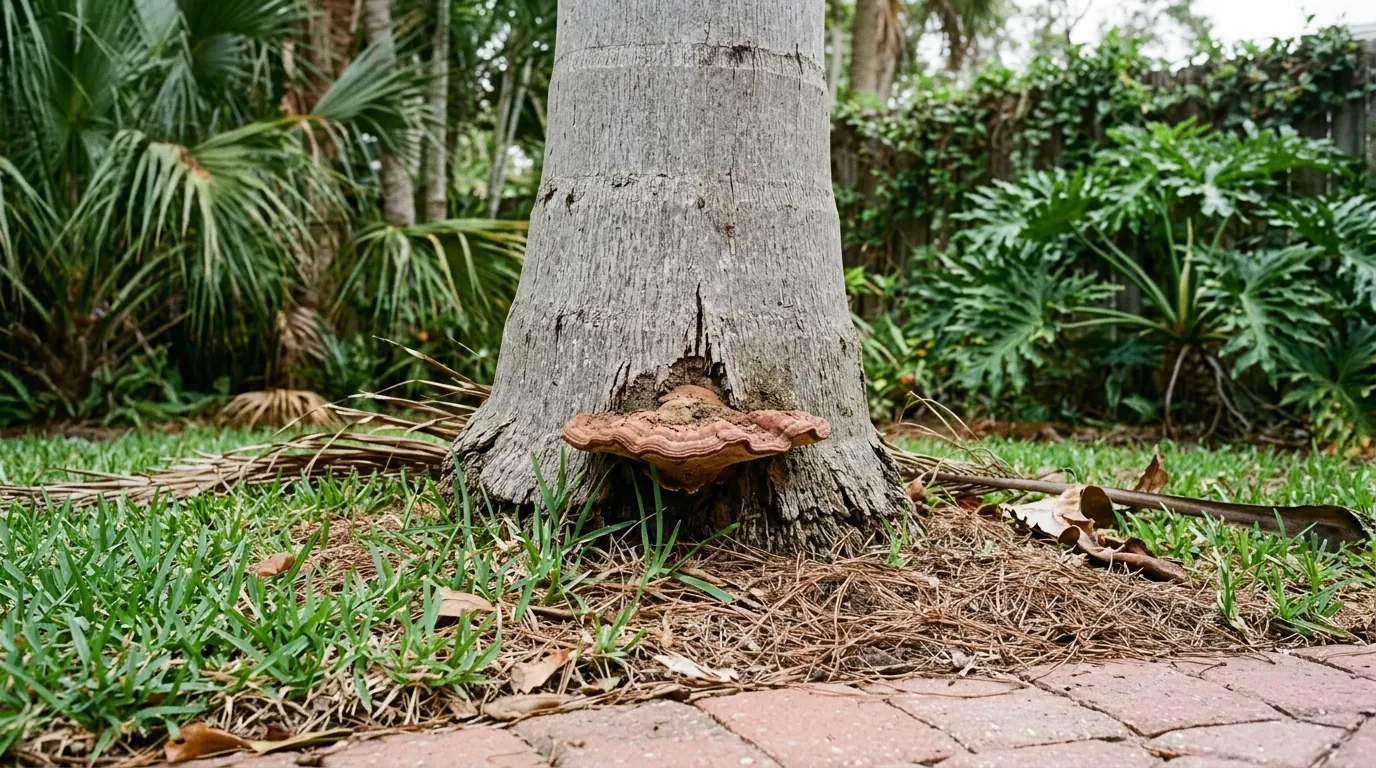
- Fungus appearing at the base of a tree that sat in surge water.
Live oaks and buttonwoods tend to recover well when only some limbs were lost. Sabal palms, rated the most salt-tolerant tree on the Pinellas Extension list, also have better odds than most. Waterfront areas like Riviera Bay and Jungle Prada saw the most of this kind of slow decline.
Wind-Damaged Trees That Need Removal Now in St. Pete
Wind damage does not wait. If a tree shows any of the signs in the first column, have it looked at this week, not next spring.
| What you see | What to do | Why |
|---|---|---|
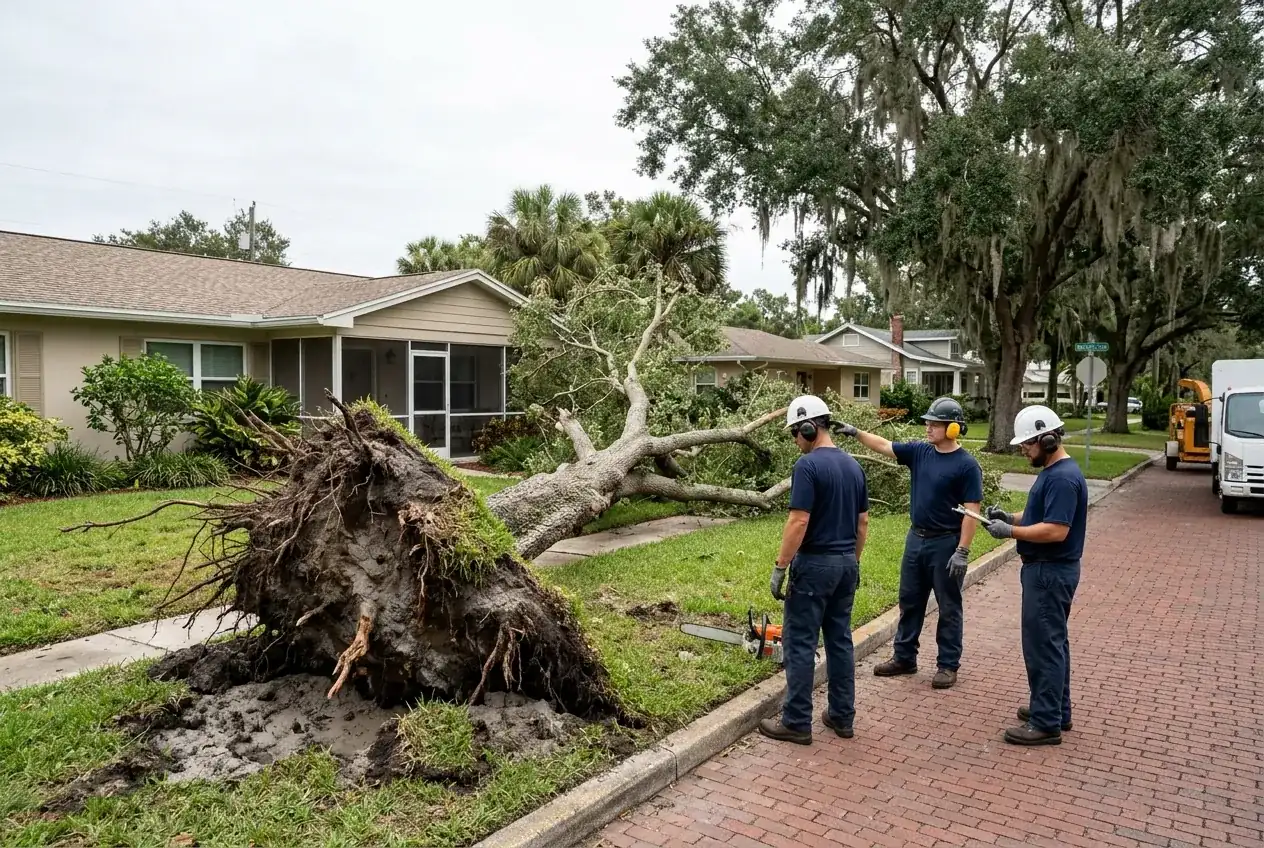
| Ground lifted or split around one side of the base | Remove now | The root plate has already partly failed and the next wind or soaking rain can finish it |
| A lean that appeared after the storm | Remove now if it can hit a house, car or road | A new lean usually means broken roots, not a tree adjusting |
| A split or crack running down the trunk | Remove or professionally assess now | Split wood does not knit back together |
| Broken limbs still hanging in the canopy | Remove the hangers now | Hangers fall without warning, often onto people cleaning up below |
| Tree resting on another tree | Have a crew take it down now | Two loaded trees are unpredictable to cut |
| Bare oak, trunk and roots solid | Wait for new growth | Defoliation alone often recovers |
| Brown palm with a firm, green spear | Wait and watch | The growing point may be alive |
A leaning or split tree near a structure is exactly the kind of job covered on our hazardous tree removal page. Trees that are already on the ground are a cleanup job, priced by crew time; see storm damage cleanup.
Power Lines and Storm-Damaged Trees in St. Petersburg
After Milton, much of the outage map traced back to trees lying on wires; Duke Energy still had about 141,000 St. Pete customers out the evening after landfall. Any tree touching a line is a Duke Energy call first. Report it as a downed line or outage and keep everyone away from it. Duke will also cut power to the service drop (the overhead wire running to your house) for free when a private crew needs to work close to it. Homeowners should never cut near a line, and we do not work on energized primary lines.
Permits for Storm-Damaged Trees in St. Pete
St. Pete's tree code lets the city waive its requirements after a hurricane to restore order, but a waiver is a decision made for a specific emergency, not a standing rule. Do not assume a storm waiver is still in effect. If a declining tree is a protected species and size inside city limits, plan on a permit or documentation, and we check what applies to your address before quoting.
For a single-family detached home, state law offers a second path: once an ISA arborist or a state-licensed landscape architect puts the tree's unacceptable risk in writing, no permit, fee or replanting can be demanded. Our tree permit guide explains both paths.
Documenting Hurricane Tree Damage for Insurance
- Photograph the tree, the damage it caused and the whole yard from several angles before anything is cut or moved.
- Photograph the root plate and any split or crack up close.
- Keep dated photos of a declining salt-damaged tree over the following months; a slow death is harder to tie to the storm without them.
- Get a written, itemized estimate that separates tree removal from structure damage and yard debris.
- Ask your insurer how they treat a tree that fell on the house versus debris in the yard; yard debris that hit nothing often falls under a separate, smaller limit.
For the specifics of a tree that came through the roof, see our guide on the first day after a tree comes through the roof.
Getting St. Pete Trees Ready Before Next Hurricane Season
Atlantic hurricane season runs June 1 to November 30. The most useful work happens in the quiet months between, when crews have open schedules and nothing is urgent.
- Winter: walk the yard and list any tree that never fully leafed back out after 2024. Those are the first to price.
- Early spring: watch for new growth on trees you were giving a chance. No growth by late spring is your answer.
- Before June: take down trees that are dead, hollow or leaning toward the house, and have weak limbs over roofs pruned within the city's one-quarter-of-canopy limit.
- Any time: consider replanting with species that stood up better, such as live oak or sabal palm, with room to grow away from the house.
The St. Petersburg tree canopy took a real loss in 2024. Taking out the trees that are truly done, and keeping the ones that are recovering, is how a yard and a city get that canopy back. If you want a second set of eyes on a tree you have been watching since the storms, book a free on-site estimate.