St. Petersburg · Pinellas County, FL
Dead Tree Removal in St. Petersburg, FL
A dead tree gets more brittle every month it stands. We confirm whether it is truly dead or only storm-burned, check the permit rules for your address, and take it down with the rigging that weak wood needs.
- Typical range
- $250–$5,500 per tree
- Dead palms
- $200–$900 for most
- First step
- Dead or dormant? Checked on site
- Included
- Cleanup and haul-off
Dead Tree Removal in St. Petersburg, FL Begins With a Real Diagnosis
Plenty of trees that looked finished in October 2024 were not. Helene pushed bay water over low parts of St. Pete, setting a record 6.31-foot reading at the city's tide gauge, and two weeks later Milton's winds stripped leaves across the county. A brown, leafless oak after that is not automatically a dead oak. Pinellas Extension guidance after earlier storms was to hold off on removing a defoliated tree until it had a chance to leaf out, and palms are notoriously slow, often going six-plus months with no new fronds.
The other side is just as real. UF/IFAS in Sarasota warned after Helene that most plants caught in saltwater flooding do not survive, and some trees that leafed out in 2025 have been sliding downhill since. On many St. Pete lots the honest answer comes from a close look at the tree, not a guess from the street.
Signs a tree is dead, not resting
- No new leaves or buds a full growing season after the damage, while the same species nearby has leafed out.
- Bark coming off in sheets, or bark that sounds hollow when tapped.
- A thumbnail scratch on a twig shows dry brown wood under the bark instead of green.
- Fungal conks or shelf mushrooms on the trunk or at the root flare.
- Twigs that snap clean instead of bending.
- On a palm, a spear leaf (the newest frond at the center) that collapses or pulls out.
Signs it may still come back
- Green, moist tissue under the bark on the scratch test.
- New sprouts along the trunk or the main limbs.
- A live oak or buttonwood that lost only some limbs. Extension notes both tend to recover well.
- A palm with a firm green spear, even when the older fronds have browned.
Why St. Pete Has So Many Dead Laurel and Water Oaks
The city's urban forestry staff have flagged it themselves. A large share of St. Pete's laurel oaks went in during the same ten-year stretch, so they are aging out together, and the city's community tree inventory warns of large laurel oak losses. UF/IFAS puts a laurel oak's life expectancy in town at 50 to 70 years and warns that decay frequently cuts that short. Water oak lifespans are briefer, roughly 30 to 50 years, with many hollow by age 40.
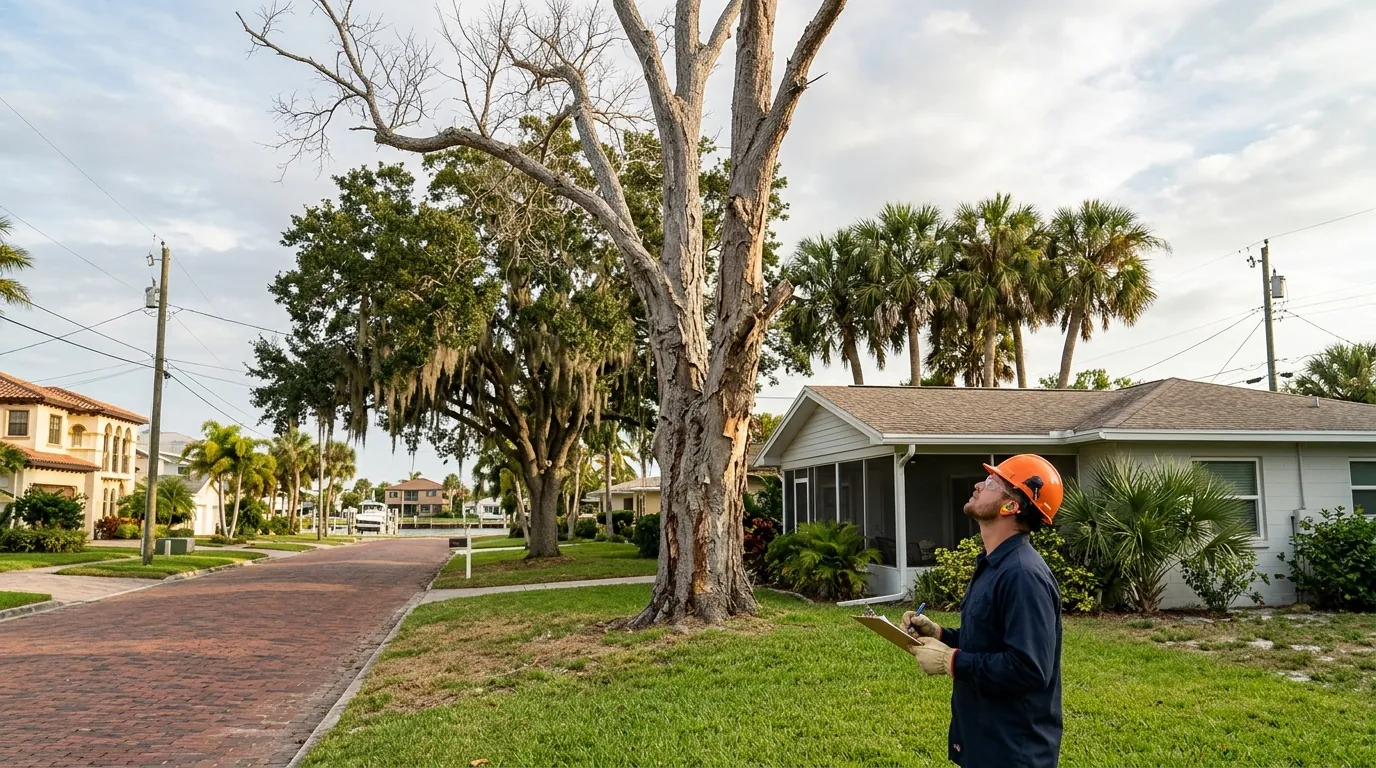
That pattern shows in postwar neighborhoods like Meadowlawn and Disston Heights, where many yard oaks date to the years the houses went up. A dead oak in that age range tends to shed big limbs before the trunk goes, often in the next strong wind. Our laurel oak guide covers why they fail, and the oak tree removal page covers live, laurel and water oaks in more detail.
Dead Palm Tree Removal: Ganoderma and Lethal Bronzing
Palms die differently than oaks, and two diseases explain a lot of the dead palms around Pinellas. Neither has a cure, so removal is the fix.
- Ganoderma butt rot is fatal and has no chemical or cultural control. Locally it is common in queen and Canary Island date palms. A shelf-like conk on the lower trunk is usually the first visible sign, and many palms die before one ever appears. The trunk comes out, then the stump, then whatever roots can be dug, and a new palm should not go back in the same spot.
- Lethal bronzing, confirmed in Pinellas County, targets cabbage palms. The oldest, lowest fronds discolor first, then the spear leaf collapses, and most palms die within two to three months of the first symptoms. A confirmed palm should come down promptly, and healthy palms nearby can get preventive injections.
A diseased sabal showing 4-plus feet of clear trunk still needs a city permit or an arborist's documentation under state law, even though it is dying. The palm tree removal page and our palm disease and cost guide go further.
St. Pete Dead Tree Removal and the Permit Question
Do not assume a dead tree is permit-free. Inside city limits the rules are written around size and species, and the code lists a tree that is diseased or declining as a reason the city approves a removal, not as a reason to skip the process. Grand trees need a certified arborist's report showing no reasonable chance of recovery. We confirm how Urban Forestry will treat your tree before we price it, and the $25 inspection fee shows on the estimate if it applies.
In unincorporated Pinellas, the county code that took effect January 23, 2026 waives mitigation for trees that are dead, dying, invasive or a nuisance, though whether a permit is needed still depends on size and on whether the lot is a homesteaded single-family home. For a single-family detached house anywhere, Florida Statute 163.045 is the other route: if a landscape architect licensed in Florida, or an arborist holding ISA certification, signs off that the dead tree is an unacceptable risk, no local permit, fee or replanting can be required.
Partly dead trees and limbs over the street
Not every dead tree has to go all at once. When only part of the crown has died, removing the dead limbs may be enough for now, and the city's limit of one-quarter of a tree's canopy per year does not apply to dead wood. What the city does require is that owners handle dead or diseased trees likely to drop into the street, alley or sidewalk, or onto a neighbor, and hold clearance of 8 feet above sidewalks and 14 feet above streets and alleys. A dead limb hanging over a public sidewalk is the owner's problem before it is anyone else's. If a whole leader is dead, or the decay reaches the trunk, trimming only buys time, and we will tell you which case you have.
Taking Down a Dead Tree Safely
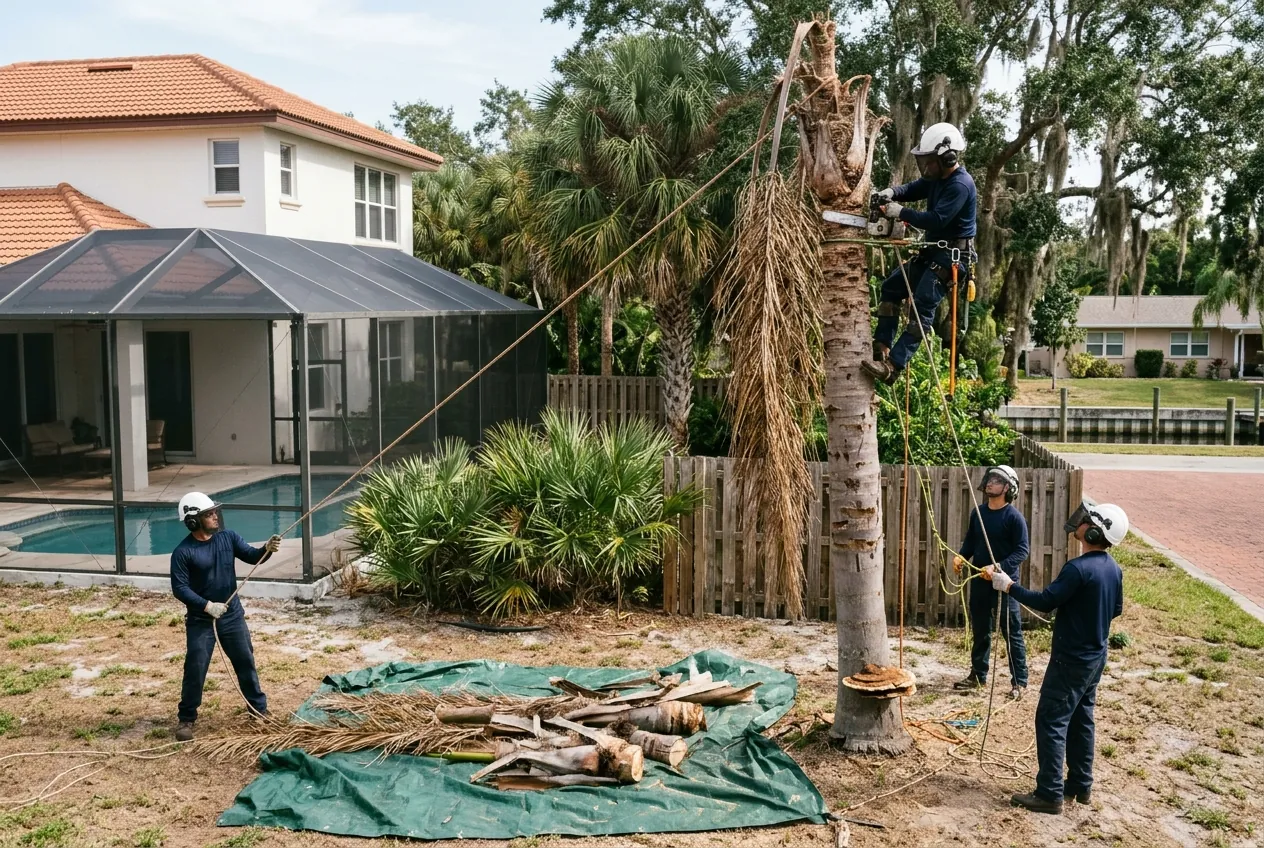
Dead wood behaves differently under a saw and a rope. It can snap where a live limb would flex, and a climber's tie-in point has to be sound. That changes the plan in a few ways.
- We sound the trunk and the main unions and look for cavities, conks and cracks before anyone leaves the ground.
- If the tree is too far gone to climb, the plan switches to a bucket truck or a crane, keeping climbers off rotten wood.
- Limbs come down in smaller pieces than on a live tree, because brittle wood can break without warning in the rigging.
- Drop zones get extra room, since dead tops and hangers can shatter when they land.
- Everything is hauled. With Ganoderma palms, conks are bagged before they are knocked loose so spores are not scattered across the yard.
Dead Tree Removal Cost in St. Pete, FL
Dead trees are priced by height like any removal, with rigging or a crane added when climbing is unsafe. Figures below are typical St. Pete-area ranges, 2026 pricing, not quotes, and cleanup and haul-off are included.
| Job | Typical range | What moves the price |
|---|---|---|
| Dead tree under 25 ft | $250–$700 | Room to fell it in one piece |
| Dead tree 25–50 ft | $700–$1,600 | Wood condition, climb versus bucket |
| 50–75 ft, dead | $1,600–$3,000 | Hanging limbs, decay at the base, drop room |
| Dead and over a roof, or taller than 75 ft | $3,000–$5,500 | Roof or lanai below, crane access |
| Dead palm, under 20 ft of trunk | $200–$450 | Disease handling, root ball removal |
| Dead palm, 20–40 ft | $400–$900 | Height, rotted crown, access |
| Crane added for rotten wood | +$700–$2,500 per job | Used when decay rules out climbing |
Waiting rarely saves money. A tree that a climber could handle this spring may need a bucket or crane next year as the wood weakens, and a dead tree that lands on a roof turns a planned job into an emergency with a premium attached. For the bigger picture, see our main page on St. Pete tree removal, or ask for a free look at the tree.
Tree Removal Services
Areas We Serve
Dead Tree Removal St. Pete Questions
Straight answers before you call.
Not automatically. Extension advice is to wait for new foliage before deciding on a tree that lost its leaves, and live oaks in particular tend to come back. If it stays bare through the next growing season, or it has split, cracked or lifted at the roots, it should come down.
Often, yes. Inside the city the rules go by size and species, and a diseased or declining tree is listed as a reason the city approves a removal rather than a reason to skip it. Single-family detached homes can also use an arborist's documentation under Florida Statute 163.045. We check your specific tree before we quote.
The clearest sign is a hard, shelf-like conk on the lower trunk. Many palms die before a conk forms, and the other way to confirm it is internal discoloration seen once the trunk is cut. There is no cure, so a palm with a conk should come out along with its stump and root ball.
UF/IFAS advises against putting a palm back in the same spot, because the fungus stays in the soil and attacks palms. Choose a tree or shrub that is not a palm for that location, and keep an eye on the other palms in the yard each month.
Florida legal references generally put responsibility on the owner of a dead tree that falls on a neighbor, though UF/IFAS notes there is no case law squarely on the live-versus-dead question. In the city, owners are also on the hook for dead trees leaning toward the street or sidewalk. This is general information, not legal advice.
Dead wood is brittle and unpredictable. A climber may not be able to tie into it safely, so the job can need a bucket truck or crane, smaller cuts and more room for each drop. Those steps add time, and time is most of the price.
More St. Pete Tree Removal Services
More ways we can help on the same trip.
- Tree RemovalWhole-tree takedowns, rigged and lowered over roofs, pools and lanais. From $250
- Hazardous Tree RemovalLeaning, split or rotten trees over homes, cars and power drops. $700–$5,500
- Emergency Tree RemovalTrees on roofs, cars, fences and lanais after storms, with fast storm response. Storm calls
- Crane Tree RemovalBig trees on tight St. Pete lots with nowhere to lower wood. +$700–$2,500
- Oak Tree RemovalLaurel and water oaks past their prime, with the permit question answered first. $700+
- Palm Tree RemovalQueen, Washingtonia and sabal palms removed to the root ball. $200–$1,500
- Pine Tree RemovalDead, leaning and lightning-struck pines. $250+
- Stump GrindingStumps ground out under the soil line, ready for sod or a new bed. $125–$400
Find Out If Your Tree Is Really Dead
We will give you a straight answer before it drops a limb.