St. Petersburg · Pinellas County, FL
Storm Damage Cleanup in St. Petersburg, FL
After a storm, the yard is full of limbs, half-down trees and questions. We cut and haul what fell, flag what is still hanging, and help you tell a tree that needs to come down now from one that just needs time.
- Typical cleanup
- $350–$1,500 per yard
- Storm crew rate
- $150–$250 per crew-hour
- Power lines
- Duke Energy first, always
- Hours
- Mon–Sat 7am–6pm; storm calls taken
Storm Damage Cleanup in St. Petersburg, FL: Salt Storms and Wind Storms
The 2024 season showed St. Pete that two hurricanes two weeks apart can damage trees in completely different ways. Knowing which kind of damage your yard took decides what to cut now and what to leave alone.
Helene: the water storm
Helene passed offshore on September 26 and 27, 2024, but drove the St. Petersburg tide gauge to a record 6.31 feet above the normal high-tide line (MHHW), topping the 3.97 feet Hurricane Elena reached in 1985. Snell Isle, Shore Acres, Coquina Key, Venetian Isles and Weedon Island were under water by midday. Wind was not the main problem. Salt was. According to UF/IFAS, salt-water flooding kills most of the plants it reaches, and even salt-tolerant species struggle when submerged. Those trees often look fine for weeks and decline over months.
Milton: the wind and rain storm
Milton made landfall as a Category 3 on October 9, 2024, and Albert Whitted Airport logged both a 101 mph gust and a record 18.88 inches of rain in a single day. Water in Pinellas reached only about a foot above mean higher high water, so this was not a surge storm here. It was wind on soil that was already soaked, which is how trees get pulled out by the roots. Fox 13 reported hundreds of downed trees and power lines across St. Pete, and in Jungle Terrace a large oak fell across the street.
A later report to City Council put the toll at about 6 percent of the city's trees knocked down, with canopy cover falling from 29 percent in 2024 to about 27 percent in 2025.
St. Pete Storm Cleanup, Step by Step
First: lines and safety
- Tree or limb on a wire: report it to Duke Energy and stay clear. Never cut near a line, and never assume a line is dead.
- Line to your house: once the storm passes, ask Duke to switch off the wire feeding your house before anyone cuts near it; there is no charge for that.
- Tree on the roof: get everyone out of the rooms beneath it. That job belongs under emergency tree removal, often with a crane.
Next: document before anything moves
Photograph the whole scene from several angles: where the tree stood, where it landed, and any damage to roof, fence, car or screen cage. Insurers want to see it as it fell. We can photograph the stump and break point before cutting if you ask.
Then: cut, stack and haul
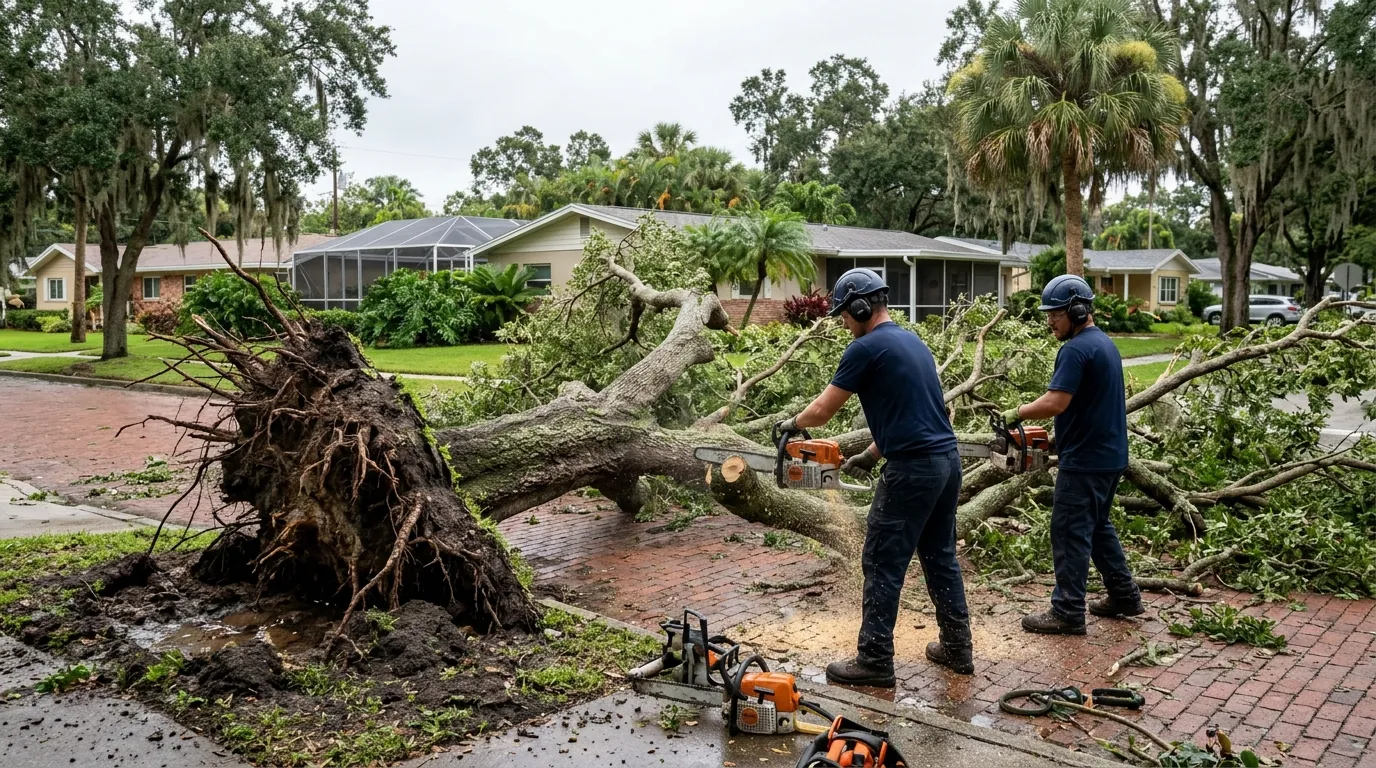
Downed trunks and limbs on the ground get cut into manageable pieces, loaded and hauled off. Limbs still hanging in the crown, called hangers, are the hidden danger after a storm, and we bring them down before anyone works beneath them. Standing trees that split or now lean with lifted roots move to hazardous tree removal.
Later: give salt-burned trees a season
A tree that browned after Helene's water but did not break is often worth waiting on. UF/IFAS Pinellas advice is to let a stripped tree leaf out again before judging it, and live oaks and buttonwoods with only some broken limbs usually recover. Palms are slower still, sometimes going half a year before a new frond shows. If the tree is still leafless when the next spring arrives, that is when dead tree removal makes sense. The Pinellas Extension office can test soil for chlorides for $10 if you want a reading first.
Storm Debris Cleanup and the City's Curb Rules
After Helene and Milton, the City of St. Petersburg ran a special storm pickup. By January 3, 2025, the city had hauled off over 2 million cubic yards of storm debris in 37,000-plus loads, and a final citywide pass was under way. Residents were told to set vegetative debris at the curb in the right-of-way, keep it separate from fencing, appliances and construction debris, leave it unbagged, and keep piles away from trees, poles, hydrants and utility boxes. The city also opened its five brush sites seven days a week.
Treat that as a disaster response, not an ongoing city service; it will not necessarily return for the next storm, and it never covered one tree dropped on a calm day. Madeira Beach alone hauled 66,725 cubic yards by late October 2024. When we clean up, the debris leaves with us, so you are not waiting on a city truck or tripping over a curbside pile for weeks.
Storm Damage Cleanup and Insurance Basics
This is general information, not legal or insurance advice. Policy wording controls, so call your insurer early.

- Tree on the house: clearing a tree off the home itself usually falls under the policy's dwelling section.
- Tree in the yard only: many policies limit tree debris removal to roughly $500 to $1,000, counted either per tree or per claim.
- Neighbor's tree: in Florida you generally start with your own policy, even when the tree was not yours. Our neighbor-tree liability guide covers the exceptions.
A written, itemized estimate that separates removal off the house from yard cleanup and stump grinding makes the claim easier to file. Every estimate we write is split that way.
Storm Damage Cleanup Cost in St. Pete, FL
Cleanup is priced by volume and crew time, and fallen trees are priced by size. Rates after a declared storm run higher because every crew in the region is booked. The ranges here are typical for the St. Pete area in 2026 and are not quotes.
| Job | Typical range | What moves the price |
|---|---|---|
| Storm cleanup, limbs and trees on the ground, hauled | $350–$1,500 per yard | Volume of wood, carry distance to the truck |
| Storm cleanup by crew time | $150–$250 per crew-hour | Tangled piles, hangers still in the crown |
| Downed or split tree, 25–50 ft | $700–$1,600 | Whether it lies flat or is wedged on something |
| Tree resting on the house or garage | $3,000–$5,500 | Roof load, rigging or crane needed |
| Crane-assisted removal | +$700–$2,500 | Weight resting on the house, setup space |
| Emergency or after-hours response | +25%–50% | Time of call, conditions on site |
| Stump grinding, first stump | $125–$400 | Uprooted root plates cost more to grind |
Haul-off is part of every cleanup price. Stump grinding is quoted separately unless stated. Our post on a tree landing on your St. Pete house walks through the first 24 hours in more detail.
St. Petersburg Storm Damage Cleanup by Neighborhood
Damage follows geography. Bayfront and canal lots, like the Park Street side of Jungle Prada where Helene put about 7 feet of water over the historic site and cost about two dozen trees, tend to see slow salt decline. Canal streets in Riviera Bay have flooded repeatedly, including a 2 to 3 foot surge in December 2023 and again in August 2024. Inland, in places like Lealman, surge is less of a worry than wind, and the usual problem is a heavy limb over an older roof or a mobile home.
Storm Damage Cleanup and the Next Hurricane Season
The Atlantic season officially spans June 1 to November 30. The cheapest storm cleanup is the one you avoid, which means dealing with dead limbs, split forks and laurel oaks with hollow trunks before a named storm is on the map. After declared emergencies, the city's code lets it relax tree rules to restore order, but that is not guaranteed, so we check what is in effect before cutting. For everything else, start with tree removal or our storm-tree guide for Helene and Milton, and for city-wide context see St. Pete tree removal.
Tree Removal Services
Areas We Serve
Storm Damage Cleanup St. Pete Questions
Straight answers before you call.
Not right away if it is still standing straight and sound. Extension guidance is to hold off until the tree has had a chance to leaf out again, and palms recover more slowly than hardwoods. Take down the ones that split, lean on a raised root plate, or stay leafless into the following spring.
Call Duke Energy first and stay clear. Homeowners should never cut near lines, and live primary lines are strictly Duke's work, never ours. Once Duke has made it safe, or has de-energized the service drop to your house, we can remove the tree and haul everything off.
Following Helene and Milton, St. Pete ran a special storm pickup that removed over 2 million cubic yards, with rules about curb placement and sorting. That pickup was a one-time response to a declared disaster rather than a routine service, so do not count on it for every storm. When we do the cleanup, the debris leaves with us.
It depends on your policy. Taking a tree off the home is usually covered as part of the dwelling claim, while coverage for clearing yard debris often tops out somewhere between $500 and $1,000. Call your insurer early, and keep photos taken before anything was moved. This is not legal or insurance advice.
It depends on the city, the tree and whether an emergency order is in effect. St. Pete's code lets the city relax tree rules after a declared emergency, but that is not automatic. For a detached single-family house, the state risk exemption under section 163.045 is another option if a qualified professional documents the danger. We check before cutting.
We take storm and emergency calls and triage by danger: trees on houses and blocked driveways first, then limbs on the ground. Regular hours are Monday through Saturday, 7am to 6pm. After a major storm, demand is high across Pinellas, so call early to get on the list.
More St. Pete Tree Removal Services
More ways we can help on the same trip.
- Tree RemovalWhole-tree takedowns, rigged and lowered over roofs, pools and lanais. From $250
- Dead Tree RemovalDead and dying trees taken down before they fall on their own. $250–$3,000
- Hazardous Tree RemovalLeaning, split or rotten trees over homes, cars and power drops. $700–$5,500
- Emergency Tree RemovalTrees on roofs, cars, fences and lanais after storms, with fast storm response. Storm calls
- Crane Tree RemovalBig trees on tight St. Pete lots with nowhere to lower wood. +$700–$2,500
- Oak Tree RemovalLaurel and water oaks past their prime, with the permit question answered first. $700+
- Palm Tree RemovalQueen, Washingtonia and sabal palms removed to the root ball. $200–$1,500
- Pine Tree RemovalDead, leaning and lightning-struck pines. $250+
Get Your Yard Cleared
Limbs down and trees leaning? Let’s sort it out.