St. Petersburg · Pinellas County, FL
Oak Tree Removal in St. Petersburg, FL
Laurel, live and water oaks each fail differently and fall under different city rules. We identify the oak, measure it, check the permit question for your address and put one fixed number in writing, hauling and raking included.
- Typical range
- $250–$5,500 by height
- Grand tree
- 30 in+ DBH, laurel oaks excluded
- City inspection
- $25 fee inside St. Pete limits
- Estimate
- Free, with a fixed written price
Oak Tree Removal in St. Petersburg, FL: Which Oak Is It?
Three oaks make up most of the oak work in St. Pete yards, and they are not interchangeable. A laurel oak, a live oak and a water oak can stand on the same lot and still fail in different ways, carry different permit rules and come down at different prices. Before anyone talks about saws, we figure out which one you have, how thick it is 4½ feet off the ground, and which government your address answers to. That three-part check sits behind every quote we write for tree removal in St. Pete.
Laurel oak
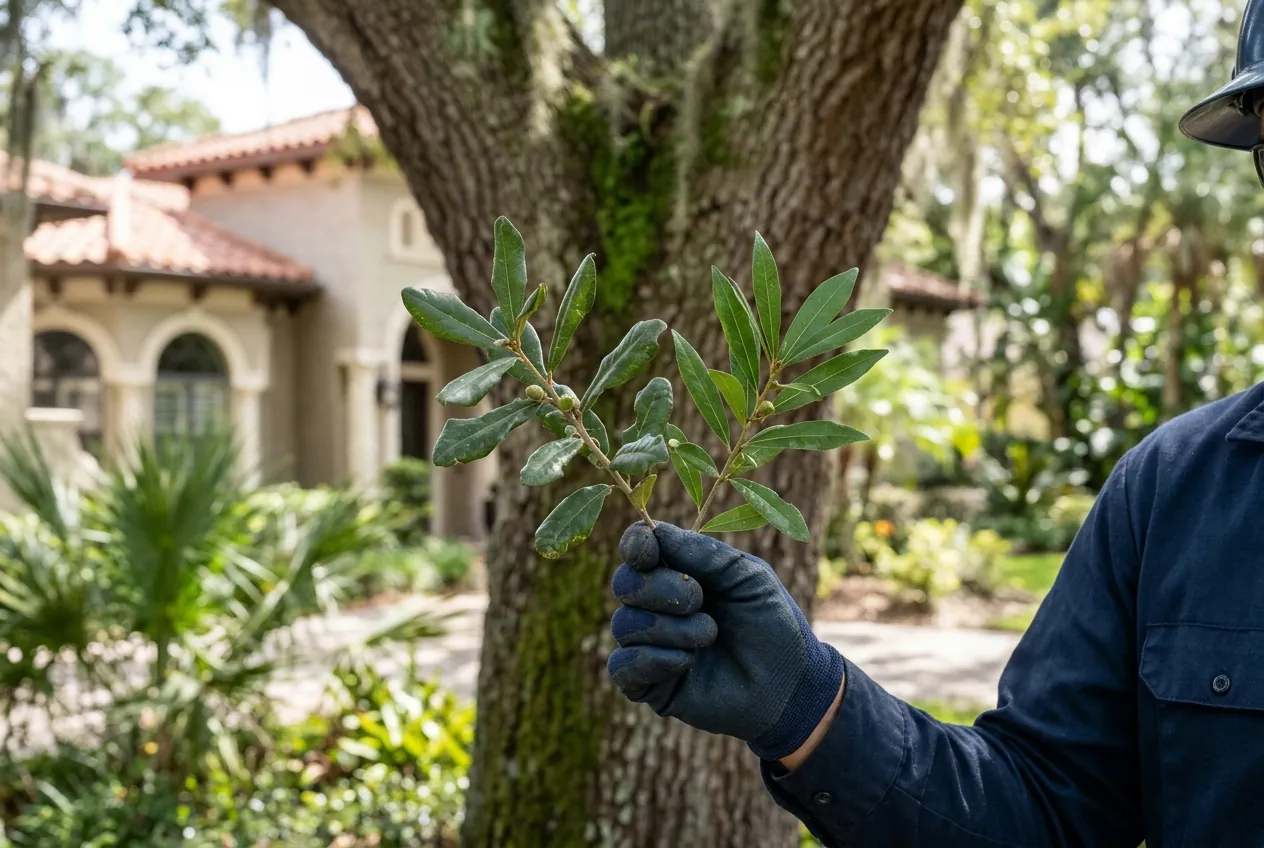
UF/IFAS describes laurel oak as fast-growing, reaching 60 feet or more with a 35 to 45 foot spread, and prone to breakage unless it was structurally pruned while young. The leaves are narrow, smooth and shiny on both sides with flat edges, and the tree holds some of them through winter. In cities its expected life runs roughly 50 to 70 years, because decay tends to move in and cut it short. St. Pete's Urban Forestry office has flagged big laurel oak losses ahead, since so many were planted in the same ten-year stretch and are now aging out together.
Live oak
On a live oak, the leaf feels stiff, almost like leather, and its margins roll downward; the underside is not silvery. The wood is strong, the tree handles salt better than most shade trees, and UF storm studies found little failure in hurricanes. That toughness makes live oak the species most likely to reach Grand status and the one most often worth keeping. When a live oak does have to go, the reason is usually root damage, a building conflict or a structural defect rather than age.
Water oak
Water oak leaves vary a lot, but most are spoon-shaped: wide at the tip and narrow at the base. UF/IFAS gives it a fairly short life of 30 to 50 years and notes that it is poor at sealing off decay, so many are hollow by age 40. Big water oak limbs tend to split in storms, which makes one leaning toward a roof worth a careful look before hurricane season.
One leaf rarely settles the question, because leaves on the same oak can differ. We read several leaves, the bark, the crown shape and the root flare together before naming the tree on your estimate.

St. Pete Oak Removal Permits: Grand Trees and the Laurel Oak Exclusion
Inside City of St. Petersburg limits, Land Development Regulation 16.40.060 protects any shade tree 4 inches or larger in diameter at 4½ feet, and oaks sit on the shade-tree list. Taking down a protected oak needs a city permit. A protected tree 30 inches or larger becomes a Grand tree, with one exception that matters a great deal here: laurel oaks can never be Grand trees, however large they grow.
- Laurel oak over 4 inches, any size: still protected, so removal needs a permit, but it is reviewed under the ordinary criteria such as an imminent hazard, decline or a conflict with a building.
- Live or water oak from 4 to just under 30 inches: protected and reviewed under those same ordinary criteria.
- Live or water oak at 30 inches and up: Grand. The code permits removal in just three cases, each needing a professional's signature: an engineer's report of danger to an existing structure, an arborist's finding of decline past recovery, or certification that planned construction cannot avoid the tree.
- Trimming a Grand oak: cutting any branch 8 inches or thicker at the collar needs its own permit, and the work has to follow ANSI A300.
The city process begins with a $25 initial inspection fee, handled through the Building Permit Portal or by emailing [email protected]. The city targets an inspection within roughly two weeks, and the city's inspector is an ISA Certified Arborist. After approval comes a permit fee set by City Council; the permit has to be displayed where passersby on the street can see it, and it remains good for six months. Skipping all of that costs far more. The city's handout shows a 30 inch Grand tree cut without a permit on a residential lot reaching as much as $6,855 when the city stacks an after-the-fact permit, a replanting payment and a fine.
Step outside city limits and the numbers move. Unincorporated Pinellas adopted a new tree code on January 23, 2026 that protects only trees over 24 inches on homesteaded, owner-occupied single-family lots. Seminole, as a city, guards live and laurel oaks starting at 4 inches and expects a certified arborist's report with the application. That is why every estimate for tree removal in Seminole starts by confirming whether the house is inside or outside Seminole's city limits.
Oak Tree Removal Under Florida's Risk Exemption
Under Florida Statute 163.045, someone who owns a detached single-family house can remove or trim a tree with no local permit, fee or replanting requirement, provided the owner has a signed risk assessment prepared on site by an ISA-certified arborist, or by a Florida-licensed landscape architect. That paperwork must conclude the oak's risk is unacceptable and that taking it down is the only realistic fix. The city says duplexes, townhomes, multi-family buildings and commercial lots do not qualify, and it asks owners using the exemption to email the documentation to [email protected].
We are the removal crew, not the people who sign that assessment. If your oak looks like a candidate, we can help you line up a qualified assessor and then schedule the takedown once the paperwork is in hand. The whole permit picture, including Signature trees and palms, is laid out in our St. Petersburg tree permit guide.
Oak Removal or Pruning? A St. Petersburg Oak Tree Call
A troubled oak does not always have to come out. City rules cap pruning at one-quarter of a tree's crown in a single year, dead wood excepted, and they forbid shaping crowns into circles, ovals or squares, so pruning can only do so much for a tree with real defects. Here is how we usually sort the options.
- Leaning toward removal: a laurel or water oak with a hollow trunk, fungus at the base, a crack running through a main fork, or roots lifted on one side after a storm.
- Leaning toward pruning: a healthy live oak missing a single limb, dead wood in the top, or branches over the roof that can be reduced inside the quarter-canopy limit.
- Waiting a season: an oak that browned after salt water or wind but still has live buds. UF/IFAS advises letting a stripped tree push new leaves before deciding its fate.
Oaks that are already gone get their own approach on the dead tree removal page, and cracked or house-leaning oaks belong under hazardous tree removal. For the bigger story of why so many laurels are failing at once, read laurel oaks in St. Pete.
Oak Tree Removal Cost in St. Pete, FL
Oaks get priced by height and by what sits beneath the crown. A 40 foot laurel oak over open lawn is a fairly simple day. The same tree hanging over a 1920s bungalow, with an alley of overhead wires behind it, becomes a rigging job. Treat the figures below as typical St. Pete-area ranges for 2026; your written quote replaces them.
| Job | Typical range | What moves the price |
|---|---|---|
| Oak under 25 ft | $250–$700 | Trunk diameter, whether wood can drop on open lawn |
| Oak 25–50 ft | $700–$1,600 | Rigging over fences, sheds and screen cages |
| Oak 50–75 ft | $1,600–$3,000 | Crown spread, how far wood is carried to the truck |
| Oak taller than 75 ft, or one hanging over the house | $3,000–$5,500 | Roof clearance, lowering every piece on ropes |
| Crane-assisted oak removal | +$700–$2,500 | Setup room, reach from the street |
| Stump grinding, first stump | $125–$400 | Width of the root flare, surface roots |
| City of St. Pete permit inspection | $25 | Paid to the city; the later permit fee is the city's to set |
Hauling off every log and raking the yard is part of the price. Grinding the stump is its own line unless the quote says otherwise, and permits are itemized. An oak too large or too boxed-in to climb safely may call for crane tree removal when the job needs one.
Large Oak Tree Removal Over a St. Pete Roof
- Confirm the tree and the paperwork. Species, diameter at 4½ feet, jurisdiction, and any permit or exemption letter.
- Bring in Duke Energy if wires run through the crown. Duke will cut power to the drop running to your house for free ahead of the work. Primary lines are Duke's responsibility, never ours.
- Protect what is underfoot. Old brick roadways, stone curbs and hexblock walks in places like Old Northeast get padded or worked around while wood is lowered and dragged out.
- Take the crown apart. A climber cuts while the ground crew lowers each limb on a line, keeping every piece off the shingles and lanai screens.
- Bring down the trunk. With open space it is felled in pieces; over a house it comes down in short rounds or gets lifted out.
- Grind, rake and haul. The stump is ground if you booked it, then every chip and log leaves on our truck.
Old citrus-grove lots with masonry homes, like those in Allendale Terrace, often need that full sequence. Postwar ranch lots in Disston Heights tend to have more working room, which usually shows up as a lower number.
Tree Removal Services
Areas We Serve
Oak Tree Removal St. Pete Questions
Straight answers before you call.
Inside City of St. Petersburg limits, usually yes if the trunk is 4 inches or more at 4½ feet, because laurel oak counts as a protected shade tree. What it cannot be is a Grand tree, so a big laurel oak is reviewed under the ordinary criteria instead of the strict Grand-tree rules. Outside city limits the rules differ, so we check the address before quoting.
Run a finger along the edge. A live oak leaf is stiff and its rim turns under; a laurel oak leaf is thinner, lies flat and shines on top and bottom. The tree's form helps too: live oaks tend to spread wide and low, laurels grow taller and more upright. Since leaves vary on one tree, we look at several along with the bark and crown.
Only for the narrow reasons the code spells out: an engineer certifies it endangers a building that is already there, an arborist reports it is failing beyond recovery, or a design professional certifies that planned construction cannot avoid it. On a detached single-family house, the state's risk exemption in Florida Statute 163.045 is another route once a qualified professional puts the unacceptable risk in writing.
It can get costly. The city's handout prices an unpermitted 30 inch Grand tree on a home lot at up to $6,855, combining a $1,000 after-the-fact permit, a $5,355 replanting payment and a $500 fine. Unpermitted removals can be reported to the city's codes office, so it pays to sort the permit first.
Often, if the tree is sound. Because the city allows at most a quarter of the crown to come off in a year, apart from dead wood, trimming cannot fix every problem. A hollow water oak or a split laurel oak is usually a removal. A healthy live oak with one bad limb is usually a pruning job.
We can, if you add it to the quote. Stump grinding is a separate line so you can see what it costs, and oak flares can be wide, which affects the price. If you plan to replant, grinding first leaves room for a new shade tree, which matters on lots that fall below the city's minimum tree count.
More St. Pete Tree Removal Services
More ways we can help on the same trip.
- Tree RemovalWhole-tree takedowns, rigged and lowered over roofs, pools and lanais. From $250
- Dead Tree RemovalDead and dying trees taken down before they fall on their own. $250–$3,000
- Hazardous Tree RemovalLeaning, split or rotten trees over homes, cars and power drops. $700–$5,500
- Emergency Tree RemovalTrees on roofs, cars, fences and lanais after storms, with fast storm response. Storm calls
- Crane Tree RemovalBig trees on tight St. Pete lots with nowhere to lower wood. +$700–$2,500
- Palm Tree RemovalQueen, Washingtonia and sabal palms removed to the root ball. $200–$1,500
- Pine Tree RemovalDead, leaning and lightning-struck pines. $250+
- Stump GrindingStumps ground out under the soil line, ready for sod or a new bed. $125–$400
Get a Written Price on Your Oak
Laurel, live or water oak? We’ll check.